Peptide Proteolysis: Predicted Sites vs Mapped Cleavage
Read peptide proteolysis evidence by separating predicted cleavage sites, assigned fragments, bond locations and quantitative product measurements.


A predicted protease cleavage site is a candidate bond; an experimentally mapped site is an assignment supported by observed products and their sequence context. A convincing peptide-proteolysis interpretation distinguishes the enzyme’s preference, the products detected, the bond assigned and the fraction cleaved. A sequence motif alone establishes none of the latter three.
- Protease subsite notation places P1 immediately before the scissile bond and P1′ immediately after it.
- A rule-based cleavage map can suggest candidate products without predicting their experimental yield or reaction rate.
- A detected fragment must be assigned to a sequence before it can support a specific cleavage location.
- Parent disappearance and the abundance of one selected product are different measurements.
A motif, a fragment and a cleavage rate are different evidence
A paper may show a predicted cut beside a peptide sequence, a chromatogram with new peaks or a decreasing parent signal over time. Each is useful, but they answer different questions. A predicted cut describes a model. A new peak establishes a detected feature. A rate claim needs a defined quantity followed over time under an appropriate model.
Keeping these observations separate prevents a familiar shortcut: a sequence contains a preferred motif, so any signal loss is called cleavage at that motif. Loss can have other explanations, and even genuine proteolysis can produce several fragments or sequential cuts. The task is to connect the proposed bond to the actual observations.
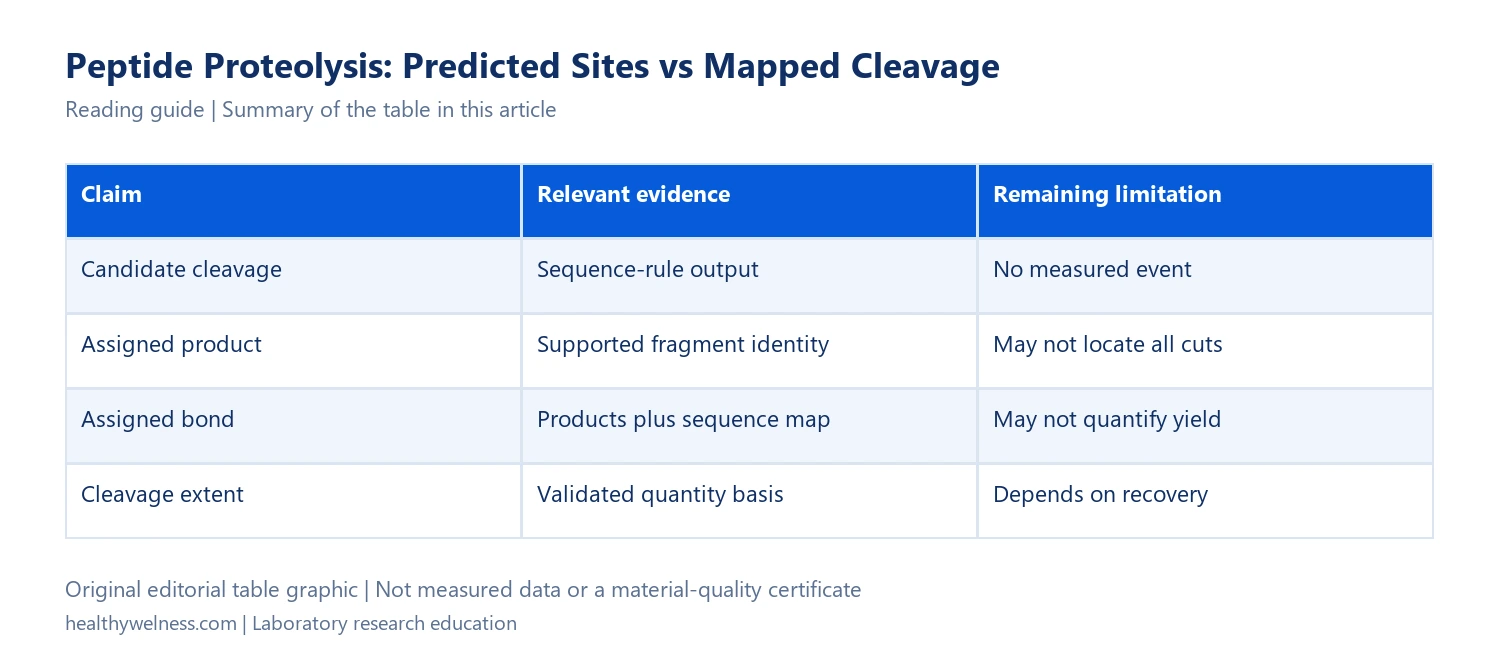
| Claim | Relevant evidence | Remaining limitation |
|---|---|---|
| Candidate cleavage | Sequence-rule output | No measured event |
| Assigned product | Supported fragment identity | May not locate all cuts |
| Assigned bond | Products plus sequence map | May not quantify yield |
| Cleavage extent | Validated quantity basis | Depends on recovery |
The table is an interpretation framework rather than a universal testing checklist. An exploratory study can reasonably stop at candidates, provided its conclusions stop there too. Calling those candidates experimentally demonstrated sites adds evidence that the prediction never supplied.
Read the bond using P and P-prime notation
ExPASy’s PeptideCutter documentation describes substrate positions around a cleaved bond using P1, P2 and further positions on the N-terminal side, with P1′, P2′ and further positions on the C-terminal side. The notation identifies a local sequence relationship, not a residue number in a database entry. PeptideCutter specificity documentation
Hypothetical sequence: take A–G–K–S–L–R–A–T, numbered 1 through 8 in that order. For a proposed cut K3|S4, K3 is P1 and S4 is P1′. G2 is P2 and L5 is P2′. The separator marks a bond between residues; it is not an extra amino acid and does not mean that residue 3 itself disappears.
For a different cut R6|A7 in the same sequence, the P1 designation moves to R6. P1 is therefore a role relative to the bond being discussed, whereas residue 6 remains a coordinate in the specified chain. Confusing the two notations can shift an assignment even when the sequence was copied correctly.
A simple rule is useful only when its assumptions remain visible
PeptideCutter explicitly states that most of its rules are relatively simple. Its documentation also says that the reported digestion products assume the selected enzymes act together and that the implementation does not account for sequence modifications. These boundaries matter for modified research peptides and for interpreting a multi-enzyme output. PeptideCutter instructions
For teaching only, stipulate a simplified rule that cuts after K or R at eligible internal bonds. Applied to the invented sequence above, full cleavage at K3|S4 and R6|A7 produces AGK, SLR and AT. This is hand-worked arithmetic under the stated rule; it is not the result of running PeptideCutter or proof of an actual trypsin digest.
The same model can generate products when one eligible bond remains intact: AGKSLR plus AT, or AGK plus SLRAT. Those are model possibilities, not an estimate of their relative abundance. Report the rule and allowed missed-cleavage convention rather than presenting a long list of calculated fragments as observed products.
Predicted preference does not provide a clock
ExPASy’s discussion of its more detailed trypsin and chymotrypsin rules makes an important distinction: the underlying cleavage-event analysis does not represent reaction rates or percentage yields, and it does not include tertiary-structure effects. A probability attached to a modeled site therefore should not be read as the fraction cleaved after a particular time. Special cleavage-rule limitations
Suppose two candidate bonds receive different model scores. That ranking can help choose questions for experiments, but it does not establish that the higher-ranked bond cleaves first in the tested preparation. A model built from one kind of sequence information may leave accessibility, chemical modifications and the experimental environment outside its representation.
For this reason, retain the actual sequence and relevant chemical annotations with the prediction. A bare letter string can omit chemistry essential to interpreting an enzyme interaction. Our D-versus-L guide explains why a residue symbol is not always a complete stereochemical specification.
Experimental site mapping needs sequence-resolved product evidence
Schilling and Overall’s 2008 primary PICS study used proteome-derived peptide libraries to examine protease cleavage preferences on both sides of the scissile bond. Its approach identified prime-side products by tandem MS and recovered corresponding nonprime sequence information through database searches. The study illustrates how product observations can be tied to a sequence context, rather than treating a motif prediction as the experiment. Schilling and Overall, 2008
The methodological lesson is broader than that particular library: show how a feature becomes an assigned product, then how the product supports a bond location. A mass-compatible signal without adequate sequence evidence may leave several products plausible. A fragment’s presence also does not necessarily identify every earlier step that produced it.
Consider an invented observation of SLRAT from the eight-residue example. With the parent sequence stipulated, it is compatible with a new N-terminus at S4 and retention of R6|A7. That does not show that R6|A7 can never be cleaved. It only describes the assigned product at the sampled state, under the actual detection limits.
Controls separate background products from the challenged preparation
Biniossek and colleagues’ 2016 primary study compared test-protease-treated and control peptide libraries using differential isotope labeling and LC-MS/MS. Its abstract describes semi-specific cleavage products enriched for the corresponding label. The comparison supplies information absent from merely finding a peptide sequence in a complex mixture. Biniossek et al., 2016
In a simpler research comparison, an appropriate no-enzyme reference helps ask whether a fragment was already present or formed without the proposed enzymatic challenge. An enzyme-related blank can address a different background source. These controls must suit the system; they are not interchangeable just because both are called blanks.
Controls also need consistent handling. If the challenged sample undergoes a processing step absent from the reference, the contrast can mix the enzyme effect with a preparation effect. The controls and replicates guide explains why a useful comparison preserves the question it is meant to isolate.
Signal fractions are not automatically molar product fractions
Hypothetical example: one analysis shows 600 response units for parent and 400 for an assigned product. The product contributes 400/(600+400) = 40% of those selected response units. Without a supported relationship between response and amount for both species, the result is not automatically 40% of peptide chains cleaved.
Now stipulate that the product gives twice as much response per mole as parent, with equal recovery and no other species. Parent amount is proportional to 600, while product amount is proportional to 400/2 = 200. The implied product fraction is 200/(600+200) = 25%. This second answer follows from additional assumptions; it is not a correction factor to apply to real data.
The example shows why the quantity definition matters. Unequal recovery, unmonitored products or an intermediate that undergoes further cleavage can complicate the balance. Explain whether an experiment measures parent depletion, product formation or a validated sum, and retain uncertainty rather than converting every peak area into a molecular fraction.
A useful site record preserves what remains unresolved
Record the full annotated substrate, numbering reference, enzyme identity, actual preparation and observation time, assigned products, evidence supporting their identities and unassigned features. Mark whether a site is predicted, directly supported, inferred from a larger pattern or unresolved. Keep that status attached when summarizing the result elsewhere.
If parent signal decreases but no products can be assigned, “parent loss under these conditions” may be the most defensible conclusion. If a product is confidently assigned while its amount is not, report identification separately from quantification. The mass-spectrometry identity guide and matrix-effect guide provide complementary limits.
Common questions
Does a predicted cleavage site prove degradation?
No. It proposes a candidate bond under a model; experimental cleavage must be established from appropriate observations.
Is P1 the first residue of the peptide?
No. P1 is the residue immediately before the bond currently being described, regardless of its chain number.
Can a missed-cleavage product appear in a valid experiment?
Yes. A model can allow eligible bonds to remain intact, but the observed identity and abundance still need evidence.
Does parent disappearance locate the cut?
No. Parent loss alone does not identify a product or the bond that changed.
Can a cleavage map establish biological half-life?
No. An analytical map under defined laboratory conditions does not by itself establish disappearance kinetics in a different biological system.
Scope and further reading
This is a guide to research evidence, not a digestion recipe or a claim about a marketed batch. Continue with other chemical changes and structural evidence levels. HealthyWelness operates a commercial laboratory-material catalog, not approved medicines for human or veterinary use.
Cover: AI-generated conceptual editorial artwork, not an exact molecular structure, measured result or a photograph of HealthyWelness staff or facilities.