Peptide Cyclization: Head-to-Tail and Side-Chain Bonds
Read peptide cyclization research with explicit bond endpoints, terminal chemistry, same-formula alternatives and limits of intact-mass identity evidence.


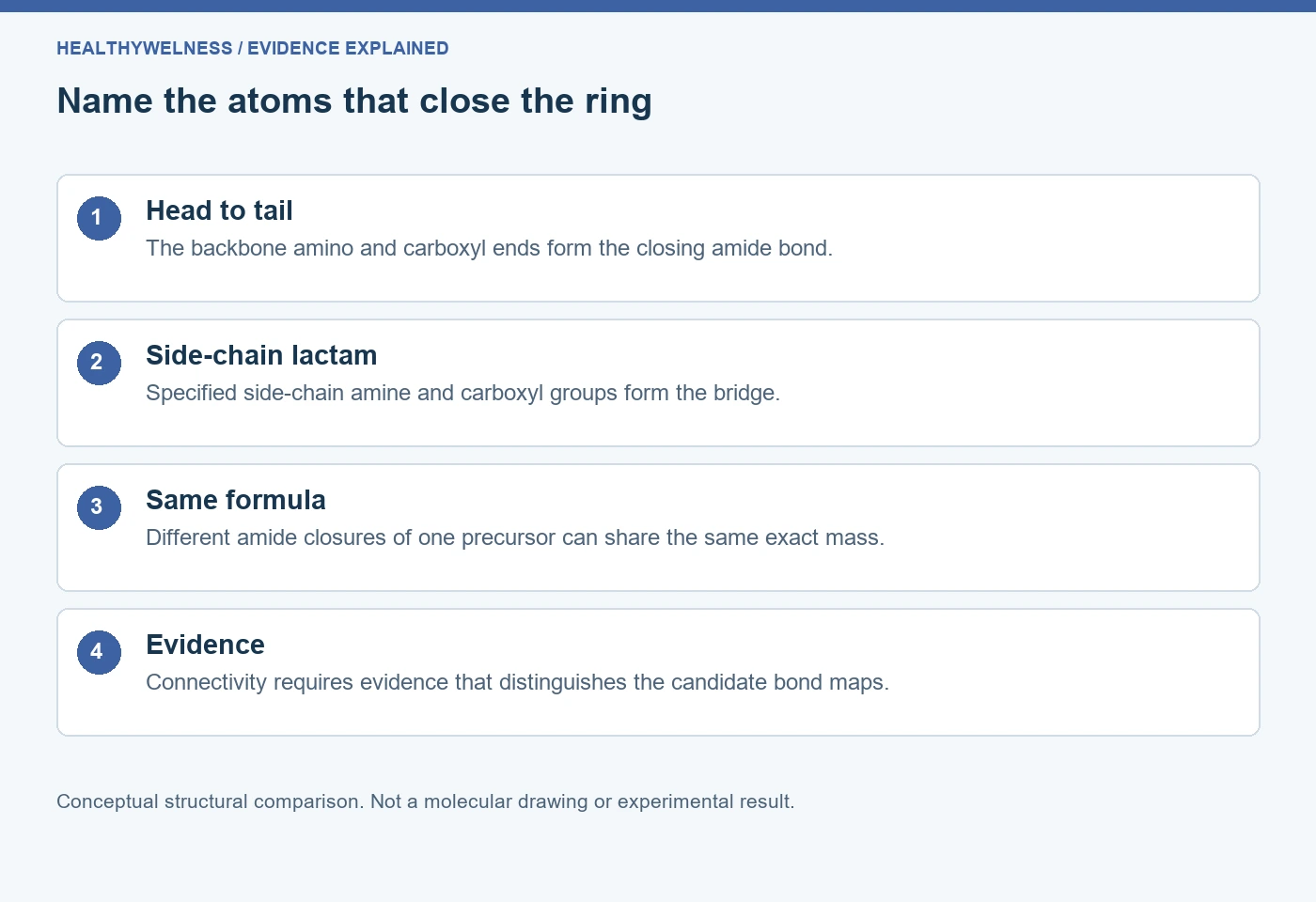
Head-to-tail peptide cyclization joins the backbone termini, while side-chain cyclization joins specified side-chain groups and can leave the backbone ends intact. A cyclic label, sequence string or intact-mass match does not uniquely specify those connections. The useful identity question is which atoms form the closing bond, which terminal groups remain, and what evidence distinguishes the proposed structure from alternatives.
- A head-to-tail backbone ring and a side-chain lactam can consume different functional groups while producing the same net elemental loss.
- Residue numbers identify positions in a declared reference sequence; a cyclic backbone has no chemically privileged first residue.
- Connectivity, stereochemistry and three-dimensional conformation are distinct structural descriptions.
- The hypothetical structures and masses below are teaching examples, not characterized HealthyWelness materials.
Specify the closing bond as a pair of chemical endpoints
The word cyclic identifies a broad architectural property. It does not provide a complete bond map. For a head-to-tail amide ring, the closing connection joins the terminal backbone carboxyl carbon to the terminal amino nitrogen. For a lysine–aspartate side-chain lactam, the participating groups are a lysine side-chain amine and an aspartate side-chain carboxyl group. Both yield amide bonds; their positions in the molecular graph differ.
IUPAC peptide nomenclature distinguishes homodetic rings, consisting solely of ordinary peptide linkages, from heterodetic rings containing other connections such as isopeptide, disulfide or ester bonds. This is a naming framework, not a method for proving that a sample has the named structure. IUPAC, sections 3AA-19.5.1–19.5.2.
For an analytical request, a plain endpoint description is often more useful than an unexplained shorthand. State the residue reference, the participating functional groups and the bond type. If a linker is present, define the linker and its attachments too. A line drawn between two residue names can otherwise conceal whether the connection uses backbone atoms, side-chain atoms or an added chemical handle.
| Closure | First endpoint | Second endpoint | Backbone termini |
|---|---|---|---|
| Head-to-tail amide | Terminal amino N | Terminal carboxyl C | Consumed in closure |
| Lys–Asp lactam | Lys side-chain amino N | Asp side-chain carboxyl C | Can remain free |
| Head-to-side-chain amide | Terminal amino N | Specified side-chain carboxyl C | Only one end consumed |
| Disulfide bridge | Cys sulfur | Specified Cys sulfur | Can remain free |
Two different amide closures can have the same exact mass
Hypothetical worked example: consider a defined linear precursor H–Lys–Ala–Gly–Asp–Phe–Gly–OH, with the stated residue configurations held fixed. Candidate A closes the backbone head to tail. Candidate B instead connects the Lys1 side-chain amino group to the Asp4 side-chain carboxyl group, leaving the backbone amino and carboxyl ends free. These are proposed teaching structures, not a synthesis report.
Each proposed intramolecular amide formation formally removes H2O relative to that same precursor. Consequently, the candidates have the same elemental formula even though they connect different atoms. This conclusion follows from the stipulated chemistry; it does not require an instrument to make the two structures identical.
For a separate numerical teaching example, stipulate a generic precursor mass of 700.000000 Da; this is not the calculated mass of the six-residue sequence above. Subtracting a water-composition loss of 18.010565 Da gives 681.989435 Da for either of two proposed single amide closures. Unimod records that elemental loss in its dehydration entry; the database entry is used here only as a mass reference, not as a cyclic-peptide assignment. Unimod record 23.
No improvement in intact-mass precision can distinguish these stipulated same-formula structures by mass alone. The missing information is connectivity. A very accurate match can exclude some wrong compositions while leaving both candidate bond maps entirely compatible. This is a different problem from distinguishing nearly equal masses with higher resolving power.
Terminal groups expose an important consequence of the bond map
In candidate A, the original backbone ends become part of the ring. The lysine side-chain amino group and aspartate side-chain acid remain available under the simplified structure specification. In candidate B, those side-chain groups form the lactam, while the backbone ends remain. The total formula is the same, but the locations of potentially ionizable groups change.
This means a matching net charge under one simplified accounting scheme would not establish matching electrostatic behavior. The groups occur in different local environments, and their solution ionization depends on conditions. Conversely, a difference in chromatographic behavior would be consistent with different structures without uniquely telling which structure is which.
It is also why terminal caps cannot be added casually to a comparison. If a side-chain-cyclized analogue has N-acetylation or C-amidation but its comparator does not, the comparison changes more than the closing bond. Keep terminal chemistry explicit when deciding whether an experiment isolates the effect of ring placement.
- Record every terminal group that remains after closure.
- Record any side-chain group consumed by the bridge.
- Keep added residues, linkers and caps visible.
- Separate a molecular difference from an explanation of its experimental effect.
Number a cyclic sequence without inventing a chemical beginning
A head-to-tail ring can be written starting at different residues while retaining the same directed order around the backbone. For example, rotating the written starting point of a specified cyclic sequence does not itself make a different molecule. Reversing the direction or changing a residue configuration is a different operation and should not be treated as a harmless rotation.
For a side-chain bridge, residue positions need a declared reference. “Bridge 1–4” is unhelpful if two documents start numbering at different points or include different terminal extensions. Specify the full reference sequence and identify the endpoint atoms within it. The named residue alone can be insufficient where several functional groups are available.
This documentation issue becomes particularly important when translating a figure into a purchase specification or an analytical work request. A visually clear diagram can lose information when copied into a one-letter sequence field. Preserve a structure drawing or an explicit bond list alongside the sequence, with the version or reference that fixes numbering.
Choose identity evidence for the actual competing connection
Start by writing the alternatives that matter. If the concern is head-to-tail versus side-chain amide closure, asking only for intact mass repeats a measurement that both candidates can satisfy. Ask instead what observation would differ between those candidates: an assignment of terminal groups, bond-specific structural correlations, or suitably interpreted fragmentation and chemical evidence.
Each approach has limits. Fragmentation of a ring can involve more than one bond cleavage before a sequence-related ion appears. A simple linear-peptide interpretation may therefore omit plausible routes. An NMR assignment needs sufficient information to support the proposed connection; a generic statement that “NMR was run” does not identify which structural question was resolved. A retention-time difference separates features under the method but does not name their bond maps.
Synthesis records are useful supporting evidence because they show which groups were intended to react and which were protected. They are not substitutes for examining the recovered material when alternative products remain plausible. Conversely, a sparse analytical report should not be described as proving a wrong closure; it may simply leave the question unresolved.
A defensible report states what the combined evidence supports and what it cannot discriminate. If the endpoints were not assigned, use wording such as “mass consistent with the proposed cyclized composition” rather than “complete connectivity confirmed.” The distinction protects later comparisons from inheriting certainty that the measurement never supplied.
A linker comparison in original research keeps the design variables visible
Bellavita and colleagues’ 2021 temporin L analogue study explicitly varied tether positions and linker chemistry, including side-chain lactam and triazole connections. Its design section describes replacing residues to create the reactive pairs, including Lys/Glu pairs for lactam formation. The experimental section describes selective deprotection and LC-MS monitoring of the coupling. Bellavita et al., 2021.
This is an example of a specified structural design, not evidence for a universal effect of cyclization. Introducing reactive residues can change sequence as well as connectivity; changing linker type adds another variable. The limited methodological lesson is to preserve those changes when describing what a comparison tested. This article does not reproduce the paper’s biological endpoints or infer any outcome for catalog materials.
Connectivity is also separate from conformation. The same connected molecule can populate several shapes, and a ring can remain conformationally flexible. Determining a preferred shape under one solvent condition does not change the bond map, nor does it prove that the same conformational population persists in a different matrix.
Frequently asked questions
Does cyclo before a sequence always specify every bond?
A formal notation can be informative, but an informal cyclic label may be incomplete. Retain the closing endpoints, bond type, stereochemistry and terminal chemistry when interpreting a real record.
Can a side-chain-cyclized peptide retain both termini?
Yes. A side-chain-to-side-chain closure can leave both backbone ends intact. Whether the ends are free, capped or further connected must still be specified.
Does an 18 Da decrease prove head-to-tail closure?
No. Several chemical changes can share a water-composition loss. Even two distinct amide closures of the same precursor can have identical exact masses.
Is a differently written starting residue a new cyclic peptide?
Not necessarily. A rotation of the written start around the same directed backbone can describe the same structure. Changed order, connectivity or configuration requires separate assessment.
Does correct connectivity establish research suitability?
No. Identity is one question. Purity, content, stability and assay behavior need evidence appropriate to the intended research measurement.
Related reading
The linear versus cyclic guide introduces architecture. Continue with disulfide connectivity mapping for sulfur bridges and terminal modifications for the chemistry of surviving ends. Use the COA lookup to locate available documentation and check the actual scope of an identity statement.
References
- IUPAC-IUB. Nomenclature and Symbolism for Amino Acids and Peptides, section 3AA-19.
- Unimod record 23: Dehydrated, elemental mass reference.
- Bellavita et al. First-in-Class Cyclic Temporin L Analogue: Design, Synthesis, and Antimicrobial Assessment.
Cover and evidence map: original conceptual editorial schematics, not measured results, exact molecular structures, or photographs of HealthyWelness facilities.