Peptide Reaction Quenching: Is the Endpoint Preserved?
Assess peptide research endpoints by separating reaction arrest, target recovery and readout compatibility during the real delay before analysis.

A nominal stopping time becomes a defensible peptide-reaction endpoint only when the stopping operation preserves the intended molecular quantity during subsequent handling and measurement. Adding a quench reagent does not itself prove that the reaction stopped, the target was recovered or the detector remained comparable. Evaluate those three questions separately over the actual delay before analysis.
For laboratory research use only. The compounds discussed are not approved for human or veterinary use and are not drugs, foods or cosmetics. This article summarises published research and is not medical advice.
- A collection timestamp and a verified chemical stopping time are different pieces of evidence.
- A stable detector reading does not independently establish target recovery or complete reaction arrest.
- Stopping chemistry can change sample recovery and downstream detection as well as enzyme activity.
- The numerical example is hypothetical and supplies no validated quench method for a research product.
The reaction clock can keep running after collection
A reaction is described as ending after a fixed incubation because an aliquot was collected then. If the aliquot retains active enzyme and suitable substrate, its composition can continue changing during transfer, queueing or preparation for analysis. The instrument then measures the preparation that reached it, not necessarily the composition present at the collection timestamp.
This is distinct from choosing an endpoint versus a time course. That choice defines which temporal feature is of interest. Quench validity asks whether the workflow faithfully preserves the selected feature long enough to measure it. Collecting many timepoints does not solve a preservation problem shared by every sample.
The NIH Assay Guidance Manual’s histone-acetyltransferase chapter explicitly discusses reaction arrest, delays between plates and compatibility with detection. It recommends checking whether the apparent stopping operation actually arrests the reaction, including serial observations after stopping. This guidance concerns HAT assays; the transferable principle is verification of the intended endpoint, not a universal recipe for peptide reactions. [1]
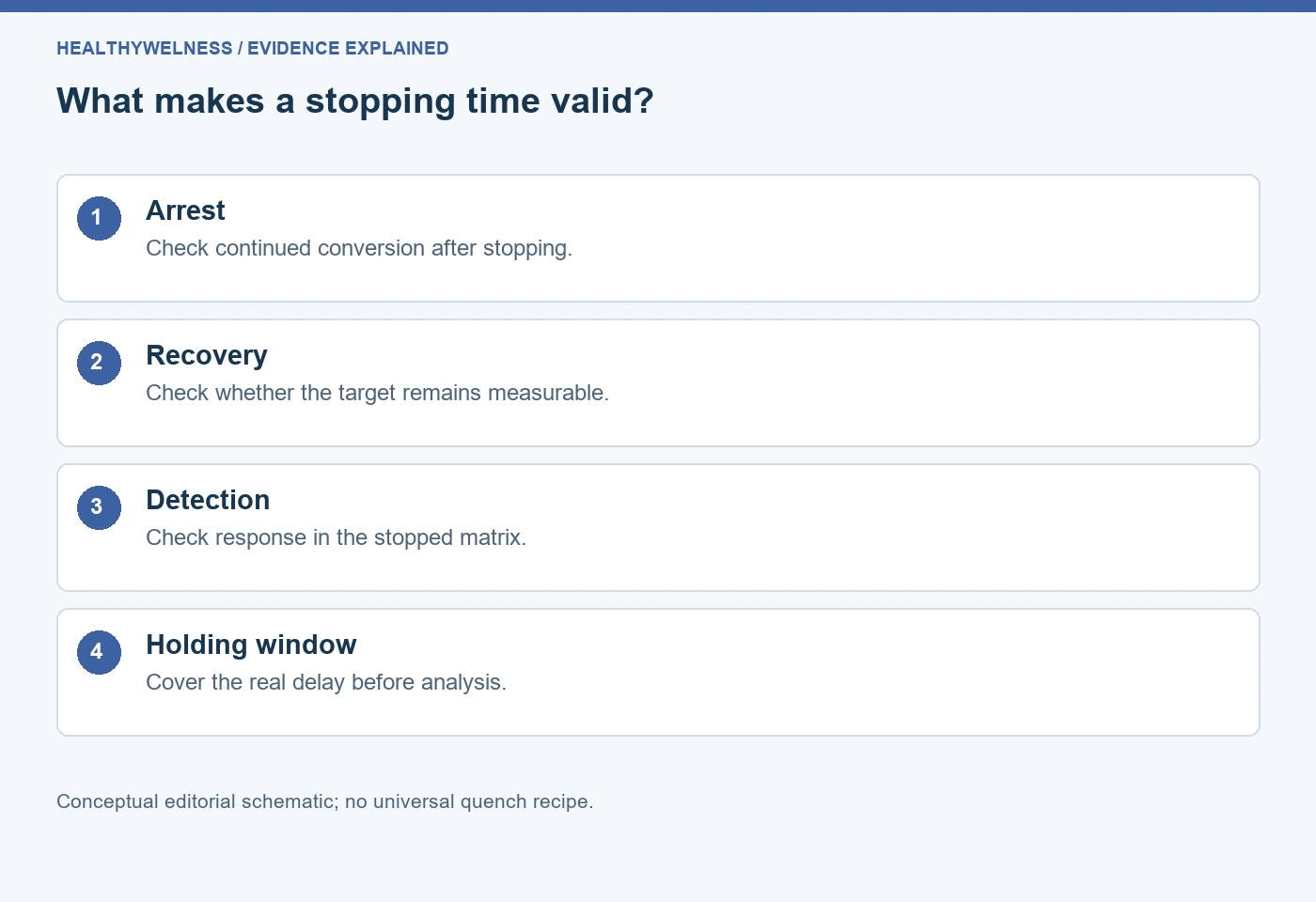
| Claim | Question to test | Possible failure |
|---|---|---|
| Reaction arrest | Does conversion continue? | Residual catalytic activity |
| Target preservation | Is target recoverable? | Precipitation or loss |
| Readout compatibility | Does signal still mean amount? | Changed detector response |
| Timing adequacy | How fast is arrest achieved? | Unrecorded conversion interval |
Stopping the enzyme is only one part of preservation
A stopping operation changes the system deliberately. A pH shift, denaturing environment or separation step may reduce catalytic conversion, but it can also change peptide solubility, partitioning or analytical response. An operation can succeed at arresting an enzyme while producing an unsuitable analytical sample. That is why a single reduced peak or flat trace cannot validate the whole operation.
Kim, Lone and Saghatelian’s 2013 peptidomics methods article illustrates this tradeoff in a specified bioactive-peptide proteolysis workflow using tissue lysates. Their quench-development passage reports precipitation of certain peptides after acid addition and describes a guanidine-based approach with subsequent desalting. The observation establishes a workflow-specific recovery concern. It does not mean acid is unsuitable for every peptide or that the reported alternative should be copied into another assay without evaluation. [2]
Ask what must remain measurable: intact substrate, a particular cleavage product, total product formation, an isotope ratio or a captured molecular species. Different endpoints can respond differently to the same stopping condition. Preserving a mass ratio is not automatically equivalent to preserving absolute amount, and preserving one product does not establish recovery of all products.
Define the reference stage as well. A target added before the stopping operation experiences the operation and later preparation. A target added after that operation experiences only the remaining preparation. Comparing these can help localize a problem, provided the target represents the relevant molecular species and the comparisons preserve the necessary matrix. It cannot erase differences in chemical history by assumption.
A hypothetical delay series exposes an endpoint bias
Invented worked example: assume a selective quantitative method can measure a designated product without interference. At the intended stopping instant, a reaction contains 40 nmol product. A candidate stopping operation leaves residual conversion at a constant 0.50 nmol per minute during a subsequent holding interval. Assume no product loss, no substrate depletion and negligible uncertainty solely for this teaching calculation.
If the sample is read after two minutes, it contains 41 nmol product. After ten minutes it contains 45 nmol; after twenty minutes it contains 50 nmol. Relative to the intended 40 nmol endpoint, these are overestimates of 2.5%, 12.5% and 25%. The relevant expression is product at measurement = product at intended stop + residual rate × delay.
| Delay after nominal stop | Extra product | Measured amount | Endpoint bias |
|---|---|---|---|
| 2 minutes | 1 nmol | 41 nmol | +2.5% |
| 10 minutes | 5 nmol | 45 nmol | +12.5% |
| 20 minutes | 10 nmol | 50 nmol | +25% |
Now imagine condition A is always read early and condition B late. Their difference can contain a delay effect even if their intended endpoints match. Randomization may distribute that error differently, but it does not establish that the stopping operation preserves the endpoint. Both timing design and stopping validity need attention.
Real residual conversion may slow, accelerate or vary across matrices. The constant rate is not a kinetic model for a named enzyme. Nor should the calculation become an automatic subtraction from experimental data: estimating and correcting a bias requires evidence that the proposed model applies over the relevant interval.
Challenge the post-stop window that the workflow actually uses
A useful validation comparison covers the delay between stopping and the last relevant analytical operation. Testing immediate analysis alone leaves a long instrument queue unexamined. Testing only a final instrument vial can miss continued conversion during earlier transfer or cleanup. Describe where preservation was evaluated and which untested intervals remain.
Include a comparison capable of revealing continued reaction rather than relying exclusively on the absence of visible drift. For example, a method-development study may compare stopped preparations across holding times while verifying that its analytical system can detect the expected change. Appropriate active and inactive controls establish the interpretation of the challenge. The precise design depends on the endpoint and method.
A flat trace can occur because conversion stopped, because detection has saturated, because product formation balances product loss or because the stopping matrix suppresses the readout. A stable signal is therefore useful evidence within a demonstrated measurement relationship. It is not a logically complete proof of all preservation claims.
- Define the maximum intended holding interval and its conditions.
- Assess whether the method can reveal a practically relevant change.
- Check recovery independently of the claim of reaction arrest.
- Preserve the stopped matrix in relevant standards or detection controls.
- Record uncertainty and the tested scope of the conclusion.
Physical removal can replace chemical stopping in a demonstrated system
The need for a chemical quench depends on whether active catalyst remains in the analyzed preparation. Mousseau and colleagues’ 2024 study examined filter-based bottom-up proteomics preparations. Its abstract reports negligible trypsin activity and intact trypsin in the peptide eluate under the tested conditions. The retrieved experimental passage describes both a chromogenic activity test and a protein-substrate challenge assessed by mass spectrometry. [3]
That is stronger reasoning than inferring absence of activity from a filtration step’s name: the investigators evaluated the relevant eluate. Their conclusion is about specified filter-trap preparations and tested readouts. It does not establish that every filtration, cleanup or separation operation removes every protease from every peptide sample.
The general decision is therefore evidence-led. If separation removes the catalyst sufficiently for the intended window, additional chemical arrest might be unnecessary. If active catalyst remains, another preservation strategy may be required. A claim that stopping is unnecessary needs the same clarity about residual activity, analytical sensitivity and holding conditions as a claim that a chemical quench works.
Report the operation and the evidence as separate statements
“Quench added” records an action. “No change larger than the method’s stated capability was observed during the tested holding window” records an observation. “The selected endpoint was adequately preserved for this workflow” is an interpretation connecting the two. Keeping those levels distinct makes the claim reviewable.
Report reaction start, collection, stopping operation, mixing or transfer, holding conditions and analysis order at the level needed to understand the timing. If complete arrest was not demonstrated, say that the sample was collected or exposed to the stopping condition rather than silently upgrading the action to a validated endpoint.
This article does not select a reagent, temperature or duration for an unspecified peptide. The sources show why stopping conditions must be assessed in their own workflow. Their individual chemical recipes and biological models cannot establish product stability, purity or suitability in another laboratory experiment.
Continue with endpoint versus time-course interpretation, peptide proteolysis and cleavage-site mapping and LC–MS matrix effects. The peptide concentration calculator checks nominal dilution arithmetic; it cannot determine a reaction’s effective stopping time.
Frequently asked questions
Does placing a sample on ice prove the reaction stopped?
No. A temperature change records a condition. Whether it sufficiently suppresses the relevant conversion over the actual holding interval requires evidence for that reaction and sample.
Is the collection time always the true endpoint?
Only if subsequent operations preserve the intended quantity adequately. Continued conversion between collection and effective arrest can shift the molecular endpoint away from the recorded timestamp.
Does a stable post-quench signal establish full recovery?
No. A preparation can lose target during stopping and then give a stable signal. Recovery, reaction arrest and readout compatibility address different uncertainties.
Can an extra cleanup step make chemical quenching unnecessary?
It can in a demonstrated workflow if active catalyst is sufficiently removed and the endpoint remains preserved. The conclusion needs residual-activity and recovery evidence rather than an assumption based on the cleanup name.
Can one validated quench be transferred to every peptide?
No. Peptide identity, matrix, reaction chemistry and detection can change the outcome. A previous validation supplies a starting point, while transfer requires evidence for the new conditions.
References
- Gadhia S, et al. Histone Acetyltransferase Assays in Drug and Chemical Probe Discovery. Assay Guidance Manual. Updated July 1, 2018. Quenching section.
- Kim YG, Lone AM, Saghatelian A. Analysis of the proteolysis of bioactive peptides using a peptidomics approach. Nat Protoc. 2013;8(9):1730–1742. PMID: 23949379.
- Mousseau CB, et al. Quenching Trypsin Is Unnecessary in Filter-Based Bottom-Up Proteomics. J Am Soc Mass Spectrom. 2024;35(8):2028–2031. doi:10.1021/jasms.4c00143.
For laboratory research use only. The compounds discussed are not approved for human or veterinary use and are not drugs, foods or cosmetics. This article summarises published research and is not medical advice.
Cover and evidence map: original conceptual editorial schematics, not measured results, exact molecular structures, or photographs of HealthyWelness facilities.
Sources
- Gadhia S, et al. Histone Acetyltransferase Assays in Drug and Chemical Probe Discovery. Assay Guidance Manual. Updated July 1, 2018. Quenching section.
- Kim YG, Lone AM, Saghatelian A. Analysis of the proteolysis of bioactive peptides using a peptidomics approach. Nat Protoc. 2013;8(9):1730–1742. PMID: 23949379.
- Mousseau CB, et al. Quenching Trypsin Is Unnecessary in Filter-Based Bottom-Up Proteomics. J Am Soc Mass Spectrom. 2024;35(8):2028–2031. doi:10.1021/jasms.4c00143.