Peptide Gravimetric Preparation: Mass, Volume, Density
Convert peptide research preparations between mass fraction and mg/mL using final solution density, with clear denominators and dilution calculations.

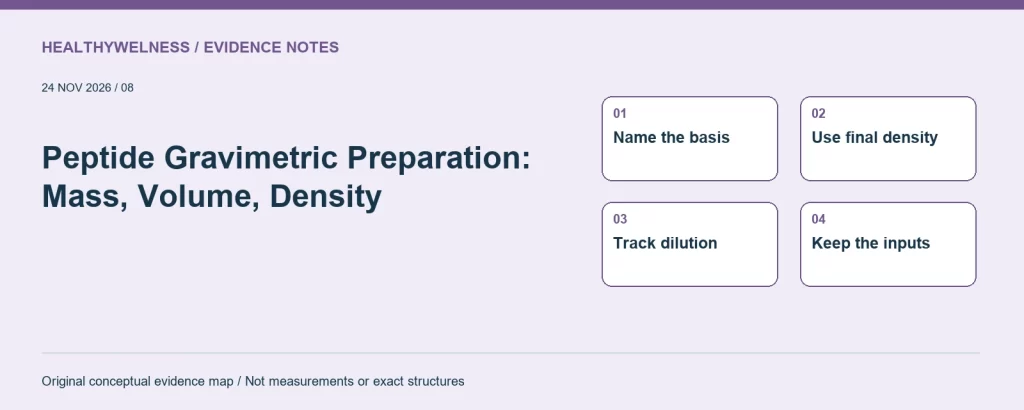
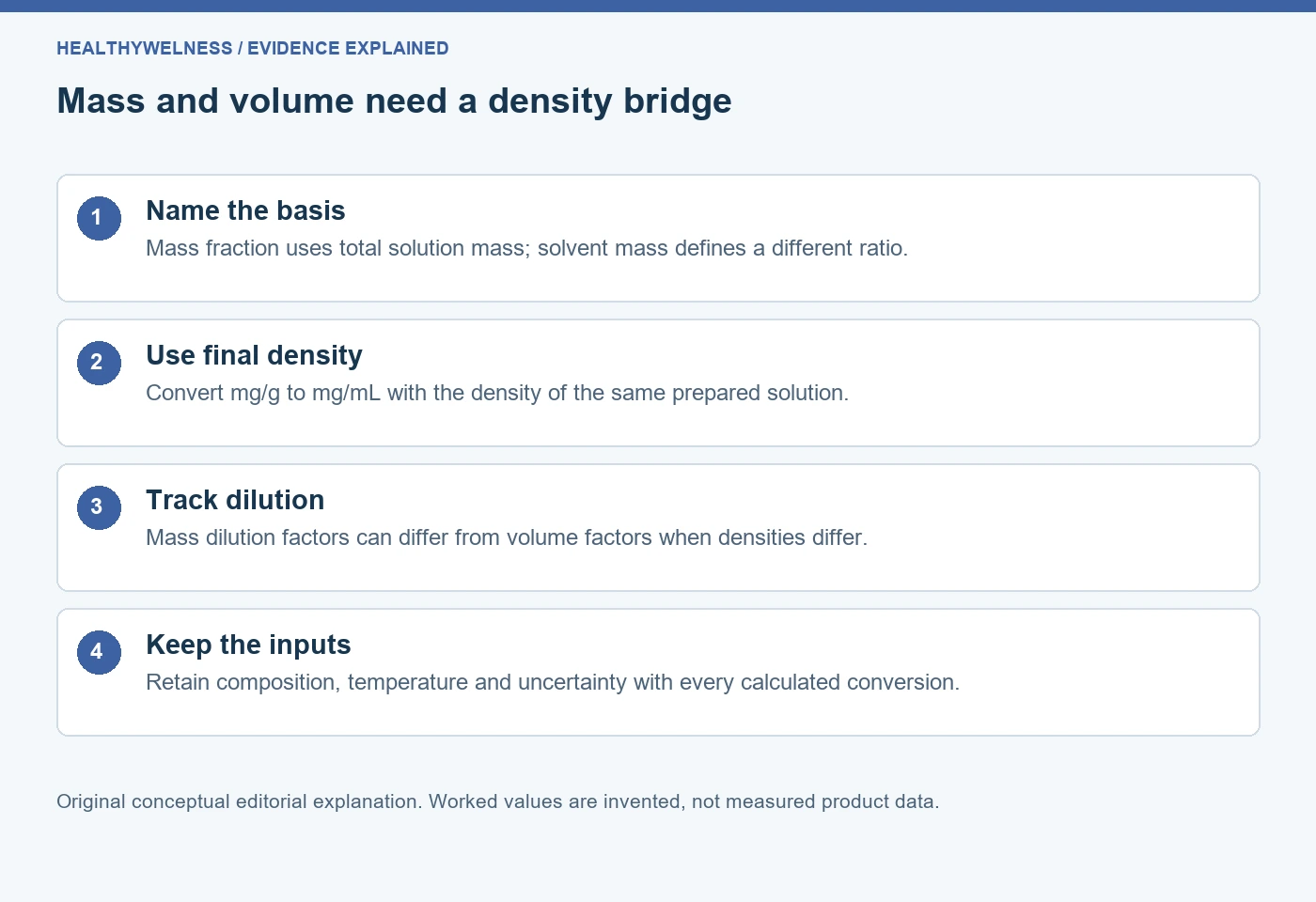
Gravimetric peptide solution preparation assigns composition from masses; converting that result to mg/mL requires the final solution’s density. Mass fraction uses the entire solution mass as its denominator. It is different from mass per solvent mass, and neither can be relabelled as mass per solution volume without a justified conversion.
For laboratory research use only. The compounds discussed are not approved for human or veterinary use and are not drugs, foods or cosmetics. This article summarises published research and is not medical advice.
- Mass fraction divides the mass of a defined constituent by the total mass of the mixture.
- Mass concentration divides the mass of a defined constituent by the volume of the mixture.
- For the same homogeneous solution and analyte basis, mass concentration equals mass fraction multiplied by solution density.
- Weighing solvent does not independently measure the final solution volume or establish target-peptide content.
A mass-based preparation needs a mass-based label
A balance can provide a useful route to solution preparation when the intended composition is expressed on a mass basis. The difficulty often begins later, when a notebook’s mg/g is copied into a spreadsheet’s mg/mL field. The numbers may look similar for some dilute aqueous systems, but the units identify different quantities. Similarity is conditional, rather than a permission to discard the denominator.
IUPAC’s Green Book lists mass fraction as a constituent mass divided by total constituent masses and mass concentration as constituent mass divided by mixture volume. It also distinguishes molality, whose denominator is solvent mass. These definitions support different labels for different preparation records. [1]
| Quantity | Denominator | Example unit |
|---|---|---|
| Mass fraction | Total solution mass | mg/g solution |
| Mass concentration | Final solution volume | mg/mL solution |
| Solute/solvent mass ratio | Solvent mass | mg/g solvent |
| Solution density | Final solution volume | g/mL solution |
The solute/solvent mass ratio is included because it is easy to produce directly when a powder portion and a solvent portion are weighed separately. It is a valid description when named correctly. Calling it mass fraction silently removes the solute from the denominator. At small fractions the difference may be numerically small, but whether that approximation is adequate depends on the intended comparison.
Density connects two descriptions of the same solution
Define mA as the assigned mass of the constituent of interest, M as total solution mass, and V as final solution volume. Then w = mA/M, density ρ = M/V, and mass concentration γ = mA/V. Multiplying w by ρ cancels M and gives γ. In convenient laboratory units, mg/g multiplied by g/mL gives mg/mL.
This identity does not require assuming additive liquid volumes. It does require that the three quantities refer to the same final mixture and a compatible state. Using the density of the starting solvent instead of the prepared solution substitutes a different input. That may sometimes be an acceptable approximation, but it should remain an explicit approximation with a justified effect on the answer.
The distinction is especially useful when comparing records from different preparation methods. One laboratory may assign a mass fraction from weighed additions. Another may make a preparation to a calibrated final volume. Both records can be internally coherent. Comparing their numerical values requires the relationship between the two denominators, alongside a consistent definition of the analyte.
- Keep the original mass-basis result in the record.
- Identify the density used for any volume conversion.
- Record the temperature and relevant composition associated with that density.
- Label a converted result as calculated, rather than directly measured volume.
A worked example shows why weighing solvent is not measuring volume
Invented teaching example: assume 20.0 mg of a fully assigned research analyte is present in a homogeneous solution whose total mass is 10.000 g. The final solution has a stipulated density of 1.040 g/mL at the stated measurement temperature. These inputs are hypothetical; the density is deliberately supplied rather than inferred from the solvent name.
The mass fraction is 20.0 mg/10.000 g = 2.00 mg/g solution. The calculated final volume is 10.000/1.040 = approximately 9.615 mL. The mass concentration is therefore 20.0/9.615 = 2.08 mg/mL. The same answer follows directly from 2.00 mg/g × 1.040 g/mL = 2.08 mg/mL.
| Invented calculation | Value | Required input |
|---|---|---|
| Assigned analyte mass | 20.0 mg | Defined analyte basis |
| Total solution mass | 10.000 g | Complete mixture |
| Mass fraction | 2.00 mg/g | Mass denominator |
| Calculated volume | 9.615 mL | Density 1.040 g/mL |
| Mass concentration | 2.08 mg/mL | Same final solution |
If someone instead relabelled 2.00 mg/g as 2.00 mg/mL, the reported mass concentration would be approximately 3.85% lower than the value supported by the stipulated density: (2.00 − 2.08)/2.08 × 100. This discrepancy is a denominator conversion error in an invented example, not a measured property of peptide solutions.
Now consider a separate preparation containing 20.0 mg analyte and 10.000 g solvent, with no other material. Its total solution mass would be 10.020 g under a closed mass balance. The mass fraction would be approximately 1.996 mg/g, while the solute/solvent mass ratio would be exactly 2.00 mg/g using the stated inputs. Neither calculation assigns a volume without density.
Mass dilutions conserve the mass-basis relationship
Suppose an invented homogeneous stock has an assigned analyte mass fraction of 4.00 mg/g solution. A representative 0.500 g portion of stock contains 2.00 mg analyte. Combining that portion with 1.500 g analyte-free diluent gives 2.000 g final solution under the assumed closed, loss-free preparation. Its mass fraction is 1.00 mg/g.
The dilution fraction is transferred stock mass divided by final solution mass: 0.500/2.000 = one-quarter. The denominator includes the transferred stock. Dividing by the added 1.500 g diluent instead would describe a different ratio. This mass-basis calculation is useful even if the stock and final mixture have different densities.
To compare their mg/mL values, each solution needs its own appropriate density. For illustration, stipulate a stock density of 1.080 g/mL and final density of 1.020 g/mL. The stock concentration is 4.32 mg/mL and the final concentration is 1.02 mg/mL. Their volume-based ratio is approximately 0.236, while the mass-fraction ratio is 0.250. Both are consistent with the same invented preparation because the denominators differ.
This example does not suggest that mass preparation is always preferable. A method’s suitability depends on the uncertainty and handling performance of the actual operation. It shows why a dilution factor should identify whether it is based on transferred mass or transferred volume before it is used downstream.
Final-volume preparation is a different measurement route
The UC Davis manual describes volumetric flasks as calibrated to contain a specified volume and gives an example marked at a stated temperature. That supports distinguishing a final-volume observation from the volume of solvent added. The manual is a laboratory teaching reference, not a peptide-specific preparation validation. [2]
Making a solution to a final volume, recording an added solvent volume, and weighing solvent are three different operations. A final-volume preparation includes the solute and other solution components inside its volume boundary. An added-solvent record describes what entered before the final mixture existed. A mass record describes an amount without independently determining its volume.
A review should therefore reconstruct the operation from raw fields rather than a phrase such as “made up in water.” Ask what was measured, when it was measured, and which final quantity the record supports. This often resolves apparent disagreements between two notebooks without requiring either balance or volumetric apparatus to have failed.
Conversion uncertainty can exceed the benefit of extra balance digits
NIST Technical Note 1297 bases uncertainty evaluation on a measurement model and the uncertainty and covariance of its inputs. For a calculated mass concentration, density belongs in that model when it is used in the conversion. An uncertain or mismatched density cannot be made exact by weighing more precisely. [3]
For a simple invented case with independent inputs, let the relative standard uncertainty of mass fraction be 0.20% and that of density be 1.00%. First-order propagation for their product gives approximately √(0.20² + 1.00²)% = 1.02%. This is a conditional standard uncertainty, not an observed instrument specification or a confidence interval.
Composition changes after preparation also require attention. If solvent evaporates, the original mass fraction no longer automatically describes the remaining solution. If the target changes chemically, the original target assignment may also become outdated. Weighing establishes part of the preparation record; it does not establish later chemical preservation.
Continue with serial dilution uncertainty for ancestry and shared errors, and evaporation and concentration drift for changes during handling. The peptide concentration calculator supports mass–volume arithmetic when a justified volume is available. It does not supply an unmeasured density.
Questions about gravimetric peptide preparations
Does 1 mg/g automatically equal 1 mg/mL?
No. The conversion requires solution density. The numerical values coincide only when density is 1 g/mL on the stated basis, or approximately coincide under an explicitly adequate approximation.
Is solvent mass the denominator of mass fraction?
No. Mass fraction uses total mixture mass. A solute-to-solvent mass ratio has a different denominator and should retain its own label.
Can I use the density of pure water for every water-based mixture?
No. A water-based solution can contain other components. Using pure-water density is an assumption that must be justified for the actual composition, temperature and required uncertainty.
Does weighing powder establish its target-peptide mass?
No. The analyte definition and content assignment remain separate. See purity versus peptide content before interpreting a bulk powder mass as a target amount.
Is a mass-based dilution factor also the volume-based factor?
Only under conditions that make the two ratios equivalent. Different stock and final densities can make their numerical dilution factors differ while both descriptions remain consistent.
References and source boundaries
- Cohen ER, et al. Quantities, Units and Symbols in Physical Chemistry. IUPAC Green Book. Third edition, 2007. Sections 2.10 and 3.10. Relevant quantity definitions and unit guidance read.
- University of California, Davis. Chemistry 2C Lab Manual. Fall 2020. Common Laboratory Procedures, A-64: volumetric flasks. Relevant section read.
- Taylor BN, Kuyatt CE. Guidelines for Evaluating and Expressing the Uncertainty of NIST Measurement Results. NIST Technical Note 1297. 1994 edition. Appendix A. Measurement-model and propagation passages read.
Sources accessed 23 November 2026. All preparation values and density values are invented teaching inputs. No universal peptide-solution density or product-specific analytical result is asserted.
For laboratory research use only. The compounds discussed are not approved for human or veterinary use and are not drugs, foods or cosmetics. This article summarises published research and is not medical advice.
Cover and evidence map: original conceptual editorial schematics, not measured results, exact molecular structures, or photographs of HealthyWelness facilities.
Sources
- Cohen ER, et al. Quantities, Units and Symbols in Physical Chemistry. IUPAC Green Book. Third edition, 2007. Sections 2.10 and 3.10.
- University of California, Davis. Chemistry 2C Lab Manual. Fall 2020. Common Laboratory Procedures, A-64: volumetric flasks.
- Taylor BN, Kuyatt CE. Guidelines for Evaluating and Expressing the Uncertainty of NIST Measurement Results. NIST Technical Note 1297. 1994 edition. Appendix A.