NAD vs NADPH: One Phosphate, Two Jobs
NADP carries an extra phosphate that cells use as an address label. It routes the same redox chemistry to biosynthesis instead of catabolism.

Cover illustration: AI-generated editorial artwork. Conceptual only; not an exact molecular structure, actual laboratory result or evidence of clinical effects.
NAD and NADP differ by a single phosphate group, and that phosphate is not where the chemistry happens. The nicotinamide ring that accepts and donates a hydride is identical in both. The phosphate is an address label, and the fact that a cell bothers to maintain two near-identical cofactors tells you the labelling is doing something important.
For laboratory research use only. The research materials supplied by HealthyWelness are not approved medicines, foods or cosmetics and are not for human or veterinary use. This article summarises published research and is not medical advice.
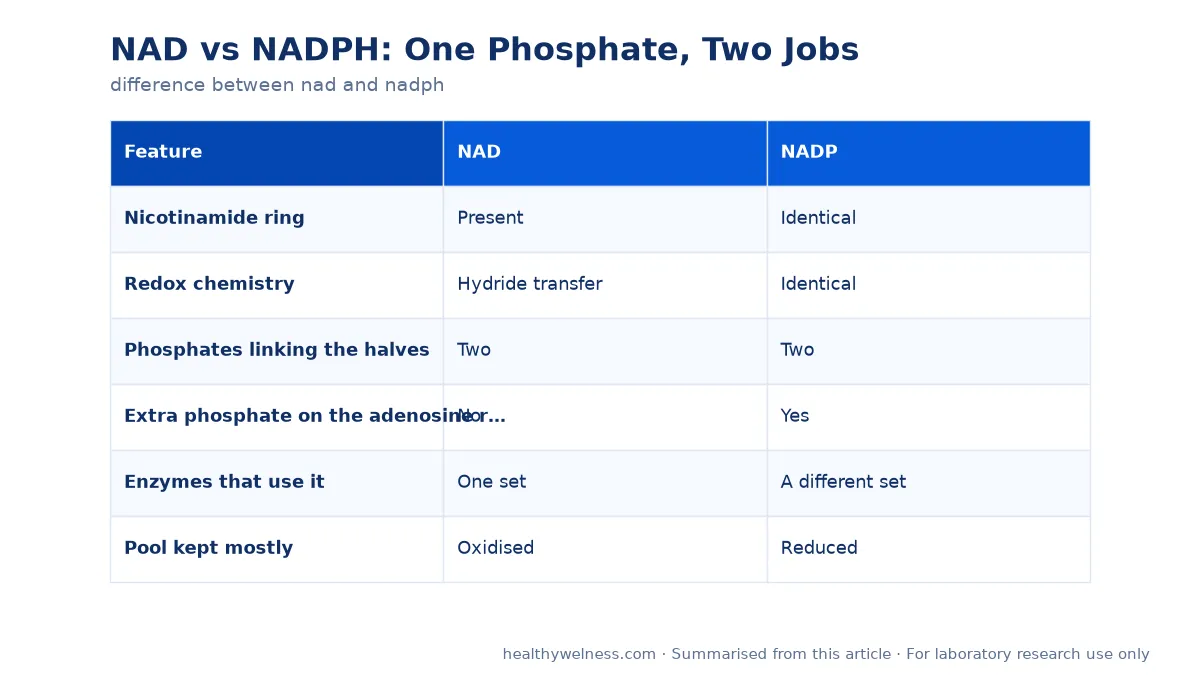
Structure
| Feature | NAD | NADP |
|---|---|---|
| Nicotinamide ring | Present | Identical |
| Redox chemistry | Hydride transfer | Identical |
| Phosphates linking the halves | Two | Two |
| Extra phosphate on the adenosine ribose | No | Yes |
| Enzymes that use it | One set | A different set |
| Pool kept mostly | Oxidised | Reduced |
| Typical role | Accepting electrons from fuel oxidation | Donating electrons for biosynthesis and antioxidant systems |
The last two rows are the whole answer. Same chemistry, opposite poise, different enzymes. The extra phosphate lets a dehydrogenase select which pool it draws from, so a cell can oxidise fuel and build molecules reductively at the same moment without the two processes fighting over one cofactor.
Why the poise differs
A largely oxidised NAD pool is good at accepting electrons; a largely reduced NADP pool is good at donating them. Maintaining both means maintaining two very different ratios in the same cytosol, which is only possible because the enzymes that set each ratio recognise their own cofactor and ignore the other.
The 2015 review by Bilan and colleagues on the main cellular redox couples is the right conceptual starting point: these are two of several couples a cell maintains, each reporting on a different aspect of its state. The implication for measurement is the same as for NAD alone and is worth repeating — the ratio is the quantity of interest, not either concentration, a point developed in NAD+ to NADH: reduction or oxidation.
Where NADPH comes from
The oxidative phase of the pentose phosphate pathway is the principal source. Two papers are worth reading together for what that actually supports.
The 2019 study by Chen and colleagues in Nature Metabolism reported that NADPH production by this pathway supports folate metabolism — a demand not usually listed alongside the familiar biosynthetic and antioxidant ones, and a good illustration that the reduced pool feeds more processes than a textbook summary suggests.
The 2023 article by Fuentes-Lemus and colleagues in Biochemical Society Transactions comes at it from the opposite direction: the enzymes of that oxidative phase are themselves targets of reactive species, with consequences for NADPH production. That makes the supply of reducing power vulnerable to the very stress it defends against, which is a feedback relationship worth having in mind when designing an oxidative-stress experiment.
The 2024 study by Lan and colleagues in Nature Communications is a concrete example of the pathway’s gatekeeping enzyme maintaining both redox homeostasis and biosynthesis in one system — the two roles of the reduced pool, in one experiment.
Compartments make it harder again
There is not one NADP pool in a cell any more than there is one NAD pool. The 2018 study by Goodman and colleagues in the Journal of Biological Chemistry addressed spatiotemporal compartmentalisation of hepatic NADH and NADPH metabolism directly.
Two consequences for anyone measuring:
- A whole-cell lysate averages compartments. The average may not correspond to the state of any compartment, and the compartments are not connected by free diffusion of the cofactor.
- Sample preparation can perturb what it measures. Redox ratios shift quickly; a slow extraction measures the extraction as much as the cell.
What this means at the bench
| Consideration | NAD+ | NADP(H) |
|---|---|---|
| Catalogue item | Usually the oxidised form | Both forms sold separately |
| Molecular weight for calculations | Of the exact salt supplied | Different again — do not reuse the NAD figure |
| Spectrophotometric handle | Reduced form absorbs near 340 nm | Same wavelength — the two are not distinguished by absorbance alone |
| Assay specificity | Enzyme-dependent | Must confirm which cofactor the enzyme uses |
| Solution stability | Limited; pH-dependent | Limited; prepare close to use |
The absorbance row is a practical trap. NADH and NADPH both absorb near 340 nm, so a reading at that wavelength reports total reduced dinucleotide, not which one. Distinguishing them requires an enzyme that is specific for one cofactor, or a chromatographic method.
Storage practice for both is the same: dry, dark and frozen as a solid, prepared close to use in solution, as set out in does NAD+ need refrigeration. Concentration maths uses the molecular weight of the exact salt, which our reconstitution calculator takes as an explicit input.
Our NAD+ research material is supplied for laboratory research use. Certificates are available for listed products — contact us for the latest report. What a coenzyme is, and why it is not a peptide, is covered in is NAD+ a peptide or a coenzyme.
Open questions
- How closely do compartment-resolved NADP ratios track whole-cell measurements across tissues?
- Which extraction methods perturb the ratio least?
- How much does oxidative damage to pentose phosphate pathway enzymes limit NADPH supply under stress?
Related research
Frequently asked questions
What is the difference between NAD and NADP?
One phosphate group, attached to the adenosine ribose. The nicotinamide ring that does the redox chemistry is identical. The phosphate is not part of the chemistry; it is a recognition feature that enzymes use to tell the two cofactors apart.
Why would a cell keep two cofactors that do the same chemistry?
So it can run the same reaction type in two directions at once. The NAD pool is kept largely oxidised and the NADP pool largely reduced, which lets catabolism and reductive biosynthesis proceed simultaneously without competing for one pool.
Which pool is more reduced?
The NADP pool, by a wide margin. That is the point of the separation: a highly reduced pool supplies electrons for biosynthesis and for antioxidant systems, while a largely oxidised NAD pool accepts electrons from fuel oxidation.
Where does NADPH come from?
Principally the oxidative phase of the pentose phosphate pathway. Published work shows this route supporting folate metabolism as well as the better-known biosynthetic and antioxidant demands.
Do NAD and NADP mix in a cell?
They are separate pools handled by different enzymes, and compartment-resolved work shows NADH and NADPH metabolism to be spatially distinct. A whole-cell lysate measurement averages compartments that are not interchangeable.
For laboratory research use only. The research materials supplied by HealthyWelness are not approved medicines, foods or cosmetics and are not for human or veterinary use. This article summarises published research and is not medical advice.
Sources
- Chen L, et al. NADPH production by the oxidative pentose-phosphate pathway supports folate metabolism. Nat Metab. 2019. PMID: 31058257
- Fuentes-Lemus E, et al. The enzymes of the oxidative phase of the pentose phosphate pathway as targets of reactive species: consequences for NADPH production. Biochem Soc Trans. 2023. PMID: 37971161
- Goodman RP, et al. Spatiotemporal compartmentalization of hepatic NADH and NADPH metabolism. J Biol Chem. 2018. PMID: 29514978
- Lan T, et al. Glucose-6-phosphate dehydrogenase maintains redox homeostasis and biosynthesis in LKB1-deficient KRAS-driven lung cancer. Nat Commun. 2024. PMID: 38997257
- Bilan DS, et al. Main Cellular Redox Couples. Bioorg Khim. 2015. PMID: 26615634