5-Amino-1MQ vs AOD-9604: Enzyme or Peptide Fragment
One is a small-molecule enzyme inhibitor, the other a growth hormone fragment. Different classes, different handling, different kinds of evidence.


Cover illustration: AI-generated editorial artwork. Conceptual only; not an exact molecular structure, actual laboratory result or evidence of clinical effects.
These two are compared because a catalogue lists them near each other. Chemically they have nothing in common: one is a charged small molecule that blocks an enzyme, the other is a short peptide taken from a region of a hormone. The comparison is only useful once that is clear, because almost every practical decision follows from it.
For laboratory research use only. The research materials supplied by HealthyWelness are not approved medicines, foods or cosmetics and are not for human or veterinary use. This article summarises published research and is not medical advice.
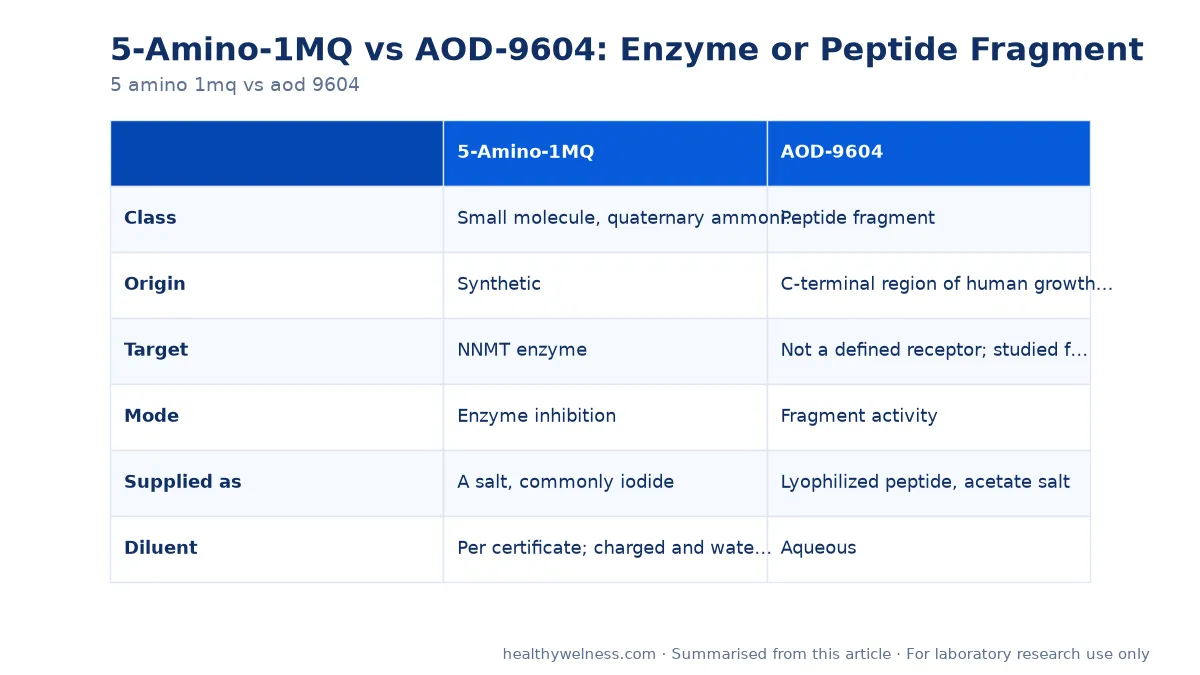
Side by side
| 5-Amino-1MQ | AOD-9604 | |
|---|---|---|
| Class | Small molecule, quaternary ammonium cation | Peptide fragment |
| Origin | Synthetic | C-terminal region of human growth hormone, with an added residue |
| Target | NNMT enzyme | Not a defined receptor; studied functionally |
| Mode | Enzyme inhibition | Fragment activity |
| Supplied as | A salt, commonly iodide | Lyophilized peptide, acetate salt |
| Diluent | Per certificate; charged and water-tolerant | Aqueous |
| Identity confirmed by | NMR, LC-MS, counterion named | HPLC plus peptide MS |
| Published animal work | 2018 mouse study | Rodent studies from around 2000 |
| Analytical literature | Within the NNMT field | 2015 detection and metabolism paper |
What each one’s evidence looks like
AOD-9604’s literature is older and more specific to the molecule. The 2000 study by Heffernan and colleagues examined a synthetic fragment of human growth hormone and lipid metabolism, and the 2001 follow-up in Endocrinology used obese mice and beta-3 adrenergic receptor knockout mice — a design that asks a mechanistic question rather than only observing an effect.
The 2015 paper by Cox and colleagues in Drug Testing and Analysis is the one we would read first for laboratory purposes. Detection and in vitro metabolism work is the most structurally rigorous literature available on a compound like this, because unambiguous identification is its whole purpose.
5-Amino-1MQ’s compound-level literature is thinner. The 2018 study by Neelakantan and colleagues describes selective, membrane-permeable NNMT inhibitors in a mouse model; the 2025 Nature paper by Heide and colleagues is about the target in a different context, not about this molecule. That distinction matters when the two are cited together, and it is developed in what the 5-Amino-1MQ evidence actually contains.
| Question | 5-Amino-1MQ | AOD-9604 |
|---|---|---|
| Is the molecular target named? | Yes — NNMT | No defined receptor |
| Published pharmacokinetics? | None found | Metabolism characterised in vitro |
| Human trials? | None found | None in this literature |
| Mechanistic control available? | Enzyme activity assay | Harder — no receptor to block |
Each has what the other lacks. 5-Amino-1MQ has a named enzyme and therefore a proximal assay; AOD-9604 has better analytical and metabolic documentation. Neither has human data.
Designing an experiment with both
Because the mechanisms do not overlap, only a shared functional readout permits comparison, and even then the interpretation is narrow.
- Molar equivalence, not mass equivalence. A small molecule and a sixteen-residue peptide differ greatly in molecular weight, and the salt forms differ again.
- Separate vehicle controls. If the small molecule needs an organic co-solvent at any point, its arm requires a matched vehicle that the peptide arm does not.
- Confirm NNMT expression before interpreting anything from the inhibitor arm. No enzyme, no inhibition, no information.
- Measure target engagement for the inhibitor — substrate and product levels — rather than inferring it from a downstream endpoint.
- No combination inference. There is no published co-administration work for this pair.
Handling: two different sets of rules
5-Amino-1MQ. A permanently charged cation supplied as a salt, so the counterion is part of the formula weight rather than a purification residue — iodide is heavy, and using the free cation’s mass overstates concentration. Iodide salts darken on exposure to light and air as iodide oxidises, which makes discolouration a visible quality signal and a reason to discard a lot. Store sealed, dry and dark at −20 °C. Detail in the handling guide.
AOD-9604. A conventional short peptide: aqueous diluent, gentle reconstitution, aliquot on first use. Concentration from net peptide content rather than vial weight, since counterion and residual water are real mass — our reconstitution calculator takes those inputs. One extra check is specific to this compound: several closely related growth hormone fragments circulate under similar names, so the stated sequence and the observed mass should be verified against each other, as set out in the fragment naming comparison.
Our 5-Amino-1MQ research material is supplied for laboratory research use. Certificates are available for listed products — contact us for the latest report.
Scope note
This material is supplied for laboratory research use only. It is not a medicine, not a supplement, and not for human or veterinary use. The published work described above is in cells and animal models.
Open questions
- Do the two converge on any shared functional endpoint under matched conditions?
- What are 5-Amino-1MQ’s pharmacokinetics in any species?
- How much do AOD-9604 preparations vary in the exact fragment supplied?
Related research
Frequently asked questions
Are these two compounds related?
No. 5-Amino-1MQ is a small-molecule inhibitor of the enzyme nicotinamide N-methyltransferase. AOD-9604 is a short peptide corresponding to a C-terminal region of human growth hormone. They share only the research area they are listed under.
Which one is a peptide?
AOD-9604. 5-Amino-1MQ is a quaternary ammonium cation, a small molecule supplied as a salt. The difference determines diluent, storage, identity confirmation and concentration arithmetic.
Which has more published research?
AOD-9604, by a clear margin, including rodent metabolic studies from around 2000 and a 2015 anti-doping paper on detection and in vitro metabolism. 5-Amino-1MQ’s literature is a 2018 mouse study plus the wider NNMT target literature.
Can they be compared in one experiment?
Only on a shared functional readout, and the result would say nothing about relative potency, because the targets are different. Each also needs its own vehicle control, since one requires an organic co-solvent and the other does not.
Which is easier to handle?
AOD-9604, as a conventional short peptide in aqueous diluent. 5-Amino-1MQ is water-tolerant as a charged salt but is light-sensitive as an iodide, and discolouration indicates oxidation.
References
- Neelakantan H, et al. Selective and membrane-permeable small molecule inhibitors of nicotinamide N-methyltransferase reverse high fat diet-induced obesity in mice. Biochem Pharmacol. 2018. PMID: 29155147 https://pubmed.ncbi.nlm.nih.gov/29155147/
- Heffernan MA, et al. Effects of oral administration of a synthetic fragment of human growth hormone on lipid metabolism. Am J Physiol Endocrinol Metab. 2000. PMID: 10950816 https://pubmed.ncbi.nlm.nih.gov/10950816/
- Heffernan M, et al. The effects of human GH and its lipolytic fragment (AOD9604) on lipid metabolism following chronic treatment in obese mice and beta(3)-AR knock-out mice. Endocrinology. 2001. PMID: 11713213 https://pubmed.ncbi.nlm.nih.gov/11713213/
- Cox HD, et al. Detection and in vitro metabolism of AOD9604. Drug Test Anal. 2015. PMID: 25208511 https://pubmed.ncbi.nlm.nih.gov/25208511/
- Heide J, et al. NNMT inhibition in cancer-associated fibroblasts restores antitumour immunity. Nature. 2025. PMID: 40702186 https://pubmed.ncbi.nlm.nih.gov/40702186/
For laboratory research use only. The research materials supplied by HealthyWelness are not approved medicines, foods or cosmetics and are not for human or veterinary use. This article summarises published research and is not medical advice.
Sources
- Neelakantan H, et al. Selective and membrane-permeable small molecule inhibitors of nicotinamide N-methyltransferase reverse high fat diet-induced obesity in mice. Biochem Pharmacol. 2018. PMID: 29155147
- Heffernan MA, et al. Effects of oral administration of a synthetic fragment of human growth hormone on lipid metabolism. Am J Physiol Endocrinol Metab. 2000. PMID: 10950816
- Heffernan M, et al. The effects of human GH and its lipolytic fragment (AOD9604) on lipid metabolism following chronic treatment in obese mice and beta(3)-AR knock-out mice. Endocrinology. 2001. PMID: 11713213
- Cox HD, et al. Detection and in vitro metabolism of AOD9604. Drug Test Anal. 2015. PMID: 25208511
- Heide J, et al. NNMT inhibition in cancer-associated fibroblasts restores antitumour immunity. Nature. 2025. PMID: 40702186