Buffer pH and Temperature: What ATC Actually Corrects
Read peptide research pH records correctly by separating electrode temperature compensation from buffer chemistry and final assay conditions.

Automatic temperature compensation corrects a pH electrode’s temperature-dependent response; it does not make a peptide assay buffer retain its room-temperature pH. The solution’s acid–base equilibria can change with temperature. Report the measured pH together with temperature and the final medium, and distinguish a reference-buffer calibration from the chemical behavior of the sample.
For laboratory research use only. The compounds discussed are not approved for human or veterinary use and are not drugs, foods or cosmetics. This article summarises published research and is not medical advice.
- A pH value without its measurement temperature leaves a potentially important condition unspecified.
- Electrode compensation and a buffer’s chemical temperature response are separate effects.
- Equal pH readings at room temperature do not establish equal pH during a warmer or colder assay.
- The calculations below use an invented buffer model and do not predict a product’s behavior.
Why a corrected meter can report a changing buffer
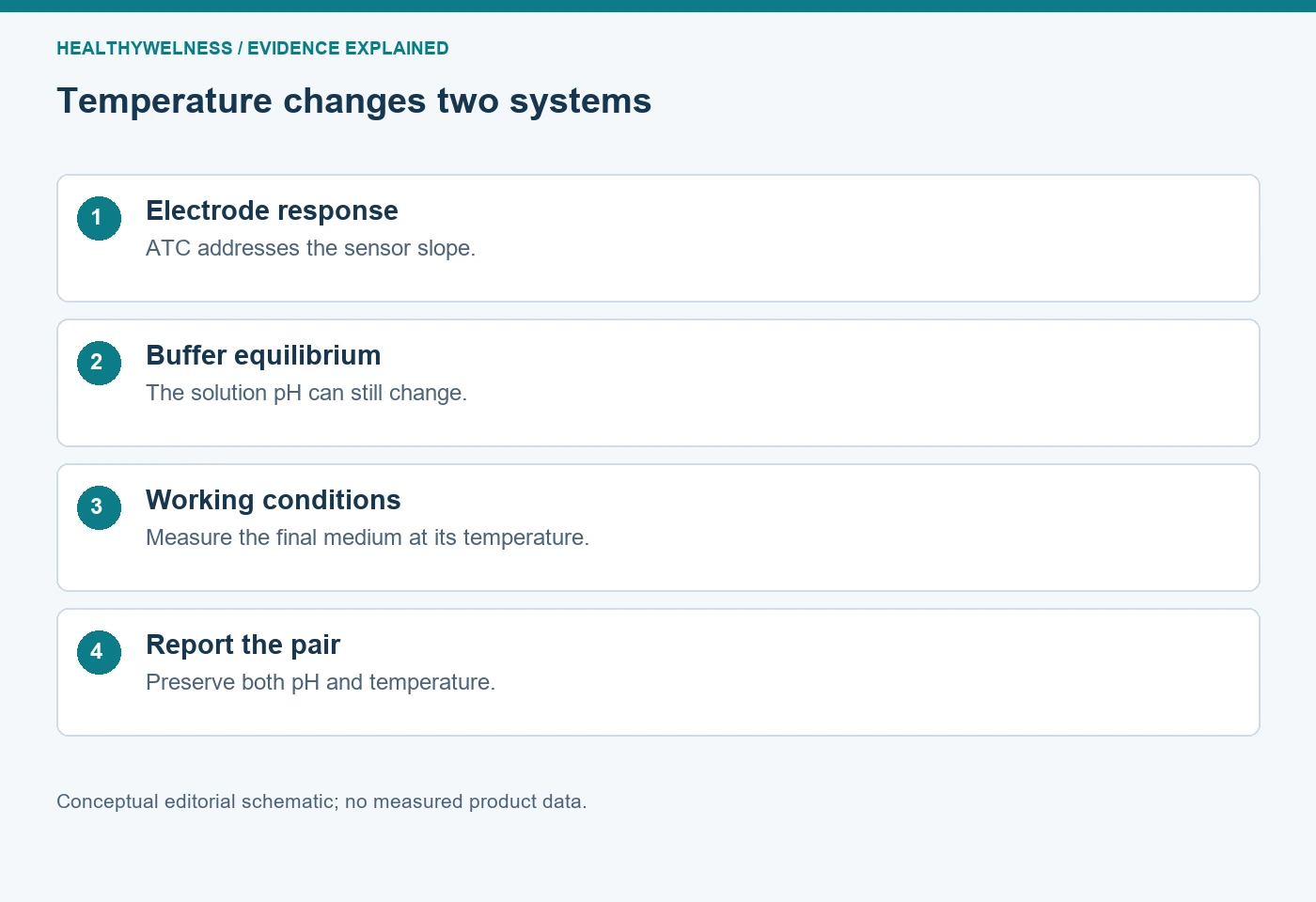
A laboratory measures an assay medium on the bench, transfers it to a temperature-controlled instrument and assumes its pH remains the bench value because the meter displayed an ATC symbol. That assumption confuses the measuring system with the measured solution. A thermometer can help the instrument interpret its electrode, but it cannot prevent a chemical equilibrium from responding to warming.
The Thermo Scientific pH Measurement Handbook separates temperature effects on electrode slope from temperature effects on buffer and sample equilibria. It also describes transient drift while the electrode, temperature sensor and sample reach compatible thermal conditions. These distinctions explain why both the displayed temperature and a stable measurement context matter. The manufacturer specifically cautions that an unknown sample cannot generally be converted to a reference-temperature pH by ordinary meter compensation. [1]
Three statements therefore have different meanings: the electrode response has been compensated at the measured temperature; the calibration buffers have known values at that temperature; and the assay medium has a particular pH at that temperature. The first two support a measurement. Neither supplies the third without a suitable sample observation or justified model.
| Question | Relevant information | Limit |
|---|---|---|
| How does the sensor respond? | Electrode slope and temperature | Not sample chemistry |
| What is the reference value? | Calibration buffer table | Applies to that standard |
| What is the assay condition? | Final medium at working temperature | Specific to that preparation |
| Has the reading settled? | Time and thermal equilibration | Not proof of chemical stability |
The buffer equilibrium has its own temperature dependence
For a simplified weak-acid buffer, the Henderson–Hasselbalch relation is pH = pKa + log10(base/acid). This model makes an important distinction visible: even if the composition ratio is preserved, a temperature-dependent pKa can change the calculated pH. No addition of strong acid or base is required for that model change. A temperature-related shift is therefore compatible with an otherwise closed preparation.
MilliporeSigma’s Buffer Reference Center presents pKa values at several temperatures and a Tris preparation table with temperature-specific pH values. Its biological-buffer brochure likewise tabulates temperature coefficients. The tables demonstrate buffer-specific behavior rather than a single correction for every solution. Their conditions and formulation remain part of the information. A coefficient taken from one table should not be silently transferred to a complex medium or treated as an exact measurement of it. [2,3]
This issue differs from buffer capacity. Capacity concerns resistance to an imposed acid or base perturbation. Temperature dependence concerns how the equilibrium changes as temperature changes. A preparation can have substantial reserve against an acid load and still have a temperature-dependent pH. Increasing its concentration does not logically remove the temperature dependence of its equilibrium constant.
Nor does a peptide’s isoelectric point solve the problem. The isoelectric point describes a molecular charge-balance condition under a stated model or measurement. It does not identify the temperature trajectory of the surrounding medium. Peptide charge, buffer pH and electrode performance belong in related but separate parts of the reasoning.
A hypothetical temperature shift shows what ATC cannot fix
Invented worked example: assume a model buffer has pKa 7.50 at 25 °C and a constant temperature coefficient of −0.020 pKa units per °C over the interval considered. Stipulate a base-to-acid ratio of one, ideal behavior and no changes in volume, composition or other equilibria. These are teaching assumptions, not specifications for a named reagent.
At 25 °C, log10(1) is zero, so the calculated pH is 7.50. At 35 °C the assumed pKa is 7.50 − 0.020 × 10 = 7.30; the model pH is consequently 7.30. At 15 °C the corresponding calculation gives 7.70. A correctly functioning compensated meter would be expected to follow the actual solution condition, rather than force every observation to 7.50.
| Temperature | Assumed pKa | Base/acid | Calculated pH |
|---|---|---|---|
| 15 °C | 7.70 | 1.00 | 7.70 |
| 25 °C | 7.50 | 1.00 | 7.50 |
| 35 °C | 7.30 | 1.00 | 7.30 |
The arithmetic isolates one mechanism. Actual mixtures can depart from it because of activities, multiple proton-binding species, changes introduced during mixing or a coefficient that is not constant across the interval. The correct lesson is to define and measure the relevant condition. It is not to subtract this invented coefficient from every laboratory reading.
Comparing temperatures can change more than one variable
Suppose two peptide-assay signals differ between cool and warm conditions. Temperature can influence the process under study, while the medium’s pH may also differ. Observing a signal difference does not reveal how much each contributed. The experiment has changed temperature deliberately, but it may have changed a second influential condition at the same time.
One comparison can preserve the same prepared formulation across temperatures and report the resulting pH values. That answers a question about the formulation under those conditions. Another comparison can evaluate media adjusted to a common pH at their respective working temperatures. That addresses a different question and introduces its own composition changes through adjustment. Neither comparison is automatically superior; the claim determines which design is informative.
A particularly misleading comparison adjusts one preparation warm and another cold, labels both simply “pH 7.5,” and later uses both at one shared temperature. Their matching labels do not establish matching composition or final pH. Preserve the adjustment temperature separately from the measurement temperature and the assay temperature. Those stages need not coincide.
- State whether the comparison preserves formulation or preserves working-temperature pH.
- Record adjustments and final ionic composition when they differ.
- Keep a measured signal separate from a proposed pH-mediated explanation.
- Describe unmeasured working conditions as unknown rather than reconstructing them from a stock label.
Make the measurement representative of the final medium
The buffer before mixing is an input to an assay. The final medium may additionally contain peptide stock, substrate, cofactors, salts and solvent. A temperature-specific reading on the buffer alone cannot establish that these additions leave the final condition unchanged. A useful record identifies which stage was measured and how it relates to the actual reaction.
Small volumes can complicate direct measurement. If a separate representative preparation is used, preserve its relevant composition and temperature history and disclose that it represents the assay rather than being a direct observation of every well. Scaling up solely to accommodate an electrode may change equilibration or gas exchange; those limitations belong with the inferred value.
Thermal equilibration also deserves an explicit observation window. A drifting number just after transfer can combine sensor lag, sample-temperature gradients and genuine solution changes. Choosing the first convenient reading or waiting for an arbitrary interval does not independently separate these causes. Establish the method’s criteria for a usable reading and retain the temperature at that point.
A concise report might say that pH was measured in the complete nonreacting assay medium at the working temperature, using a stated calibration system after the reading met the method’s stability criterion. That sentence is more reproducible than “pH checked with ATC.” It still does not claim the medium remains unchanged throughout the experiment.
Use temperature information without inventing a stability claim
A measured pH shift is evidence about the medium, not direct evidence of peptide degradation. A matching pH value likewise does not prove intact sequence, unchanged assembly state or preserved assay performance. Those claims require their own measurements. Separate the environmental condition from the molecular endpoint.
The source tables are technical references for defined buffer systems. They do not validate a universal assay pH, demonstrate compatibility with a particular peptide or establish a storage duration. Their strongest contribution here is showing why temperature belongs in the reported condition and why compensation cannot replace knowledge of the sample.
Read buffer capacity versus pH for acid-load behavior and peptide isoelectric point versus pH for charge interpretation. The peptide concentration calculator supports nominal mass–volume arithmetic; it cannot calculate a complex medium’s temperature-dependent pH.
Frequently asked questions
Does ATC turn every pH reading into a value at 25 °C?
Ordinary electrode temperature compensation does not establish an unknown sample’s pH at 25 °C. A reference-temperature conversion would require a justified sample-specific relationship and clear reporting of that additional calculation.
Can a buffer change pH without becoming contaminated?
Yes. Temperature-dependent acid–base equilibria can change pH without introducing contamination. A changing reading still needs evaluation because thermal lag and other chemical changes can also contribute.
Will a higher buffer concentration prevent the shift?
Higher concentration may change resistance to an acid or base load. It does not by itself remove temperature dependence of the buffer equilibrium or establish an unchanged working-temperature pH.
Should the stock or the final assay medium be measured?
Identify the condition relevant to the claim. A stock measurement characterizes that stock; establishing final assay conditions requires evidence representative of the complete medium at the relevant temperature.
Does the same pH guarantee the same peptide response?
No. Temperature, buffer identity, ionic composition and other experimental conditions remain relevant. Equal pH supports one aspect of comparability without establishing equivalent molecular behavior or detection.
References
- Thermo Scientific. pH Measurement Handbook. pH theory and pH versus temperature theory, printed pages 4–5.
- MilliporeSigma. Buffer Reference Center. Temperature-specific pKa and Tris tables.
- MilliporeSigma. High-Purity Biological Buffers from Bench to Bulk Volumes. Buffer portfolio and selection tables.
For laboratory research use only. The compounds discussed are not approved for human or veterinary use and are not drugs, foods or cosmetics. This article summarises published research and is not medical advice.
Cover and evidence map: original conceptual editorial schematics, not measured results, exact molecular structures, or photographs of HealthyWelness facilities.
Sources
- Thermo Scientific. pH Measurement Handbook. pH theory and pH versus temperature theory, printed pages 4–5.
- MilliporeSigma. Buffer Reference Center. Temperature-specific pKa and Tris tables.
- MilliporeSigma. High-Purity Biological Buffers from Bench to Bulk Volumes. Buffer portfolio and selection tables.