Peptide DMSO Carryover: Matching Solvent in Assays
Track DMSO in peptide research assays, identify concentration–solvent confounding and understand what matched vehicle controls can establish.

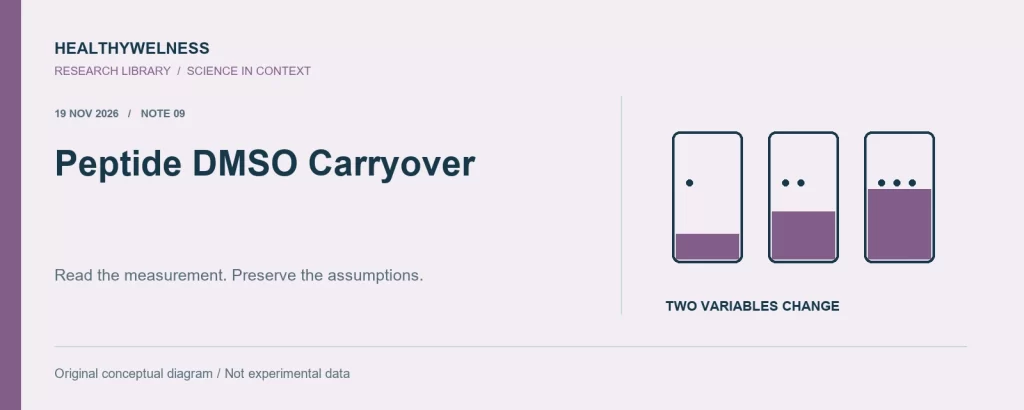
DMSO carried from a peptide stock is a component of the final assay medium, and its fraction can become confounded with peptide concentration. Calculate the final solvent contribution from every addition, evaluate compatibility in the actual assay and use appropriately matched solvent comparisons. A concentration-dependent signal alone cannot distinguish peptide behavior from a solvent effect when both vary together.
For laboratory research use only. The compounds discussed are not approved for human or veterinary use and are not drugs, foods or cosmetics. This article summarises published research and is not medical advice.
- Final DMSO percentage depends on transferred solvent volume and total final volume, not the peptide concentration label alone.
- Changing the transfer volume from one stock changes both peptide and solvent amounts.
- Matching solvent removes one source of confounding but does not establish peptide solubility or an interference-free readout.
- No universal tolerated DMSO percentage follows from the word peptide or from a single published assay.
A stock solvent becomes part of the experiment
A peptide concentration series is often described only by the nominal peptide amount in each well. If the series is made by transferring different volumes of a DMSO-containing stock, the wells also receive different amounts of DMSO. That creates two linked experimental changes. A smooth curve can then reflect the intended material, the solvent or an interaction between them.
This problem is a composition-accounting issue before it becomes a curve-fitting issue. Replicating each well precisely can produce a highly reproducible confounded curve. A narrow confidence interval describes the precision of the measured relationship; it does not identify which co-varying component caused it.
The Assay Guidance Manual’s histone-acetyltransferase chapter recommends assessing the compound solvent in the assay and keeping its amount constant across compound concentrations. This is assay-development guidance, not evidence that one fixed DMSO percentage is universally compatible. Its practical contribution is to make solvent composition an explicit part of the comparison. [1]
| Quantity | How it is established | What remains unknown |
|---|---|---|
| Nominal peptide | Stock amount and dilution | Available dissolved target |
| Final DMSO fraction | All solvent contributions | Assay compatibility |
| Vehicle response | Solvent-matched comparison | Peptide–solvent interaction |
| Detected signal | Specified readout | Unique molecular cause |
Calculate the final solvent fraction from every addition
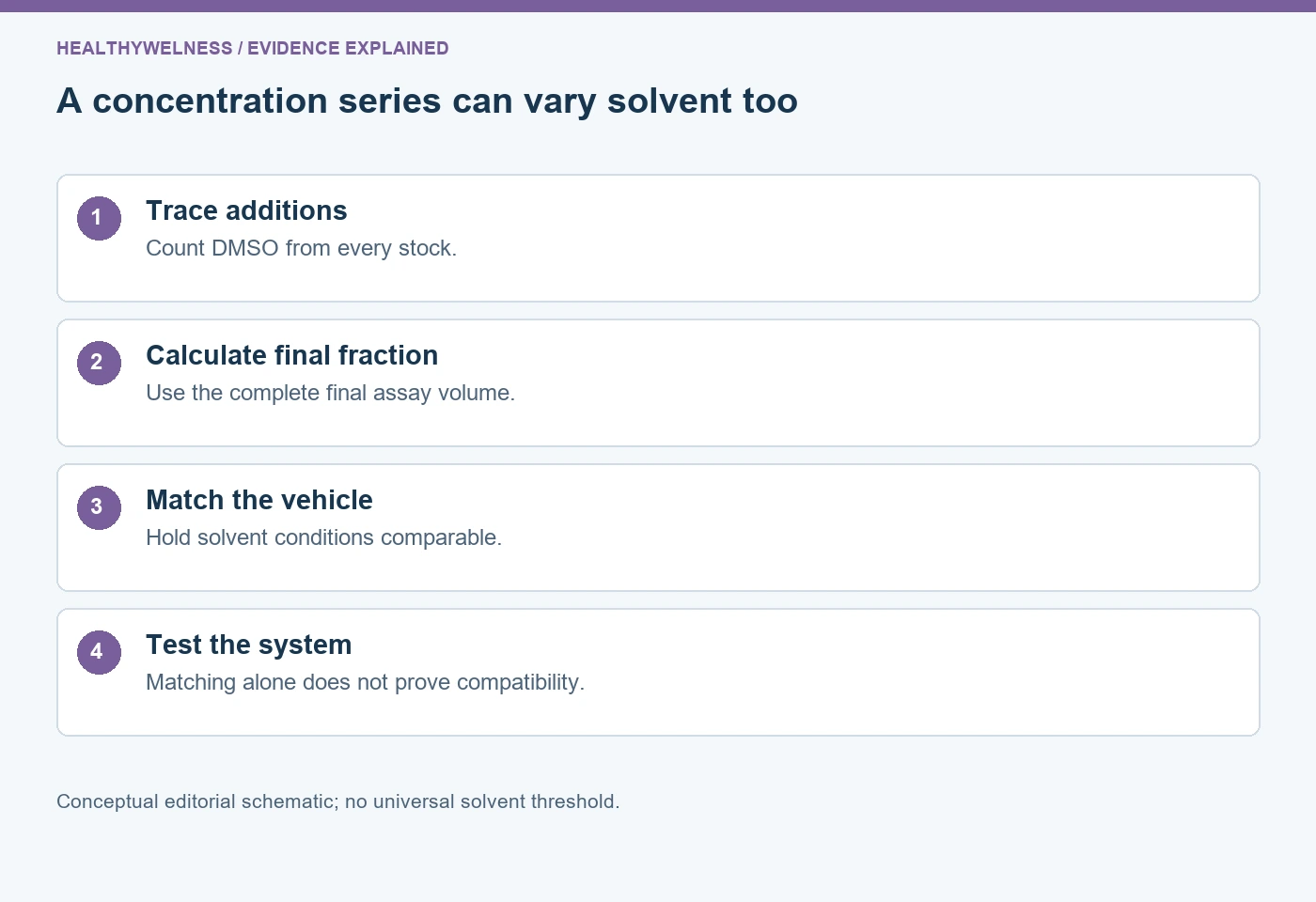
For ordinary nominal volume accounting, the DMSO volume contributed by an addition equals its transfer volume multiplied by its DMSO volume fraction. Sum the contributions from peptide stock, substrate stock and any other DMSO-containing component. Divide by the final assay volume and multiply by 100 to express the nominal percentage by volume.
The denominator is the complete final volume, including the additions. If a preparation receives stock on top of a pre-existing volume, using the pre-addition volume silently changes the definition. The volume convention should be suitable for the method; this simple bookkeeping is not a high-precision model of mixture volume contraction.
Track the solvent through intermediate dilutions. A stock diluted into aqueous medium has a different solvent fraction from the original stock, whereas serial dilution in the same DMSO medium can preserve it. The phrase “tenfold diluted stock” is incomplete unless the diluent and solvent fraction are known.
Also distinguish a specified amount from a measured condition. Arithmetic can establish the nominal contribution under the stated preparation assumptions. It cannot establish that the peptide remained dissolved, that the stock concentration was correct or that the solvent had no effect on the biological or detection system.
A hypothetical series confounds peptide and DMSO
Invented worked example: assume a 1 mM peptide stock prepared in nominally 100% DMSO, quantitative transfer and a final assay volume of 100 µL. Transfers of 0.10, 0.50 and 1.00 µL yield nominal peptide concentrations of 1, 5 and 10 µM. They simultaneously yield DMSO fractions of 0.10%, 0.50% and 1.00% by volume.
| Stock transferred | Final peptide | Final DMSO | Variables changed |
|---|---|---|---|
| 0.10 µL | 1 µM | 0.10% | Peptide and solvent |
| 0.50 µL | 5 µM | 0.50% | Peptide and solvent |
| 1.00 µL | 10 µM | 1.00% | Peptide and solvent |
These volumes and concentrations are arithmetic teaching inputs, not practical transfer recommendations. Very small transfers require equipment and methods appropriate to their uncertainty. The example intentionally assumes perfect transfer so that the composition problem can be seen independently of pipetting limitations.
Suppose the measured signal declines across those wells. Comparing all wells to a single solvent-free reference does not isolate a peptide effect because the reference does not match their solvent conditions. A solvent-only series at the corresponding fractions can investigate solvent behavior, although it cannot fully reproduce a possible interaction between solvent and peptide.
A different experimental design could vary stock peptide concentration while holding stock solvent fraction, transfer volume and total final volume constant. The resulting final solvent fraction would then be constant across the peptide series. That resolves the specific co-variation in this example if the preparations are valid. It still requires compatibility and solubility evidence at the chosen final condition.
Published enzyme studies show why tolerance is system-specific
Misuri and colleagues studied DMSO in aldose-reductase inhibition experiments. Their 2017 abstract reports that DMSO’s effects depended on which substrate transformation was examined, including different apparent inhibition behavior and an unaffected transformation. The study concerns specified enzyme–substrate systems; it does not assign the same behavior to research peptides or establish a universally inert solvent level. [2]
A separate original study by Pasha and colleagues examined human N-myristoyltransferase with peptide substrates. The retrieved abstract passages report DMSO-associated stimulation with a pp60src-derived peptide substrate and a dependence on substrate context. This is a useful counterexample to the assumption that solvent effects always mean inhibition. Only those passages and the publisher’s accessible summary were assessed here; no general concentration threshold is inferred. [3]
Together these examples support a narrow conclusion: the direction and meaning of a solvent effect depend on the measured system. A solvent percentage compatible with one enzyme, substrate, reporter and incubation cannot be automatically imported into another. Nor does a solvent-free condition necessarily define the most informative assay if the material cannot remain comparably available there.
Compatibility is consequently an operational conclusion tied to endpoints and tolerances. A solvent comparison might preserve baseline signal while changing dynamic range or time dependence. Another might preserve a reporter but alter the reaction under study. Define what must remain adequate for the research question before describing the medium as compatible.
Matched vehicle controls answer a limited causal question
A vehicle control contains the relevant solvent contribution without the test material, as far as the comparison can achieve that match. It provides a reference for the solvent-containing matrix. A medium-only reference can separately show how adding that vehicle changes the system. The two comparisons answer different questions and should be named clearly.
If all peptide conditions contain the same nominal DMSO fraction, a common matched vehicle reference can support a cleaner comparison than an unmatched solvent-free reference. However, matching does not prove that solvent and peptide act independently. A peptide may behave differently at that solvent fraction than in another medium, and that dependence can be part of the observed phenomenon.
Subtracting the solvent-only response requires a model in which the relevant contributions add appropriately. A nonlinear interaction, altered availability or changed detector response can make simple subtraction misleading. Report the measured references and justify any transformation used to derive a peptide-associated quantity.
- Use the complete final vehicle composition in the reference.
- Preserve relevant timing and addition history when they affect interpretation.
- Separate a vehicle comparison from a detection-focused interference comparison.
- State whether conclusions apply only within the tested solvent environment.
Availability and readout remain separate after solvent matching
Dilution into aqueous medium can create a preparation different from the stock. A clear stock does not prove the intended dissolved concentration remains available after transfer. Conversely, a changed assay signal does not prove precipitation. Evaluate the actual uncertainty instead of using solvent matching as a substitute for molecular or physical evidence.
The handling history can matter even when final arithmetic matches. Two preparations can reach the same nominal peptide and DMSO concentrations through different intermediate conditions. This article does not claim those routes will necessarily behave differently; it explains why identical final labels alone cannot demonstrate that their molecular states are equivalent.
A detection control addresses whether the medium changes the relationship between the measured species and the signal. A reaction control addresses the process generating that species. A quantitative recovery measurement addresses target availability within its method’s scope. Combining these observations can narrow explanations more effectively than repeatedly fitting the same concentration-response data.
Preserve final solvent percentage, stock solvent fraction, transfer scheme, total volume, timing and the definition of each reference in the research record. If a publication omits the solvent fraction, keep it unknown. Do not reconstruct it from a familiar stock concentration or assume that all authors used the same preparation convention.
Read serial dilution and uncertainty, kinetic versus thermodynamic solubility and controls in peptide experiments for the neighboring questions. The peptide concentration calculator checks nominal mass–volume relationships; a solvent ledger and assay-specific evidence are still needed.
Frequently asked questions
Is a small DMSO percentage automatically harmless to an assay?
No universal harmless percentage follows from a volume fraction alone. Compatibility depends on the reaction, sample, detection system, timing and the criteria relevant to the experiment.
Can peptide concentration rise while DMSO stays constant?
Yes. A design can vary peptide stock concentration while preserving solvent fraction, transfer volume and final volume. The actual stock preparations and resulting dissolved material still need to be suitable.
Does a solvent-only series remove every solvent artifact?
No. It helps characterize the solvent’s effect without test material. It does not automatically reproduce peptide–solvent interactions or validate simple subtraction of solvent and peptide responses.
Should DMSO from the substrate stock be counted?
Yes. Nominal final solvent accounting includes every DMSO-containing addition. Counting only the peptide stock can underestimate the final fraction and mismatch the vehicle reference.
Does constant DMSO prove every concentration stayed dissolved?
No. Constant solvent composition removes one changing variable. Solubility, recovery and molecular state remain separate questions requiring evidence appropriate to the final preparation.
References
- Gadhia S, et al. Histone Acetyltransferase Assays in Drug and Chemical Probe Discovery. Assay Guidance Manual. Updated July 1, 2018. Compound Solvent section.
- Misuri L, et al. The use of dimethylsulfoxide as a solvent in enzyme inhibition studies: the case of aldose reductase. J Enzyme Inhib Med Chem. 2017;32(1):1152–1158. PMID: 28856935.
- Pasha MK, et al. Enhanced activity of human N-myristoyltransferase by dimethyl sulfoxide and related solvents in the presence of serine/threonine-containing peptide substrates. Biochem Pharmacol. 2002. PMID: 12417259.
For laboratory research use only. The compounds discussed are not approved for human or veterinary use and are not drugs, foods or cosmetics. This article summarises published research and is not medical advice.
Cover and evidence map: original conceptual editorial schematics, not measured results, exact molecular structures, or photographs of HealthyWelness facilities.
Sources
- Gadhia S, et al. Histone Acetyltransferase Assays in Drug and Chemical Probe Discovery. Assay Guidance Manual. Updated July 1, 2018. Compound Solvent section.
- Misuri L, et al. The use of dimethylsulfoxide as a solvent in enzyme inhibition studies: the case of aldose reductase. J Enzyme Inhib Med Chem. 2017;32(1):1152–1158. PMID: 28856935.
- Pasha MK, et al. Enhanced activity of human N-myristoyltransferase by dimethyl sulfoxide and related solvents in the presence of serine/threonine-containing peptide substrates. Biochem Pharmacol. 2002. PMID: 12417259.