Peptide DVS: Humidity Paths and Sorption Hysteresis
Read peptide research DVS curves through humidity history, reference mass and equilibration, separating hysteresis from water-content measurements.

Dynamic vapor sorption measures how a peptide powder’s mass responds to a defined humidity history; a water-content result describes a sampled state. An uptake–release loop can reveal path dependence that a single moisture percentage cannot show. Interpreting that loop requires the reference mass, temperature, equilibration rule and exposure sequence, together with evidence about any proposed physical or chemical change.
For laboratory research use only. The compounds discussed are not approved for human or veterinary use and are not drugs, foods or cosmetics. This article summarises published research and is not medical advice.
- DVS records mass change while a solid is exposed to controlled vapor conditions.
- Sorption and desorption branches compare material reached through different humidity histories.
- A DVS reference mass is an operational denominator, not automatically an anhydrous peptide mass.
- Humidity-path hysteresis alone does not identify irreversible chemical degradation.
A moisture snapshot cannot describe an exposure path
Two portions of the same research powder might begin with the same measured water fraction and still respond differently when opened to humid air. Their particle structure, previous drying history or solid form could differ. Alternatively, they may ultimately approach similar mass changes but take different times to do so. A snapshot does not distinguish these possibilities because it contains no record of the approach to that state.
Surface Measurement Systems defines DVS as gravimetric observation under controlled humidity or vapor concentration. The balance follows mass over time while the surrounding environment changes. This is the central measurement definition, rather than a claim that every recorded milligram is water or that one instrument directly establishes storage lifetime. [1]
| Question | Useful observation | Remaining boundary |
|---|---|---|
| Water now? | Water-specific assay | One sampled state |
| Humidity response? | Mass versus RH | Temperature and path |
| How quickly? | Mass versus time | Geometry and stopping rule |
| Same return state? | Return-path comparison | Cause still unassigned |
The existing Karl Fischer water-content discussion addresses water-specific chemistry, blanks and reporting bases. DVS asks an additional question: how the specimen responds to an imposed atmosphere. A properly designed comparison can connect these observations, but substituting one label for the other discards the distinction that makes them useful.
The reference mass determines every percentage
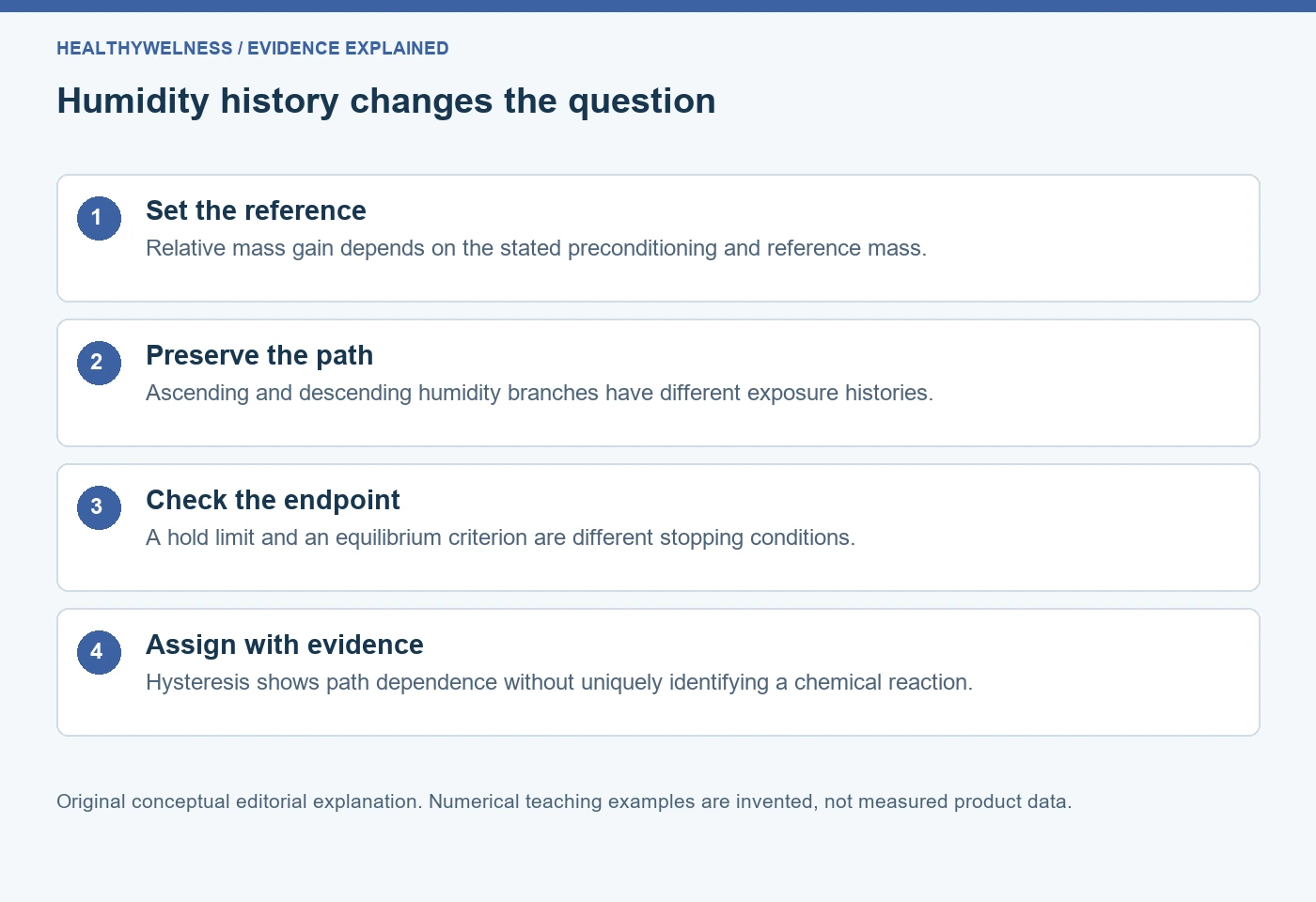
Let m0 be the mass selected as the DVS reference and m be the mass at a later observation. Define relative gain as 100(m − m0)/m0. This calculation describes change relative to m0. If the reference still contains water, the calculation remains valid as a relative mass change, but calling it absolute dry-basis water content adds an unsupported interpretation.
Preconditioning therefore belongs to the result. A reference after a particular low-humidity hold may differ from the as-received state. Drying can remove volatile material or alter physical structure; the fact that the balance eventually becomes quiet does not chemically identify everything that left. Preserve the initial mass and the chosen reference separately rather than treating their difference as a correction that needs no explanation.
Even the word dry needs a definition. An operationally dried specimen has undergone stated conditions. It need not be a hypothetical water-free peptide with unchanged counterions and morphology. A comparison between laboratories becomes difficult when one reports change from the received powder and another reports change from a preconditioned residue while both use the heading moisture uptake.
- Name the material and its counterion or formulation where established.
- Record the received state, preconditioning and reference-mass convention.
- Retain temperature and the order of relative-humidity steps.
- Preserve the time trace as well as the selected endpoint values.
An invented loop makes the denominator and path visible
All values in this teaching example are invented. Assume a stable reference mass of 10.000 mg and no non-water mass exchange. At 40% RH on an ascending humidity sequence, the recorded endpoint is 10.400 mg. After visiting 70% RH, the descending sequence reaches 40% RH with an endpoint of 10.650 mg. Temperature and the endpoint rule are held the same.
The ascending gain is 100 × 0.400/10.000 = 4.00%. The descending gain is 100 × 0.650/10.000 = 6.50%. Their separation is 2.50 percentage points, corresponding to 0.250 mg on this reference. It is not a 2.50% increase relative to the ascending gain: that relative increase would be 62.5%. Both descriptions can be calculated, but they answer different arithmetic questions.
| Observation | Mass | Gain from reference |
|---|---|---|
| Reference | 10.000 mg | 0.00% |
| 40% RH ascending | 10.400 mg | 4.00% |
| 40% RH descending | 10.650 mg | 6.50% |
| Return to initial RH | 10.050 mg | 0.50% |
The final 0.050 mg residual deserves investigation, but it does not identify a degradation product. The sample may not have fully equilibrated, water may remain differently associated, a physical transformation may have occurred, or the measurement may contain a baseline contribution. The hypothetical assumption that only water changes mass narrows this example; a real sample needs evidence supporting that assumption.
Burnett and colleagues’ 2015 application note explicitly compares sorption and desorption on the same specimen and uses their separation to discuss hysteresis. Its illustrated systems include starch and pharmaceutical materials. The note supports the path-comparison principle; it does not supply the invented masses above or a universal hysteresis limit for peptide powders. [2]
A flat-looking endpoint needs a time rule
A humidity step does not make the specimen instantaneously equilibrate. Gas conditions, material transport and structural relaxation have their own time scales. Selecting the last point after an arbitrary hold produces a time-defined endpoint. Calling that endpoint equilibrium requires adequate evidence that the relevant remaining change is small enough for the intended interpretation.
Imagine an invented trace that gains 0.200 mg in the first ten minutes and a further 0.080 mg over the next fifty minutes. A short hold and a longer hold would produce different isotherm points from the same initial specimen. Their disagreement could arise from incomplete approach to a state, without requiring a different chemical composition. A maximum hold reached before the selected mass-change criterion should remain identifiable in the record.
TA Instruments’ TA375 technical note describes isothermal humidity steps with equilibration and warns that continuous ramps should be slow enough to approach equilibrium. Its sucrose examples show why rate and temperature can change which events become visible. These are material-specific demonstrations, not transferable RH thresholds for peptides. [3]
The practical comparison is to examine whether longer holds or a different rate materially change the feature being interpreted. Agreement across a limited set of histories strengthens a bounded conclusion. It cannot establish equilibrium for every possible time scale, especially when a sample is slowly reorganizing while vapor exchange continues.
Hysteresis narrows the question without naming the mechanism
A branch separation establishes that the selected observations depend on the route under those conditions. It can motivate hypotheses about retained water, metastable states, pore-related behavior or a humidity-induced transformation. Those hypotheses make different predictions, so the next measurement should be chosen to separate them. Merely assigning a familiar mechanism to a loop shape is weaker than testing one of its consequences.
For example, compare a second humidity sequence with the first. A changed second sequence supports an effect of prior exposure on the subsequent response. It does not by itself specify whether the effect is chemical or physical. A matching second sequence would show reproducibility of the observed path under those conditions, while still allowing reversible path dependence within each sequence.
A structural comparison across the exposure can address solid-form change. A chemical assay can address intact peptide and degradation products. A water-specific assay can examine the compositional meaning of a mass endpoint. These measurements complement the humidity experiment because each has a different observation target. None should be presented as an automatic confirmation merely because it produces another precise number.
Translate the experiment into a bounded handling decision
A DVS trace can help frame an exposure comparison for the material tested. It does not reproduce a sealed vial, its headspace or its packaging barrier. An open specimen continuously contacted by a controlled gas stream has different transport conditions from powder behind a closure. Transferring a response directly into a shelf-life estimate ignores those differences.
Similarly, the sample pan and powder distribution matter when comparing time traces. A thinly spread portion and a deeper bed can expose different effective paths for transport. A slower response should not immediately become a molecular diffusion coefficient unless the geometry and transport model justify that calculation. Report the directly observed kinetics before assigning a material constant.
The powder-transfer mass-balance article explains how atmospheric exchange can affect handling weighings. DVS offers a controlled way to investigate a related exposure question; it does not retrospectively correct an undocumented transfer. Keep actual opening history with the preparation record.
Use the COA lookup to locate available documentation and check which solid-state or water measurements are actually reported. This article asserts no DVS characterization of catalog materials. No exposure duration, humidity acceptance threshold or storage period is prescribed here.
Frequently asked questions
Can a KF water percentage predict a DVS curve?
No. A water-content measurement describes a sampled state. The humidity response additionally depends on the material, temperature, path and measurement conditions.
Does hysteresis prove irreversible peptide degradation?
No. A branch separation establishes path dependence under the selected conditions. Assigning chemical degradation requires suitable chemical evidence.
Is the low-humidity reference automatically water-free?
No. The reference is established by the stated preconditioning procedure. Its remaining water and other components need independent assessment if an absolute composition is claimed.
Can a maximum hold be reported as equilibrium?
Only with justification appropriate to the question. If the stopping criterion was not reached, retain that fact and describe the result as a time-defined endpoint.
Can DVS establish a sealed-vial shelf life?
Not by itself. Open-pan vapor exposure differs from a packaged system, and storage claims require relevant packaging, time and chemical or physical endpoints.
References and access scope
- Surface Measurement Systems. Dynamic Vapor Sorption (DVS). Undated technical overview. Measurement definition and methodology read.
- Burnett D, Garcia AR, Naderi M, Acharya M. Moisture Sorption Properties of Pharmaceutical Materials Studied by DVS. Application Note 101. Version 1.0, 27 August 2015. Method, hygroscopicity and hysteresis sections read.
- TA Instruments. Characterization Techniques to Assess the Stability of Amorphous Materials Using Vapor Sorption Analysis. TA375. Undated technical note. Experimental and conclusions sections read.
Sources accessed 25 November 2026. Manufacturer technical guidance explains measurement principles; its examples are not peptide product measurements.
For laboratory research use only. The compounds discussed are not approved for human or veterinary use and are not drugs, foods or cosmetics. This article summarises published research and is not medical advice.
Cover and evidence map: original conceptual editorial schematics, not measured results, exact molecular structures, or photographs of HealthyWelness facilities.
Sources
- Surface Measurement Systems. Dynamic Vapor Sorption (DVS). Undated technical overview. Measurement definition and methodology read.
- Burnett D, Garcia AR, Naderi M, Acharya M. Moisture Sorption Properties of Pharmaceutical Materials Studied by DVS. Application Note 101. Version 1.0, 27 August 2015. Method, hygroscopicity and hysteresis sections read.
- TA Instruments. Characterization Techniques to Assess the Stability of Amorphous Materials Using Vapor Sorption Analysis. TA375. Undated technical note. Experimental and conclusions sections read.