Peptide Mixing Order: Local Conditions and Final Recipes
Examine peptide research mixing history, why equal final recipes can hide different local conditions and how to test a preparation-path effect.

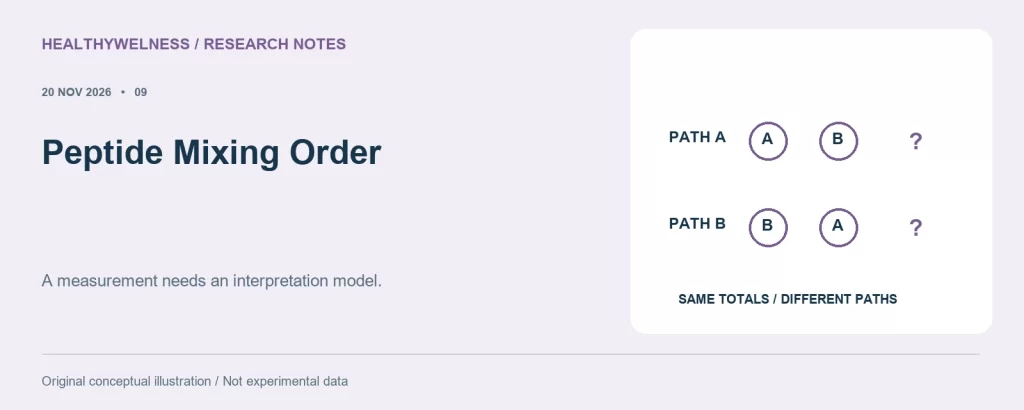
Two peptide preparations can have the same final composition yet reach it through different local conditions during mixing. Order of addition, transfer location and mixing time can alter transient concentration, solvent and pH gradients. Whether those differences persist depends on the material’s kinetics; final concentration arithmetic alone cannot establish an equivalent molecular state.
For laboratory research use only. The compounds discussed are not approved for human or veterinary use and are not drugs, foods or cosmetics. This article summarises published research and is not medical advice.
- Final composition describes an endpoint recipe; mixing history describes the route to that endpoint.
- Published peptide-material studies demonstrate that solvent and pH gradients can participate in self-assembly.
- A mixing-order effect is a testable hypothesis for a research preparation, not a universal property of every peptide.
- A different signal after a preparation change does not identify aggregation, chemical damage or detector interference by itself.
The final recipe does not describe the first contact
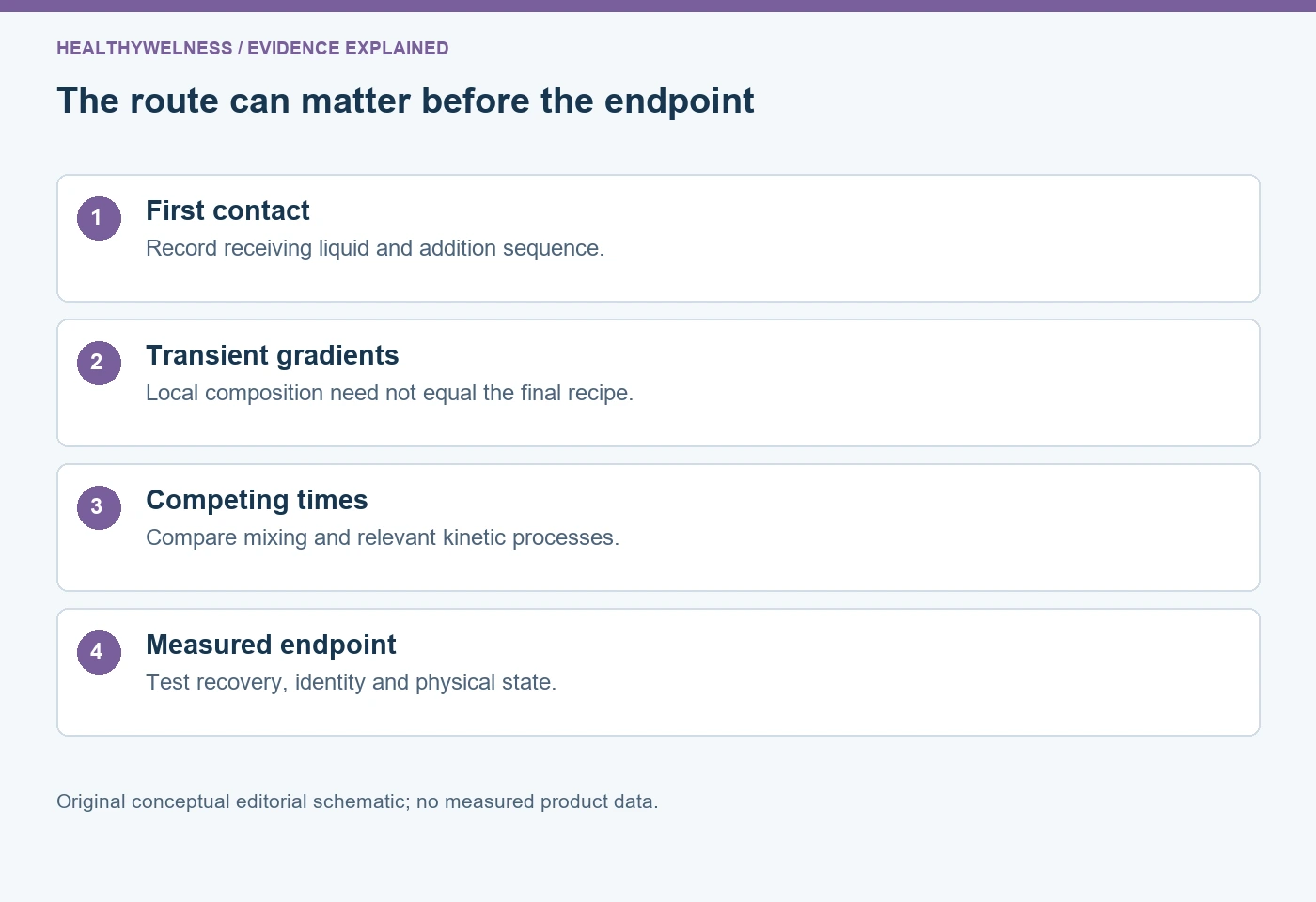
When a concentrated stock first contacts a receiving liquid, the stock has not instantly become a uniform fraction of the final volume. A neighborhood around the addition initially differs from more distant parts of the vessel. Diffusion and bulk movement then redistribute material. A final concentration calculation describes the intended uniform endpoint under its assumptions, while the evolving local conditions require a separate description.
This distinction is especially useful when transferring a published preparation. “Combine A and B” may specify ingredients but omit which liquid receives the other, how quickly they are combined and when the observation clock begins. A researcher can reproduce the final recipe precisely while leaving the initial contact conditions uncertain.
| Preparation feature | Information it preserves | What it cannot establish alone |
|---|---|---|
| Final composition | Nominal endpoint amounts | Earlier local conditions |
| Addition order | Sequence of first contact | Complete mixing time |
| Mixing method | How material is redistributed | Unchanged target state |
| Elapsed time | Observation stage | Equilibrium attainment |
The neighboring DMSO carryover guide asks how much solvent remains in the final assay. This article asks a different question: what happens along the route to that final composition, and how could a preparation comparison test whether the route matters?
Compare mixing time with the time of the relevant process
Path dependence becomes plausible when some relevant process occurs before the local environment has become uniform. Possibilities include nucleation, association, precipitation or a chemical reaction. If redistribution is much faster than the process of interest, transient gradients may have little lasting consequence. If the process is competitive with redistribution, a final uniform recipe may conceal an earlier event.
This is a conceptual comparison of timescales, not a universal numerical rule. A vessel’s visible uniformity does not provide a measured microscopic mixing time. Likewise, a rapid optical response may reflect the reporter rather than the material state. The useful question is whether the preparation supplies enough evidence to connect mixing history to the endpoint being interpreted.
A reversible association can also relax after mixing. Two routes might produce different early observations but converge later. A persistent difference would invite further investigation of slowly relaxing states or irreversible changes. Neither outcome should be assumed simply because the sequence is described as self-assembling, hydrophobic or short.
It is therefore helpful to distinguish three clocks: time from initial contact, time from the end of the stated mixing operation, and time from any later transfer into the measurement system. Comparing a sample at one clock time with another at a different definition can create apparent disagreement without an actual contradiction.
Published peptide-material examples establish plausibility, with limits
Li and colleagues reported insect-cuticle peptides that form nanocapsules during solvent exchange. The original study’s abstract attributes localization and self-assembly to a water–acetone concentration gradient. This directly illustrates a system in which an evolving solvent environment participates in assembly. The evidence used here is the abstract, not a reviewed complete experimental dataset, and it is not a claim that ordinary research-peptide stocks form the same structures. [1]
Krishna Kumar and colleagues studied polymer–dipeptide coacervate droplets containing a functionalized dipeptide. Their experimental and conclusion passages contrast gradual acidification using glucono-δ-lactone with stronger-acid addition. They observed different morphologies and interpreted the transformation in terms of pH gradients and kinetic control. The reagents and chemistry differ between those routes, so the study is not a pure demonstration that addition order alone caused every difference. It shows why the route of a chemical trigger can matter. [2]
Garcia and colleagues reported microfluidic-assisted formation of a heterochiral short-peptide hydrogel with optical waveguiding properties. The publisher’s abstract describes exploring peptide concentration, dyes and flow rate, and obtaining structures difficult to devise under bulk conditions. Only that accessible abstract and publication record support the discussion here. The example concerns a deliberately designed materials system; no flow-rate recommendation is transferred to unrelated peptide assays. [3]
These sources support a narrow proposition: preparation pathways and spatial gradients can be scientifically meaningful in particular peptide systems. They do not prove that reversing two additions changes every peptide, that faster mixing always improves a sample, or that any observed difference necessarily represents self-assembly.
An invented equal-composition comparison isolates the question
Hypothetical arithmetic example: take 0.10 mL of an unnamed peptide stock at 10.0 mg/mL in a nominally pure solvent, and 0.90 mL of aqueous medium. Assume additive volumes, quantitative transfer and no amount loss. Both routes below end with 1.00 mg of target in 1.00 mL and a nominal solvent fraction of 10% by volume.
| Invented route | First receiving liquid | Final target | Final stock solvent |
|---|---|---|---|
| Stock into medium | 0.90 mL aqueous | 1.00 mg/mL | 10% v/v |
| Medium into stock | 0.10 mL stock | 1.00 mg/mL | 10% v/v |
In the first route, a small stock volume initially meets a larger aqueous reservoir. In the second, the stock initially experiences the first increment of aqueous medium while much of the receiving liquid remains stock-like. The final arithmetic is identical, but those descriptions of first contact differ. The example does not assign any actual local concentration or pH because neither is determined by the bulk amounts alone.
Suppose an appropriate measurement later detects different recovered target concentrations. The observation would establish a preparation-associated difference within the tested method. It would not establish its mechanism. Loss to surfaces, excluded particles, a chemical change and altered detector response remain distinguishable possibilities. A more detailed investigation should target those alternatives instead of labeling every decrease as precipitation.
Suppose instead the two routes produce indistinguishable measurements within the method’s uncertainty. That would support comparability for the measured endpoint, material, interval and conditions. It would not establish that the routes are interchangeable at every earlier time or in another vessel size. A useful negative observation has a defined scope.
Design a comparison that can distinguish history from composition
A research comparison should preserve the same intended final amounts while making the preparation difference explicit. If solvent percentage, temperature, vessel material and wait time also change, the comparison no longer isolates addition history. Record these properties even when they appear routine. They make it possible to decide which uncertainty the experiment actually addresses.
- Define each stock’s composition and assigned target concentration.
- Describe receiving liquid, addition sequence, transfer location and addition interval.
- Preserve vessel geometry, fill volume and mixing method sufficiently for the comparison.
- Define the observation clock and sample the relevant time window.
- Retain the measured fraction and analytical recovery alongside the nominal recipe.
Replicating only the detector reading misses preparation variability. Independently prepared samples can assess whether the route produces a reproducible difference. Repeated readings of one preparation assess measurement repeatability for that preparation. Both can be useful, but they answer different questions.
A blank following the same mixing history can investigate preparation-dependent background. A target recovery measurement can examine the amount reaching the analytical method. A chemical identity measurement can address molecular change. A physical-state measurement can address association within its demonstrated capability. No one observation should be asked to establish all four.
A better-looking preparation is not automatically better evidence
Clear appearance does not establish monomeric material or the nominal dissolved concentration. Conversely, visible material may be part of an intended assembly experiment rather than an unwanted impurity. The research question determines which state is relevant. A preparation method should be assessed against that state and its measurement requirements.
More vigorous mixing is also not an independent guarantee of uniformity or preservation. It can change multiple process variables, including contact with interfaces and temperature. A statement such as “mix thoroughly” is difficult to evaluate unless the operation and relevant endpoint are defined. The aim is a reproducible preparation supported by evidence, not the strongest available agitation.
Scale transfer deserves particular care. Matching final concentration while increasing total volume changes the distances over which material must redistribute and can change the mixing pattern. Matching nominal revolutions or an arbitrary number of inversions does not demonstrate matched local history. An appropriately scoped comparison is needed when the scientific conclusion depends on preserving a particular state.
The kinetic versus thermodynamic solubility guide explains why preparation and elapsed time belong with a solubility claim. The serial dilution guide separately addresses ratio arithmetic and uncertainty. Use the peptide concentration calculator for nominal mass–volume relationships; it does not simulate local gradients or assembly kinetics.
HealthyWelness operates a commercial research-material catalog. The invented comparison reports no product experiment, and the cited materials studies supply no universal order of addition for the catalog. When evidence is missing, preserve the uncertainty rather than replacing it with a familiar mixing instruction.
Questions about addition history in peptide experiments
Does identical final concentration prove identical preparations?
No. It establishes a matching nominal endpoint under the calculation assumptions. Molecular state, recovery and preparation history require their own evidence.
Must reversing the order of addition change every peptide?
No. The effect depends on the material and the relationship between mixing and relevant kinetic processes. It should be tested for the intended endpoint.
Can a later common pH exclude an earlier local difference?
No. A bulk endpoint pH does not reconstruct the earlier spatial trajectory. It also does not establish that any earlier difference had a persistent consequence.
Does faster mixing always preserve more dissolved peptide?
No universal relationship follows. Faster mixing can change several conditions together, and suitability depends on the preparation and the measured outcome.
What does a route-dependent signal difference prove?
It supports a difference associated with the tested preparation routes. Additional controls and measurements are needed to distinguish recovery, molecular state, chemical change and detection effects.
References
- Li H, et al. Self-assembly of peptide nanocapsules by a solvent concentration gradient. Nat Nanotechnol. 2024;19(8):1141–1149. PMID: 38671050. Abstract assessed.
- Krishna Kumar R, et al. Self-transformation and structural reconfiguration in coacervate-based protocells. Chem Sci. 2016;7:5879–5887. PMID: 30034729.
- Garcia AM, et al. Microfluidic-driven short peptide hydrogels with optical waveguiding properties. J Mater Chem C. 2024;12:6027–6034. doi:10.1039/D4TC00282B. Abstract assessed.
For laboratory research use only. The compounds discussed are not approved for human or veterinary use and are not drugs, foods or cosmetics. This article summarises published research and is not medical advice.
Cover and evidence map: original conceptual editorial schematics, not measured results, exact molecular structures, or photographs of HealthyWelness facilities.
Sources
- Li H, et al. Self-assembly of peptide nanocapsules by a solvent concentration gradient. Nat Nanotechnol. 2024;19(8):1141–1149. PMID: 38671050. Abstract assessed.
- Krishna Kumar R, et al. Self-transformation and structural reconfiguration in coacervate-based protocells. Chem Sci. 2016;7:5879–5887. PMID: 30034729.
- Garcia AM, et al. Microfluidic-driven short peptide hydrogels with optical waveguiding properties. J Mater Chem C. 2024;12:6027–6034. doi:10.1039/D4TC00282B. Abstract assessed.