Survodutide Mechanism of Action: Two Receptors, Two Organs
Survodutide engages the glucagon receptor on liver cells and the GLP-1 receptor elsewhere. Why the second receptor opens a tissue, not just potency.


Cover illustration: AI-generated editorial artwork. Conceptual only; not an exact molecular structure, actual laboratory result or evidence of clinical effects.
Survodutide activates the glucagon receptor and the GLP-1 receptor, and because glucagon receptors are concentrated on liver cells, the second receptor gives it a direct route to hepatic metabolism. That is the mechanism in one sentence, and the rest of this article is why “a second receptor opens an organ” is a more accurate framing than “a second receptor adds potency”.
For laboratory research use only. The research materials supplied by HealthyWelness are not approved medicines, foods or cosmetics and are not for human or veterinary use. This article summarises published research and is not medical advice.
- Survodutide, development code BI 456906, is a dual agonist at the glucagon receptor (GCGR) and the GLP-1 receptor (GLP-1R).
- Glucagon receptors are concentrated on hepatocytes, so glucagon signalling acts directly on liver metabolism.
- Survodutide has a published phase 2 trial in MASH and fibrosis, a liver condition (Sanyal et al., N Engl J Med 2024, PMID 38847460).
- Both the glucagon receptor and the GLP-1 receptor are class B G protein-coupled receptors.
- Tirzepatide pairs GLP-1 with GIP rather than glucagon, making it a different pairing rather than a weaker or stronger version.
Which receptors, and where are they?
Both targets belong to the class B family of G protein-coupled receptors, which bind long peptide ligands in two parts: the receptor’s extracellular domain grips the ligand’s C-terminal region while the N-terminal region reaches into the receptor core to activate it. A peptide able to do that at two related receptors is what makes dual agonism possible at all.
Where those receptors sit is the part that matters for mechanism.
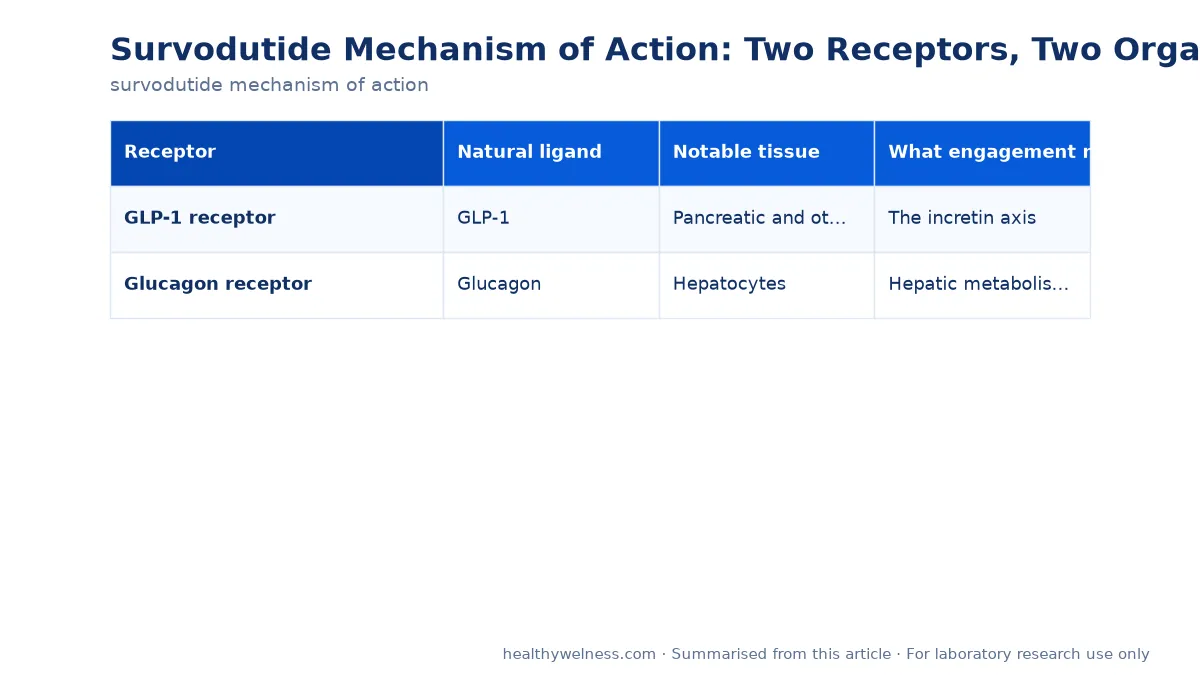
| Receptor | Natural ligand | Notable tissue | What engagement reaches |
|---|---|---|---|
| GLP-1 receptor | GLP-1 | Pancreatic and other tissues | The incretin axis |
| Glucagon receptor | Glucagon | Hepatocytes | Hepatic metabolism, directly |
Two receptors on two tissue distributions means a dual agonist is doing two jobs in two places, not one job twice as hard.
What is the evidence that the second receptor opens a tissue?
The clearest evidence is the shape of the trial programme rather than an argument from first principles.
Survodutide was tested in metabolic dysfunction-associated steatohepatitis and fibrosis, published by Sanyal and colleagues in the New England Journal of Medicine in 2024. A liver trial is a reasonable thing to run for a compound that engages hepatocyte receptors directly, and a much less obvious thing to run for an agent whose second receptor is GIP.
The dose-finding phase 2 obesity trial by le Roux and colleagues in Lancet Diabetes & Endocrinology covers the metabolic side, and the 2025 review by Arun and colleagues in Cardiology in Review places the compound in its wider class. Read together, the three show a programme pursuing two different organ systems with one molecule, which is what dual agonism is for.
How does this compare with the other dual agonist mechanism?
Tirzepatide pairs GLP-1 with GIP. The 2020 study by Willard and colleagues characterised it as an imbalanced and biased dual agonist — more potent at one receptor than the other, and favouring some downstream arms within a receptor over others.
Those two terms are worth carrying across to any dual agonist, including this one:
- Imbalance means the ratio of the two receptor activities is not fixed. It shifts with concentration, so a result at one concentration is not a result about the compound in general.
- Bias means receptor occupancy does not predict downstream output, so matching occupancy with a different ligand does not guarantee matching effect.
Whether survodutide is imbalanced in the same way is a question we cannot answer from the literature we have found; the characterisation that exists for tirzepatide does not transfer. What does transfer is the framework: these are the two properties a dual agonist has to be checked for, and assuming balance is an assumption. The compound-level comparison is in mazdutide, survodutide and tirzepatide compared.
What follows for experimental design?
Three consequences, in the order they usually bite.
- Receptor expression has to be established in the system. A preparation rich in GLP-1 receptors and poor in glucagon receptors will respond as though the compound were a single-receptor agonist, and the result will look like a weak dual agonist rather than what it is — an incomplete system.
- An effect cannot be assigned to one receptor. Attribution needs a selective comparator in the same system. A GLP-1-only agonist is the obvious floor, and a non-peptide one is especially useful because it is chemically unrelated, so peptide-handling artefacts do not travel between arms. The structural basis for non-peptide agonism is described by Sloop and colleagues.
- Liver-relevant readouts are where the glucagon arm should be visible. If an experiment measures only incretin-axis endpoints, the second receptor’s contribution is largely invisible by construction.
Why is the exposure profile part of the mechanism?
Because the molecule is engineered to persist, and persistence changes what a receptor sees.
Survodutide was given once weekly in its published trials. Getting a peptide from minutes to a week requires blocking enzymatic cleavage and raising the effective size of the molecule so it is not filtered — usually with a lipid chain that binds albumin.
That has a specific consequence for in vitro work: the albumin interaction only exists where albumin does. In serum-free medium the property that defines the compound in a whole organism is absent, and the free concentration is the nominal one. In serum-containing medium the nominal and available concentrations diverge, by an amount that depends on albumin content. Neither condition reproduces the trials, and knowing which one you are in is part of interpreting the result. The profile is covered in what survodutide is.
Our survodutide research material is supplied for laboratory research use. Certificates are available for listed products — contact us for the latest report. Concentration maths runs from net peptide content, which our reconstitution calculator applies.
What would settle the open mechanistic questions?
Three measurements would move this from a plausible account to a characterised one, and all three are things a laboratory can do rather than wait for.
- Potency at each receptor, measured in one system. That is what establishes whether the compound is balanced or imbalanced, and it is the most useful missing number. Without it the receptor ratio at any given concentration is unknown.
- Signalling bias at each receptor. Measuring two downstream arms rather than one shows whether receptor occupancy predicts output. A single readout cannot detect bias by construction.
- Tissue-resolved response. Because the two receptors have different distributions, running the same compound in a hepatocyte model and in an incretin-responsive model separates the contributions without needing selective ligands at all.
The third is the cheapest and the most often skipped. If the glucagon arm is the reason the compound reaches the liver, a liver model and a non-liver model should disagree about it — and that disagreement is the evidence.
Scope note
This material is supplied for laboratory research use only. It is not a medicine, not a supplement, and not for human or veterinary use. The clinical trials cited are referenced as published literature about a molecule; nothing here describes administration of research material to any organism.
Open questions
- Is survodutide imbalanced between its two receptors, and in which direction?
- Does it show signalling bias at either receptor?
- How much of its liver-relevant activity requires glucagon receptor engagement specifically?
Related research
Frequently asked questions
What is survodutide's mechanism of action?
It activates two class B G protein-coupled receptors: the glucagon receptor and the GLP-1 receptor. The glucagon receptor is concentrated on hepatocytes, so the second receptor gives the compound a direct route to liver metabolism that a GLP-1-only agonist does not have.
Why does glucagon receptor agonism matter?
Because glucagon receptors are expressed on liver cells and glucagon signalling acts directly on hepatic metabolism. That is the mechanistic reason a dual GLP-1 and glucagon agonist was tested in a liver condition, which is published as a phase 2 trial in MASH and fibrosis.
Is adding glucagon just a way of increasing potency?
No. The two receptors sit on different tissues, so adding glucagon opens a different organ rather than amplifying the same signal. That is the single most useful idea for understanding why dual agonists of this type exist.
How does the mechanism differ from tirzepatide's?
Tirzepatide pairs GLP-1 with the GIP receptor, not glucagon. GIP and glucagon are different hormones acting on different tissues, so the two dual agonists are two different pairings rather than two points on one scale.
Can the two receptor contributions be separated experimentally?
Not with survodutide alone. An effect observed with it is an effect of dual agonism. Separating the contributions requires selective comparators run in the same system, such as a GLP-1-only agonist.
For laboratory research use only. The research materials supplied by HealthyWelness are not approved medicines, foods or cosmetics and are not for human or veterinary use. This article summarises published research and is not medical advice.
Sources
- le Roux CW, et al. Glucagon and GLP-1 receptor dual agonist survodutide for obesity: a randomised, double-blind, placebo-controlled, dose-finding phase 2 trial. Lancet Diabetes Endocrinol. 2024. PMID: 38330987
- Sanyal AJ, et al. A Phase 2 Randomized Trial of Survodutide in MASH and Fibrosis. N Engl J Med. 2024. PMID: 38847460
- Arun AJ, et al. Survodutide: A Dual GLP-1/Glucagon Agonist Reshaping Cardiometabolic Care. Cardiol Rev. 2025. PMID: 40963161
- Willard FS, et al. Tirzepatide is an imbalanced and biased dual GIP and GLP-1 receptor agonist. JCI Insight. 2020. PMID: 32730231
- Sloop KW, et al. The pharmacological basis for nonpeptide agonism of the GLP-1 receptor by orforglipron. Sci Transl Med. 2024. PMID: 39693407