Peptide Policy and Research: Week to 16 November 2026
This week: a peptide-policy FAQ, the TAX2 trial milestone, teriparatide analogue design and a PLAPI preprint, with dated sources and evidence limits.

Week covered: 9–15 November 2026; checked 16 November. This week brought a new policy FAQ, a sponsor-reported clinical-development milestone for TAX2, a teriparatide analogue paper in the journal issue and PubMed record dated 12 November, and a peptide-level interaction preprint posted that day. The useful connection is evidence attribution: identify the document, the actual molecule or sample, and the question each result can answer before drawing a conclusion.
What changed this week
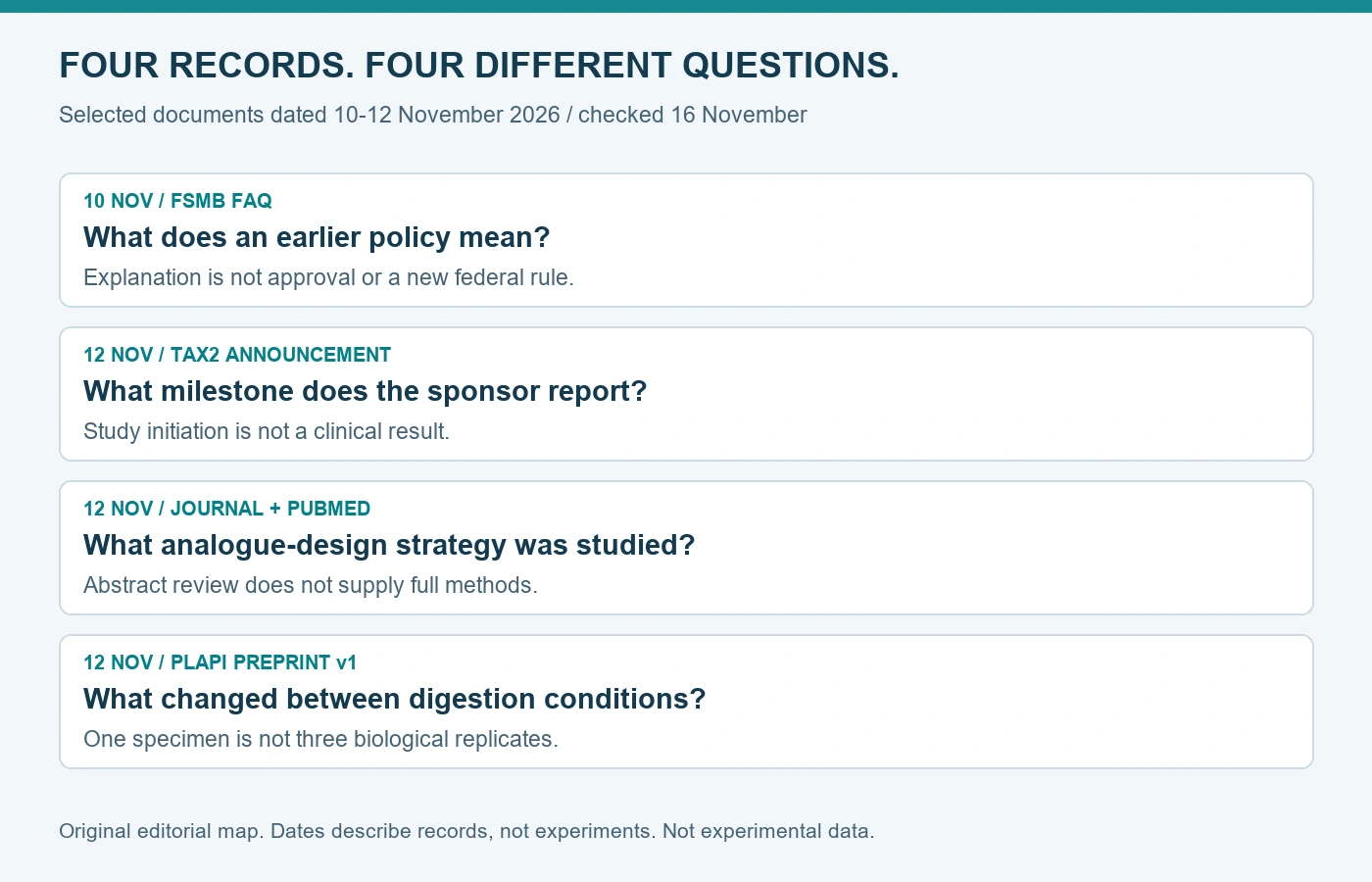
- Policy communication: the Federation of State Medical Boards (FSMB) issued a 10 November FAQ about the earlier HHS peptide-compounding policy. This is a new explanatory document, not a new HHS rule.
- Development milestone: Apmonia announced on 12 November that its TAX2 first-in-human study had begun treating participants. An announcement of trial activity is different from a report of clinical results.
- Molecular design: a teriparatide analogue study combines iterative site scanning with selective chemical modification. Its PubMed abstract supports a discussion of research strategy, without supplying every condition needed to reproduce the work.
- Analytical methods: the PLAPI preprint uses native and denatured proteolysis to prioritise protein regions. Its single-specimen design makes technical reproducibility and biological generalisation different questions.
1. A new policy FAQ clarifies the earlier federal notice
The FSMB FAQ dated 10 November, hosted by the Alabama Board of Medical Examiners, distinguishes conditional federal enforcement discretion from approval, inclusion on the 503A bulks list, and state-law permission. The issuer is FSMB; hosting on a board website should not be rewritten as a new federal regulation. The FAQ itself cautions that it is not a comprehensive or authoritative statement of law.
Earlier-document follow-up: the 30 October Federal Register notice concerns docket HHS-OASH-2026-0496. Its stated two-week comment period corresponds to 13 November. That date is the stated deadline in the notice, not proof that no extension or later action exists. We did not independently confirm the live docket’s final submission count or a subsequent final rule. The notice describes a draft enforcement policy and says that it does not establish rights or bind HHS or the public.
The editorial lesson is to separate a procedural event from a change in product status. A comment deadline can pass without proving approval, an amendment to a regulatory list, or permission for a particular seller’s material. A useful record therefore keeps the document’s issuer, date, scope and procedural stage together. A headline that drops those fields may sound simpler while answering a different question.
2. TAX2: identify the milestone before interpreting the mechanism
In its 12 November company announcement, Apmonia reports the first participant treated in APM-CT001, a phase 1/2a study of TAX2, also called AP-01. It identifies TAX2 as a cyclic peptide intended to bind thrombospondin-1 and interfere with its interaction with CD47. The release gives trial identifier NCT07688148 and says initial safety and biomarker data are expected in 2027. These are sponsor statements; this brief did not independently audit participant-level data or verify the registry record.
What the event establishes: the sponsor reports movement into clinical evaluation. It does not establish a successful clinical outcome. The mechanism described is the programme’s rationale, while a biomarker plan describes what investigators intend to examine. Neither should be converted into a demonstrated effect in an unrelated commercial peptide.
For research readers, three records should remain distinguishable: the identity of a candidate, evidence that an experiment or study started, and the results collected under its conditions. Combining those records too early turns an interesting hypothesis into an apparent conclusion. This distinction also prevents a mechanism-based comparison from becoming a claim that two different sequences, formulations or manufacturing processes produce equivalent materials.
3. Teriparatide analogue research: modification is a design variable
The primary research record for Liu and colleagues, PMID 43018567, describes iterative peptide scanning followed by serine/threonine ligation chemistry for site-specific modifications. The abstract reports preparation of lipidated analogues and identifies compound 62 as a candidate with improved serum stability in the reported work. We read the original abstract and bibliographic record through NCBI; the complete publisher article and supporting information were not available for this review. No numerical half-life, undisclosed experimental condition or clinical conclusion is inferred here.
Date distinction: the journal issue date and PubMed entry are 12 November 2026. The record gives acceptance on 6 October. We have not established a separate first-online publication date; an acceptance date is not a publication date, and database entry is not automatically the first public appearance.
The research strategy raises a broader experimental-design question: which property is being changed, and which property must remain acceptable? A modification intended to improve stability can also alter solubility, binding, chromatographic behaviour or measurement recovery. Those are separate endpoints. An improvement on one axis should lead to additional questions rather than an assumption that every other axis improved.
Consider a hypothetical comparison of an unmodified peptide and a lipidated analogue. A larger recovered signal after incubation could reflect greater persistence, better extraction, or a different detector response. This is not a result from the cited study. It illustrates why a stability conclusion needs a defined assay, appropriate comparators and controls for analytical response. The paper’s full methods and supporting information would be necessary before evaluating those details in its actual experiments.
4. PLAPI: technical replication does not create independent specimens
The version 1 PLAPI preprint by Chen and Tian is recorded by the bioRxiv API as posted on 12 November, despite 9 November appearing in the DOI identifier. Its abstract describes one human serum specimen, three paired technical preparations, native and denatured proteolysis, and LC–MS/MS. Applying its stated detection rule yielded 920 denatured-only peptides and 124 detected under both conditions. We reviewed the repository’s original abstract and version metadata; the full-text page returned an access error. This is a preprint, not a peer-reviewed validation.
The direct observation is condition-dependent peptide detection. Assigning an interaction interface is a subsequent interpretation that also depends on mapping and biological context. Three technical preparations help assess repeatability of preparation and measurement; they do not turn one specimen into three independent biological observations. A missing peptide signal is not, by itself, proof that a protein region was physically inaccessible.
A practical reading sequence is to ask what changed experimentally, what was actually measured, and what additional claim was inferred. For a hypothetical peptide absent from one condition, plausible questions include detection thresholds, digestion efficiency, sample handling and recovery. These are general analytical alternatives, not claims that the authors failed particular controls. Full methods, additional specimens and targeted follow-up would be needed to assess the strength of the proposed interpretation beyond the abstract.
Evidence table: what each dated record can support
| Record and date | Evidence type | Supported use in this brief | Unresolved boundary |
|---|---|---|---|
| FSMB, 10 November | Institutional policy explanation | Distinguish federal policy, approval and state authority | Not a replacement for current primary law |
| Apmonia, 12 November | Sponsor announcement | Attribute the reported TAX2 study milestone | No independently reviewed clinical results here |
| Liu et al., issue and PubMed entry 12 November | Original research abstract | Describe an analogue-design approach | First-online date and full methods not verified |
| Chen and Tian, posted 12 November | Version 1 preprint abstract | Explain an exploratory peptide-level method | One specimen; not peer-reviewed validation |
| HHS notice, 30 October | Earlier federal document; follow-up only | Identify the stated comment window | No verified later disposition in this review |
A repeatable way to read next week’s claims
Start with the noun attached to the evidence. A licence belongs to an identified entity and scope; an analytical result belongs to a sample and method; a study outcome belongs to its tested product and population; a policy statement belongs to a jurisdiction and procedural stage. Similar terminology does not remove those boundaries. This is particularly relevant when a website presents company information alongside a research catalogue: corporate documentation and a selected lot’s analytical report answer different questions.
Next, preserve the dates that serve different purposes. A study may be accepted, posted online, assigned to an issue, entered into PubMed and discussed in a company announcement on different days. A weekly brief should say which of those made the item timely. The same discipline applies to versioned repositories: an identifier’s date-like characters cannot replace the repository’s posting metadata.
Finally, state what observation would change the interpretation. An announced milestone calls for eventual results; an abstract-only assessment calls for full methods; a single-specimen exploration calls for independent specimens; a policy follow-up calls for the current operative document. These are different follow-up tasks. Combining them into a generic claim that a peptide is now “proven” would hide the work still required.
Open questions and scope
- What later HHS or docket documents, if any, alter the interpretation of the earlier notice? This issue does not infer an answer from the calendar alone.
- What results will TAX2’s sponsor report, and what independent records will support them?
- How do the analogue study’s full analytical methods distinguish stability from changes in recovery or measurement response?
- How reproducible is PLAPI across independent specimens and targeted interface measurements?
This is a selected research and policy brief, not an exhaustive surveillance service. It is not a finding about the quality, approval or manufacturer of any HealthyWelness product. No new COA, certification, clinical-review relationship or AI citation is claimed.
Frequently asked questions
Does this week’s policy FAQ approve research-catalog peptides?
No. It explains an earlier enforcement policy and distinguishes that policy from approval. It cannot establish the status or suitability of an unrelated catalogue lot.
Does a first-participant announcement report trial results?
No. It identifies a development milestone as reported by the sponsor. Results require actual observations and their analysis.
Why distinguish technical preparations from biological specimens?
Repeated preparation of one specimen examines technical variation. Independent specimens are needed to study variation between biological sources; the two counts should be reported separately.
Can the reported modification strategy be assumed to work for any peptide?
No. A design approach prompts experiments. Its suitability depends on the sequence, modification site, analytical method and endpoint under investigation.
Why is this weekly report not giving personal-use recommendations?
Its purpose is to explain research evidence and document scope. It does not assess an individual’s circumstances or provide administration, treatment or purchasing advice.
Related reading and documentation
- Previous week’s peptide policy and research brief
- Predicted proteolysis sites versus mapped cleavage
- What a mass-spectrometry identity match can establish
- Look up an available analytical certificate and read corporate-document scope
For catalogue nomenclature only, the TB-500 research-material listing is separate from evidence that any ingredient meets a policy’s specific requirements. A matching common name does not establish regulatory eligibility or material equivalence.
Sources and reading limits
- FSMB. FAQ dated 10 November 2026, hosted by Alabama BME; all five pages reviewed. This is the issuing organisation’s explanatory document.
- Apmonia Therapeutics. Company announcement dated 12 November 2026; full announcement reviewed, sponsor attribution retained.
- Liu B, et al. Development of Long-Acting Teriparatide Analogues through Iterative Peptide Scanning and Site-Specific Modification by Serine/Threonine Ligation. Journal of Medicinal Chemistry. DOI: 10.1021/acs.jmedchem.6c01924. Original NCBI abstract and date metadata reviewed; publisher full text not reviewed.
- Chen S, Tian Z. PLAPI preprint, DOI: 10.64898/2026.11.09.765259, version 1. Original bioRxiv API abstract and posting metadata reviewed; full text unavailable to this review.
- HHS. Federal Register notice 2026-22192, 30 October 2026, pages 68526–68527; relevant notice read in full. Earlier-document follow-up.
Cover and evidence map: original editorial graphics, not experimental data, exact molecular structures or photographs of company facilities.
Sources
- FSMB. Peptide compounding policy FAQ. 10 November 2026; hosted by Alabama BME.
- Apmonia. Sponsor announcement of TAX2 first-participant milestone. 12 November 2026.
- Liu B, et al. Teriparatide analogue design. J Med Chem. DOI 10.1021/acs.jmedchem.6c01924. PMID 43018567; original abstract and metadata.
- Chen S, Tian Z. PLAPI. bioRxiv. DOI 10.64898/2026.11.09.765259, version 1; posted 12 November 2026. Original repository abstract reviewed.
- HHS. Federal Register notice 2026-22192, 30 October 2026. Earlier-document follow-up.