What Is Unusual About Glutathione’s Structure?
Glutathione's glutamate is linked through its gamma-carboxyl, not the usual alpha one. Why that bond, the cysteine thiol and NAC's role as a precursor matter.

Cover illustration: AI-generated editorial artwork. Conceptual only; not an exact molecular structure, actual laboratory result or evidence of clinical effects.
Glutathione’s unusual feature is its first peptide bond: glutamate is linked to cysteine through its side-chain gamma-carboxyl group instead of the alpha-carboxyl used in ordinary peptides and proteins. That gamma linkage makes it resistant to general peptidases, and its free cysteine thiol makes it the cell’s main small-molecule reductant.
For laboratory research use only. The research materials supplied by HealthyWelness are not approved medicines, foods or cosmetics and are not for human or veterinary use. This article summarises published research and is not medical advice.
- Glutathione (GSH) is gamma-L-glutamyl-L-cysteinyl-glycine, a ubiquitous low-molecular-weight thiol nucleophile and reductant (Lapenna, 2023).
- GSH is the most abundant non-protein thiol in mammalian tissues, and its synthesis is limited by cysteine availability and by glutamate cysteine ligase activity (Lu, 2013).
- The gamma-glutamyl bond of extracellular reduced and oxidized glutathione is hydrolysed by gamma-glutamyl transpeptidase (GGT), a cell-surface enzyme (Hanigan, 2014).
- N-acetylcysteine’s antioxidant effect is attributed mainly to its role as a precursor of reduced glutathione (Aldini et al., 2018).
The structure, residue by residue
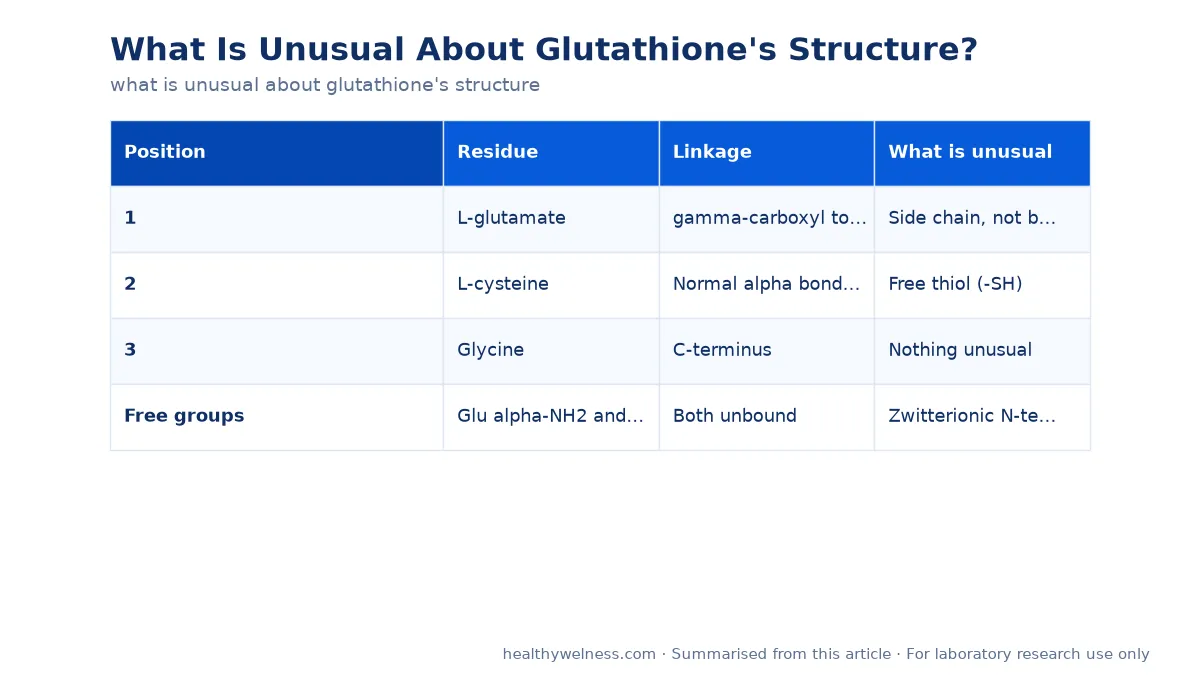
Glutathione is a tripeptide, three amino acids long, and two of its three bonds are perfectly ordinary. What makes it unusual is concentrated at the glutamate end.
| Position | Residue | Linkage | What is unusual |
|---|---|---|---|
| 1 | L-glutamate | gamma-carboxyl to Cys | Side chain, not backbone |
| 2 | L-cysteine | Normal alpha bond to Gly | Free thiol (-SH) |
| 3 | Glycine | C-terminus | Nothing unusual |
| Free groups | Glu alpha-NH2 and alpha-COOH | Both unbound | Zwitterionic N-terminal end |
In a normal peptide, each amino acid’s alpha-carboxyl group bonds to the next residue’s amine. Glutamate has a second carboxyl group at the end of its side chain, the gamma position. In glutathione it is this gamma-carboxyl that forms the bond with cysteine, leaving glutamate’s alpha-carboxyl and alpha-amine both free. The molecule therefore starts with what looks like a complete free amino acid hanging off the side of the peptide. The full name, gamma-L-glutamyl-L-cysteinyl-glycine, records that arrangement (Lapenna, 2023).
Why the gamma bond matters: resistance and a dedicated enzyme
Proteases and most peptidases recognise the alpha-peptide backbone. A gamma bond does not fit their active sites, so glutathione survives in environments where an ordinary tripeptide would be degraded. To break it down, the body uses a specialist: gamma-glutamyl transpeptidase.
Hanigan’s review described GGT as a cell-surface enzyme that hydrolyses the gamma-glutamyl bond of extracellular reduced and oxidized glutathione, starting their cleavage into glutamate, cysteine and glycine. It is normally expressed on the apical surface of ducts and glands, where it salvages amino acids from glutathione in ductal fluids, and its expression is essential to maintaining cysteine levels in the body. Tumours often express it across the whole membrane, gaining access to extra cysteine, which has made GGT inhibitors a target in cancer research (Hanigan, 2014).
Okada and colleagues solved the crystal structure of the E. coli enzyme at 1.95 Å resolution and trapped its gamma-glutamyl-enzyme intermediate by flash-cooling a crystal soaked in glutathione. The structures showed a pocket that recognises the gamma-glutamyl moiety, with the N-terminal threonine of the small subunit as the catalytic nucleophile, and residues known to be essential for human GGT activity all involved in binding the gamma-glutamyl group (Okada et al., 2006). The enzyme, in short, is built around glutathione’s odd bond.
The cysteine thiol: the business end
The second notable feature is the free sulfhydryl group on the cysteine. This thiol is what makes glutathione a reductant and nucleophile. Averill-Bates summarised what it does: it acts directly against free radicals and pro-oxidants; it is a cofactor for glutathione peroxidases, which reduce peroxides while two GSH molecules are oxidized to glutathione disulfide (GSSG); it supports glutathione S-transferases in conjugating electrophiles; and it regulates protein function through reversible S-glutathionylation of cysteine residues (Averill-Bates, 2023).
| Form | Structure | How it is regenerated |
|---|---|---|
| GSH (reduced) | Free -SH | Active form |
| GSSG (disulfide) | Two GSH linked S-S | Glutathione reductase + NADPH |
| Protein-SSG | GSH bound to protein Cys | Deglutathionylation enzymes |
| GS-conjugates | GSH bound to electrophile | Exported, not recycled |
The ratio between GSH and GSSG is one of the standard readouts of cellular redox state, much as the NAD+/NADH ratio is for energy metabolism. The connection is direct: glutathione reductase uses NADPH to turn GSSG back into GSH (Averill-Bates, 2023), so the glutathione and NADP(H) systems are coupled. See NAD and glutathione for that link.
Made by enzymes, not ribosomes
A third structural oddity follows from the first. Ribosomes can only make alpha-peptide bonds, so they cannot build glutathione. Instead, two ATP-dependent cytosolic enzymes do it. Glutamate cysteine ligase (GCL), composed of a catalytic and a modifier subunit, joins glutamate’s gamma-carboxyl to cysteine to make gamma-glutamylcysteine; glutathione synthetase then adds glycine. Lu identified cysteine availability and GCL activity as the key determinants of how much glutathione a cell makes, with transcription factors such as Nrf2 regulating the genes involved (Lu, 2013; Lapenna, 2023).
Where N-acetylcysteine fits
The search phrase that brings many readers to glutathione’s structure is “N-acetyl cysteine and glutathione”. The link is the cysteine. Because cysteine supply limits glutathione synthesis, supplying cysteine in a more stable form can support it. N-acetylcysteine (NAC) is cysteine with an acetyl group on its amine. Aldini and colleagues reviewed its mechanisms and concluded that its antioxidant effect is due mainly to acting as a precursor of reduced glutathione. Under conditions of significant cysteine and GSH depletion, NAC can also act directly against some oxidants such as NO2 and hypohalous acids, and its ability to break disulfide bonds releases free thiols from proteins, which also explains its mucolytic use (Aldini et al., 2018).
| Property | Glutathione | N-acetylcysteine |
|---|---|---|
| Size | Tripeptide | Modified amino acid |
| Thiol | Yes, on Cys | Yes |
| Main role | Direct reductant, cofactor | Cysteine supply for GSH |
| Disulfide breaking | Via enzymes | Direct, reported |
A direct comparison of the two as compounds is in NAC vs glutathione, and the broader profile of glutathione is in what is glutathione.
Handling in the lab
The free thiol that makes glutathione useful also makes it the part most likely to change in storage. In solution, especially at neutral to alkaline pH and in the presence of trace metals and oxygen, GSH oxidizes to GSSG. For reproducible work:
- Record the form. Reduced glutathione (GSH) and oxidized glutathione (GSSG) are separate reagents; certificates should state which.
- Prepare solutions fresh and keep them cold; degassed diluent reduces oxidation. Steps are in how to reconstitute glutathione.
- Calculate concentration from net content with the peptide calculator.
- Check identity by mass. GSSG has roughly twice the mass of GSH, so mass spectrometry distinguishes them at once.
Material from the glutathione research compound listing is supplied as a dry powder for laboratory research. Certificates are available for listed products — contact us for the latest report.
Open questions
The gamma bond explains why glutathione resists ordinary peptidases, but it also means that, in tissues expressing GGT, extracellular glutathione is cleaved at the cell surface and its amino acids are salvaged (Hanigan, 2014). How much exogenous glutathione enters cells intact in different tissues, and how that differs between reduced and oxidized forms, remains an area where reviews disagree. The relative contribution of NAC’s precursor role versus its direct disulfide-breaking action also seems to depend on how depleted cysteine and glutathione are in the system studied, which makes results hard to compare across models (Aldini et al., 2018).
Frequently asked questions
What is the full chemical name of glutathione?
Glutathione (GSH) is gamma-L-glutamyl-L-cysteinyl-glycine, a tripeptide of glutamate, cysteine and glycine in which glutamate is joined to cysteine through its side-chain (gamma) carboxyl group (Lapenna, 2023).
Why does the gamma-glutamyl bond matter?
Ordinary peptidases cleave alpha-peptide bonds, so the gamma linkage protects glutathione from general proteolysis. It is hydrolysed instead by a dedicated cell-surface enzyme, gamma-glutamyl transpeptidase (GGT), which begins the breakdown of extracellular glutathione into glutamate, cysteine and glycine (Hanigan, 2014).
How is N-acetylcysteine related to glutathione?
N-acetylcysteine (NAC) is the N-acetyl derivative of cysteine. Its main antioxidant effect is attributed to acting as a precursor of reduced glutathione, since cysteine availability is a key determinant of glutathione synthesis (Aldini et al., 2018; Lu, 2013).
What is the difference between GSH and GSSG?
GSH is reduced glutathione with a free cysteine thiol. GSSG is glutathione disulfide, two GSH molecules joined through their sulfur atoms after oxidation. Glutathione reductase converts GSSG back to GSH using NADPH (Averill-Bates, 2023).
Is glutathione made by ribosomes like other peptides?
No. It is synthesized in the cytosol by two ATP-dependent enzymes: glutamate cysteine ligase forms the gamma-glutamylcysteine bond, and glutathione synthetase adds glycine (Lu, 2013; Lapenna, 2023).
For laboratory research use only. The research materials supplied by HealthyWelness are not approved medicines, foods or cosmetics and are not for human or veterinary use. This article summarises published research and is not medical advice.
Sources
- Lapenna D. Glutathione and glutathione-dependent enzymes: From biochemistry to gerontology and successful aging. Ageing Res Rev. 2023. PMID: 37683986
- Lu SC. Glutathione synthesis. Biochim Biophys Acta. 2013. PMID: 22995213
- Hanigan MH. Gamma-glutamyl transpeptidase: redox regulation and drug resistance. Adv Cancer Res. 2014. PMID: 24974180
- Okada T, et al. Crystal structures of gamma-glutamyltranspeptidase from Escherichia coli, a key enzyme in glutathione metabolism, and its reaction intermediate. Proc Natl Acad Sci U S A. 2006. PMID: 16618936
- Aldini G, et al. N-Acetylcysteine as an antioxidant and disulphide breaking agent: the reasons why. Free Radic Res. 2018. PMID: 29742938
- Averill-Bates DA. The antioxidant glutathione. Vitam Horm. 2023. PMID: 36707132