Native Chemical Ligation: Reading the Peptide Junction
Read native chemical ligation research through junction chemistry, temporary cysteine, final sequence evidence and the limits of a native bond claim.

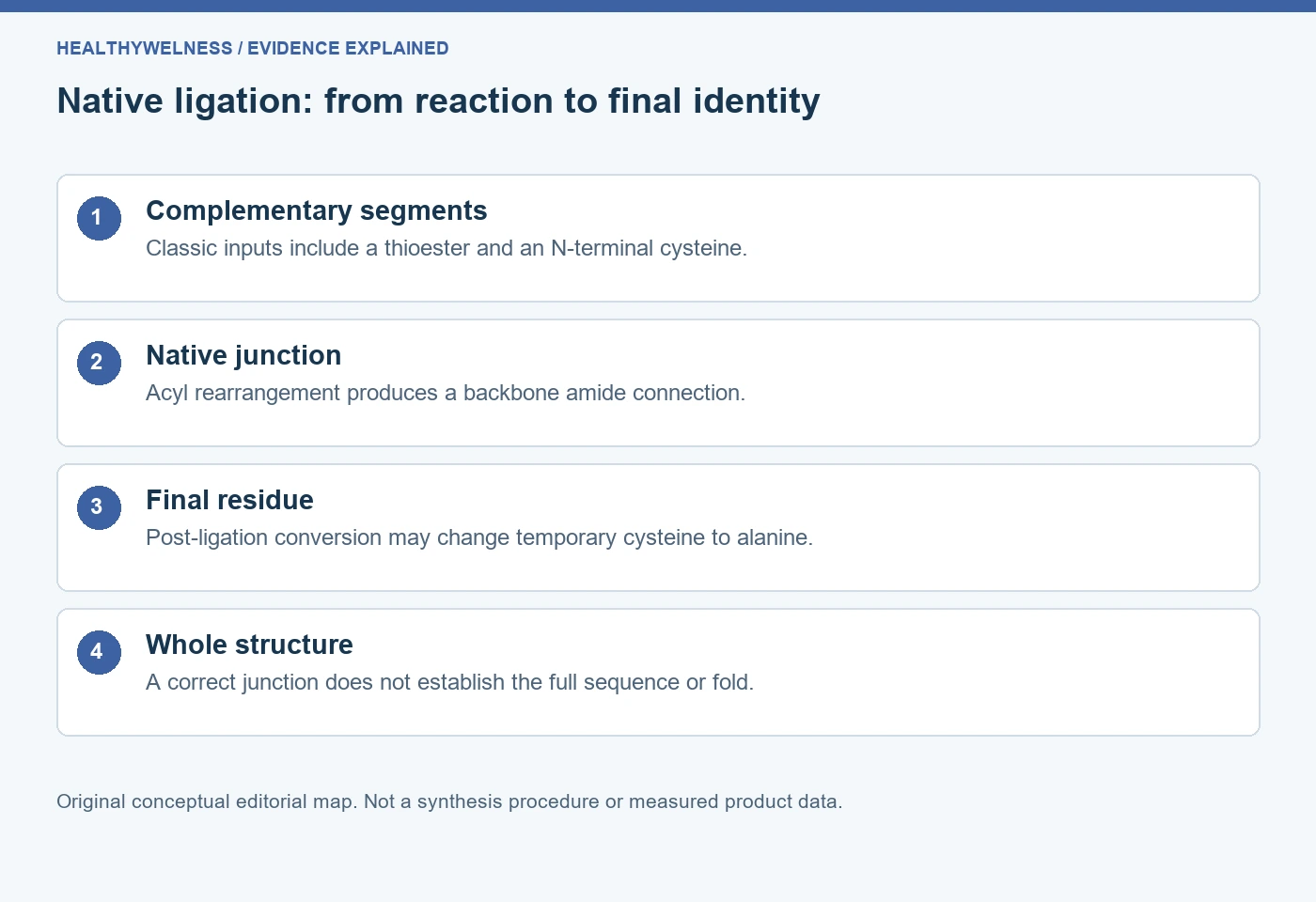
Native chemical ligation joins peptide segments through a native backbone amide bond at the junction. The classic chemistry uses a C-terminal thioester and an N-terminal cysteine, followed by an acyl rearrangement. “Native” describes that bond chemistry; it does not by itself establish the complete sequence, folding, disulfide pattern or purity of the isolated product.
For laboratory research use only. The compounds discussed are not approved for human or veterinary use and are not drugs, foods or cosmetics. This article summarises published research and is not medical advice.
- Classic native chemical ligation uses complementary reactive ends on two peptide segments.
- The transient sulfur-linked intermediate and the final backbone amide have different connectivity.
- Post-ligation desulfurization can change a junction cysteine to alanine in an appropriately designed synthesis.
- A correct junction does not establish all other structural features of a long peptide or protein.
A ligation method and a product identity answer different questions
A synthesis description tells the reader how a molecule was assembled. A molecular specification tells the reader which structure was intended. Analytical evidence connects the isolated material to that specification. Those three records overlap, but none can substitute for the others. The phrase “made by native chemical ligation” is useful process information; it is not a complete characterization statement.
The distinction becomes especially important when a long chain is assembled from shorter fragments. Each fragment has its own sequence, terminal chemistry and possible impurities. The assembly introduces a junction and may be followed by transformations, purification and folding. A final identity claim therefore spans more than the one bond formed during segment joining.
This article concerns the chemical meaning of the junction and the evidence needed to interpret it. For the broader chain-building process, see solid-phase peptide synthesis. Fragment assembly does not replace that process in every case: chemically synthesized segments can themselves be the starting materials for ligation.
Why the sulfur intermediate is not the endpoint
In the classic reaction, the C-terminal acyl group of one segment is presented as a thioester. The second segment begins with cysteine, whose side-chain sulfur participates in the initial capture. An intramolecular sulfur-to-nitrogen acyl transfer then places that acyl group on the cysteine’s backbone amino nitrogen. The final junction is the ordinary amide linkage between adjacent residues.
The 1994 original study by Dawson, Muir, Clark-Lewis and Kent described unprotected peptide segments, an initial thioester-linked species and rearrangement to a native peptide bond. The authors also folded and oxidized their ligation product to obtain a disulfide-containing protein. That sequence of events illustrates why covalent chain assembly and subsequent structural organization should be described separately. [1]
Calling the final product “thioester-linked” would therefore misdescribe successful completion of classic native chemical ligation. Calling any sulfur-mediated segment connection “native chemical ligation” can also be misleading if the structure retains a different bridge. Identify the final bond explicitly. The presence of sulfur in the starting chemistry does not imply a disulfide junction, and the word ligation alone does not specify a backbone amide.
| Stage | Structural question | Evidence needed |
|---|---|---|
| Segment inputs | Which reactive ends? | Annotated structures |
| Initial joining | Which intermediate? | Reaction assignment |
| Final junction | Which covalent bond? | Local structural evidence |
| Later conversion | Which residue remains? | Final sequence evidence |
| Folded endpoint | Which organization? | Structure-specific analysis |
Cysteine can be a temporary synthetic solution
A reader may see a cysteine-bearing ligation intermediate even though the target sequence contains alanine at that position. This is not necessarily an inconsistency. Yan and Dawson’s 2001 original work demonstrated native chemical ligation followed by desulfurization, converting a deliberately introduced junction cysteine to alanine in the studied syntheses. The intermediate and the final target consequently need different annotations. [2]
The useful lesson is that a reaction handle may be temporary. A production record should distinguish the residue used to enable ligation from the residue specified after conversion. An analysis performed before that conversion establishes an intermediate, not the final alanine-containing molecule. Conversely, detecting the final alanine does not by itself tell the reader how the chain was assembled.
Compatibility with other residues must remain a method-specific question. The existence of a successful desulfurization example does not mean that every sulfur-containing group in every peptide will be preserved or altered in exactly the desired way. A process label cannot supply a missing selectivity study. The final claim should name what was established for the actual molecule rather than borrowing a general success from a different model.
- Mark the fragment boundary on the intended full-length sequence.
- Annotate both the junction residue used for assembly and the residue specified after conversion.
- Keep temporary handles, protecting groups and final modifications distinct.
- Evaluate final material against the final target, rather than an intermediate drawing.
A hypothetical junction accounting exercise
Hypothetical worked example: an investigator wants the six-residue chain Ala–Gly–Ala–Ser–Lys–Gly with free termini. A planned fragment boundary lies immediately before the third residue, alanine. A temporary ligation design instead uses Ala–Gly as the acyl-donor segment and Cys–Ser–Lys–Gly as the second segment. After successful native ligation, the assembled intermediate is Ala–Gly–Cys–Ser–Lys–Gly.
That intermediate has the intended backbone connection but the wrong third residue for the final target. Desulfurization is a separate required conversion in this hypothetical design. Only after the cysteine becomes alanine does the annotated sequence match the original target. A report that stops at “full-length product formed” has not yet established completion of the final molecular specification.
The simple residue bookkeeping predicts that conversion from cysteine to alanine removes one sulfur atom from the peptide composition while preserving the carbon skeleton. That is a conditional elemental prediction, not a measured mass shift or evidence that the conversion occurred. Intact mass can support the composition change, while local sequence evidence addresses its position.
Now imagine that an alternative impurity has the same total composition as the intended product but a different residue order elsewhere. A mass compatible with desulfurization would not exclude it. The example demonstrates why the process history, the local junction evidence and the overall sequence evidence should stay visible as separate statements. Successful completion of one planned transformation does not resolve every possible impurity.
Not every amide-forming ligation is the same method
Other segment-joining strategies can also form an amide bond. Mao and colleagues’ 2004 original study used the enzyme sortase for in vitro ligation of an LPXTG-bearing substrate to an aminoglycine substrate. The sequence recognition and substrate requirements differ from those of classic native chemical ligation. An amide endpoint therefore does not uniquely identify the process used to make it. [3]
For interpreting a final construct, the retained sequence is especially important. If a method requires a recognition motif or appended residues that remain in the isolated chain, those residues belong in the final molecular specification. The word native does not grant permission to omit them. A construct may be useful for a research question while still differing from the unmodified reference sequence.
“Scarless” also needs a stated reference. Does it mean that no synthetic linker remains? That no extra amino acids remain? That the full native configuration and modifications are preserved? Those are progressively broader claims. A reader should ask for the actual final sequence and connectivity rather than inferring every property from a reassuring adjective.
Junction-spanning evidence is valuable but has a boundary
A fragment that spans the joining site can provide evidence unavailable from separate fragments lying entirely on either side. The separate fragments show that both sequence regions are present; a correctly assigned spanning fragment can support their local continuity. The distinction is analogous to finding two halves of a sentence versus reading the words across the join.
That local conclusion must still fit the method. A nominal digest mass may match more than one candidate fragment. A tandem spectrum may have incomplete informative coverage. A modified residue can alter digestion behavior. The report should explain how the observed signal distinguishes the proposed junction from plausible alternatives, including an incompletely converted intermediate when relevant.
Local continuity also leaves global questions open. A correctly joined segment can coexist with a deletion elsewhere, a configuration discrepancy, an unintended modification or an alternative disulfide map. Structural characterization should be chosen for the uncertainty that matters to the research. There is no universal rule that a junction spectrum or an overall purity percentage establishes every layer.
For the same reason, a biological assay cannot silently repair missing chemical identity. A signal compatible with an expected response may support a functional property under the assay conditions. It does not specify the complete molecular structure of every component generating that signal. Chemical and functional evidence can complement one another when their distinct scopes are stated.
How to describe the isolated material without overclaiming
A useful description might state that the final fraction has an intact mass consistent with the target, a mapped fragment supporting continuity across the planned junction, and a documented post-ligation conversion. If folding or bridge connectivity was assessed, describe those measurements separately. If it was not assessed, retain the limit rather than converting “native bond” into “native fold.”
Keep yield and purity separate too. Reaction conversion describes consumption or formation within a reaction mixture, isolated yield describes recovered material on a stated basis, and analytical purity describes a method-dependent proportion. A high conversion does not promise high isolated recovery, and a purified fraction does not reveal every intermediate lost during processing.
The custom peptide specification guide helps connect these distinctions to sequence and modification records. The disulfide mapping article addresses the separate problem of sulfur pairing. The COA lookup is a document-finding tool; conclusions remain limited to the evidence in the identified document.
Questions about ligation and the final junction
Does native chemical ligation leave a thioester at the junction?
Successful completion of classic native chemical ligation gives a backbone amide after rearrangement of a transient sulfur-linked intermediate.
Does a native peptide bond prove native folding?
No. The bond describes local covalent connectivity. Folding and any disulfide arrangement require their own evidence.
Must the final target contain cysteine at the ligation site?
Not always. Published ligation–desulfurization work demonstrates designs in which a temporary cysteine is converted to alanine after joining.
Is sortase ligation another name for native chemical ligation?
No. Sortase is an enzyme-mediated strategy with its own recognition and substrate requirements, even though an amide bond can result.
Does a correct junction establish the entire peptide sequence?
No. Junction evidence supports local continuity. Other regions, modifications, configuration and impurities remain separate analytical questions.
Primary literature and limits of this guide
- Dawson PE, Muir TW, Clark-Lewis I, Kent SBH. Synthesis of proteins by native chemical ligation. Science. 1994;266:776–779. DOI: 10.1126/science.7973629; PMID: 7973629.
- Yan LZ, Dawson PE. Synthesis of peptides and proteins without cysteine residues by native chemical ligation combined with desulfurization. J Am Chem Soc. 2001;123:526–533. DOI: 10.1021/ja003265m; PMID: 11456564.
- Mao H, Hart SA, Schink A, Pollok BA. Sortase-mediated protein ligation: a new method for protein engineering. J Am Chem Soc. 2004;126:2670–2671. PMID: 14995162.
Sources checked 19 November 2026. The original abstracts were read; the 1994 abstract was available through Princeton’s publication record and the 2001 abstract through the publisher’s indexed record. The fragment design is hypothetical and is not a synthesis procedure, a validated analytical method or a statement about any HealthyWelness manufacturing route.
For laboratory research use only. The compounds discussed are not approved for human or veterinary use and are not drugs, foods or cosmetics. This article summarises published research and is not medical advice.
Cover and evidence map: original conceptual editorial schematics, not measured results, exact molecular structures, or photographs of HealthyWelness facilities.