Glutamine vs Glutathione: Precursor and Product
Glutamine is a single amino acid; glutathione is a tripeptide built from three. One feeds the synthesis of the other. Where the names mislead.

Cover illustration: AI-generated editorial artwork. Conceptual only; not an exact molecular structure, actual laboratory result or evidence of clinical effects.
Glutamine is one amino acid; glutathione is a tripeptide assembled from three, one of which comes from glutamine. The relationship is precursor to product, not two names for the same thing. They differ in mass, in chemistry and in how a vial of each behaves on the bench.
For laboratory research use only. The research materials supplied by HealthyWelness are not approved medicines, foods or cosmetics and are not for human or veterinary use. This article summarises published research and is not medical advice.
- Glutamine is a proteinogenic amino acid with the formula C5H10N2O3 and a monoisotopic mass near 146 Da.
- Glutathione is the tripeptide γ-L-glutamyl-L-cysteinylglycine, formula C10H17N3O6S, with a mass near 307 Da.
- The bond joining the first two residues of glutathione is a γ-peptide bond formed from the glutamate side chain, not the ordinary α-peptide bond found in proteins.
- Restricting glutamine lowered glutathione levels in A549 and H460 lung cancer cell lines, and the effect tracked with radiation sensitivity (Sappington et al., 2016).
- Glutathione’s reducing activity is carried by a single cysteine thiol, which glutamine does not possess.
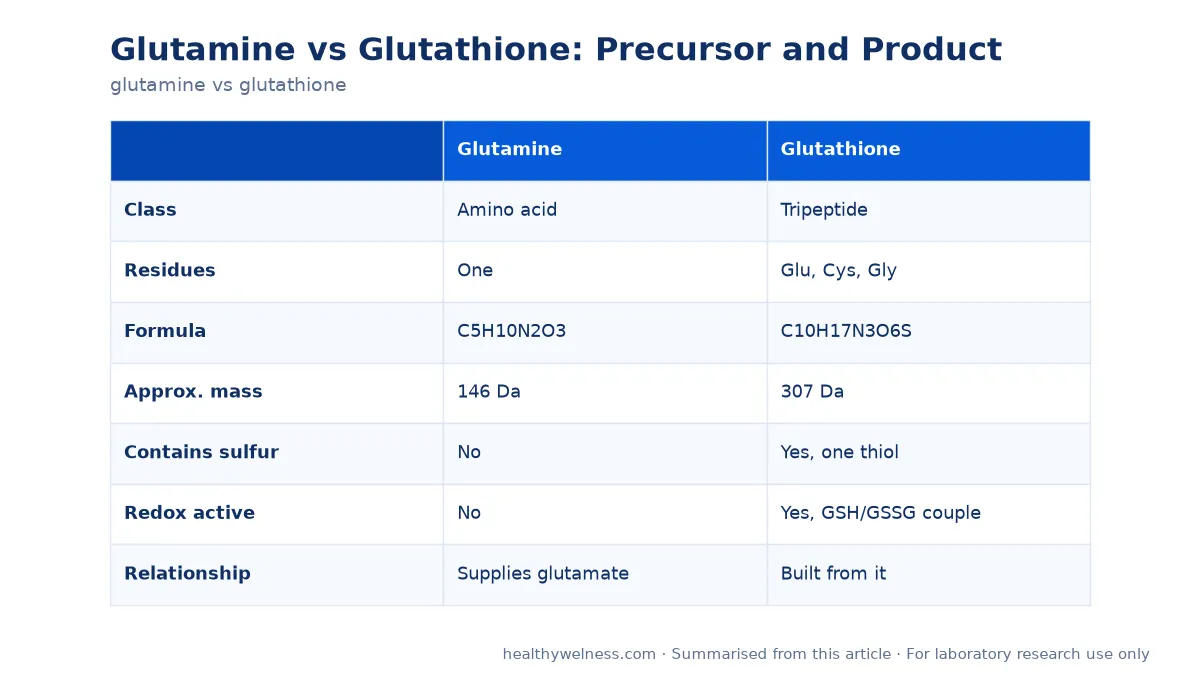
Side by side
| Glutamine | Glutathione | |
|---|---|---|
| Class | Amino acid | Tripeptide |
| Residues | One | Glu, Cys, Gly |
| Formula | C5H10N2O3 | C10H17N3O6S |
| Approx. mass | 146 Da | 307 Da |
| Contains sulfur | No | Yes, one thiol |
| Redox active | No | Yes, GSH/GSSG couple |
| Relationship | Supplies glutamate | Built from it |
Why the two names get confused
Both begin with the same four letters, both are sold as white research-grade solids, and both turn up in the same oxidative-stress papers. That is enough to make a catalogue look as though it lists one substance twice.
The chemistry separates them immediately. Glutamine is a single amino acid, one of the twenty that ribosomes assemble into proteins, and it is among the most abundant free amino acids in mammalian tissue (Wu, 2009). Glutathione is not an amino acid at all. It is a short peptide, three residues long, and it is not made by a ribosome. Two dedicated enzymes ligate it in sequence, which is why its structure contains a bond a ribosome could not make.
The γ bond is the structural tell
In an ordinary peptide the carboxyl group of one residue joins the amino group of the next. In glutathione the glutamate contributes its side-chain carboxyl instead. The resulting γ-glutamyl linkage is the reason the molecule survives in cytoplasm where ordinary tripeptides would be cleaved: most peptidases read α bonds and leave this one alone (Averill-Bates, 2023).
That single structural detail explains a practical observation. A tripeptide that resists general peptidases can accumulate to millimolar concentrations inside a cell, which is what makes glutathione usable as a cellular redox buffer rather than a transient signal.
What the precursor relationship actually is
Glutamine does not become glutathione in one step, and describing it as “converting” overstates the directness. The route runs through glutamate:
- Glutaminase hydrolyses glutamine to glutamate and ammonia.
- Glutamate-cysteine ligase joins glutamate to cysteine, forming the γ bond.
- Glutathione synthetase adds glycine.
Only the first residue traces back to glutamine. The cysteine, which carries all of the reducing chemistry, comes from elsewhere, and in most systems cysteine rather than glutamate is the limiting supply (Amores-Sánchez et al., 1999).
The experimental consequence is that glutamine availability and glutathione levels are linked but not proportional. In the A549 and H460 lung cancer lines, glutamine restriction did lower the glutathione pool and did shift radiation sensitivity (Sappington et al., 2016) — but that was a cell line in which glutamine flux was already the dominant carbon source. Generalising the ratio to another system is not supported by that design.
What each one is used to study
| Question | Which compound | Why |
|---|---|---|
| Redox buffering capacity | Glutathione | The GSH/GSSG ratio is the readout |
| Thiol conjugation chemistry | Glutathione | The thiol is the reactive group |
| Nitrogen and carbon supply | Glutamine | Major free amino acid pool |
| Precursor limitation | Both | One constrains the other |
Glutathione’s published roles extend well past antioxidant chemistry: it participates in conjugation reactions, in the handling of reactive electrophiles, and in processes reviewed across central nervous system tissue where several of its functions are unrelated to simple radical scavenging (Cooper et al., 1997). Treating it as “the antioxidant” is a simplification that an experimental design should not inherit.
What this means for a supply experiment
If the design is “add glutamine, measure glutathione”, three things have to be true for the result to mean what it appears to mean: glutamate supply has to be limiting in that system, cysteine must not be the tighter constraint, and the ligase steps must have capacity to use the extra substrate. The pathway diagram does not establish any of them, and in most tissues cysteine rather than glutamate is the step that binds (Amores-Sánchez et al., 1999).
| Assumption | Often true? |
|---|---|
| Glutamate is limiting | In high-flux cells |
| Cysteine is not limiting | Frequently false |
| Ligase has spare capacity | System-dependent |
A negative result in such an experiment is therefore not evidence that the precursor relationship is absent. It is more often evidence that a different step was the constraint.
Handling in the lab
The thiol that makes glutathione useful also makes it the more demanding of the two to handle. On exposure to air the reduced form (GSH) oxidises to the disulfide (GSSG), and any assay that reports a GSH/GSSG ratio is measuring something the handling itself can change.
- Minimise headspace and air exposure when a vial is opened, and limit the number of entries.
- Prepare working solutions close to the time of use rather than holding dilute aqueous stocks.
- Record whether a stated assay value refers to total glutathione or to the reduced form; the two numbers differ and the difference is the point.
- Keep the concentration arithmetic separate from the chemistry — the peptide calculator handles the label-weight-to-molarity step for either compound.
Glutamine has no thiol and no equivalent oxidation route. Its own instability in aqueous solution is a separate chemistry and should not be managed with the same assumptions.
Our glutathione research material is supplied as a solid for laboratory preparation. Specification details for a given batch are stated on its documentation rather than assumed from the compound name.
Related research
For the compound itself and what its literature covers, see what glutathione is. The relationship between glutathione recycling and the nicotinamide nucleotides is covered in NAD+ versus NADPH, and the broader redox couple in NAD+/NADH redox.
The same caution applies in reverse. A study reporting that glutamine restriction lowered glutathione has demonstrated a dependency in that system; it has not measured how much headroom existed before the restriction began, which is what would make the size of the effect comparable with another system.
Open questions
How tightly glutamine supply constrains the glutathione pool outside rapidly dividing cells is not settled. The clearest demonstrations come from cancer cell lines with unusually high glutamine flux, and extending that to primary tissue is an assumption rather than a finding. As of 2026-11-07, a PubMed search for “glutamine glutathione precursor” combined with “primary cells” or “non-proliferating” returned no study designed to test that extension directly; absence of such a study is a statement about this search, not evidence that the relationship does not hold.
Frequently asked questions
Is glutamine the same as glutathione?
No. Glutamine is a single amino acid. Glutathione is a tripeptide of glutamate, cysteine and glycine. The names are close because glutamine supplies the glutamate end of that tripeptide, but they are different molecules with different masses, different handling and different assays.
Does glutamine convert into glutathione?
Indirectly. Glutamine is hydrolysed to glutamate, and glutamate is one of the three residues ligated into glutathione. A labelled-glutamine study in A549 and H460 lung cancer cell lines traced glutamine carbon into the glutathione pool and reported that restricting glutamine lowered glutathione (Sappington et al., 2016).
Which one is the antioxidant?
Glutathione. The reducing chemistry sits in the cysteine thiol, which glutamine does not have. Glutamine’s connection to redox work is as a supply line for that cysteine-bearing tripeptide, not as a reducing agent in its own right.
Why do they appear in the same product lists?
Because both are sold as research-grade solids and both appear in oxidative-stress literature. The grouping reflects the research area, not shared chemistry: one is an amino acid of about 146 Da and the other a tripeptide of about 307 Da.
Do they need the same handling?
No. Glutathione carries a free thiol that oxidises to the disulfide GSSG on air exposure, so its handling is dominated by keeping oxygen away. Glutamine has no thiol and no equivalent oxidation route; its instability in solution is a different chemistry.
For laboratory research use only. The research materials supplied by HealthyWelness are not approved medicines, foods or cosmetics and are not for human or veterinary use. This article summarises published research and is not medical advice.
Sources
- Amores-Sánchez MI, et al. Glutamine, as a precursor of glutathione, and oxidative stress. Mol Genet Metab. 1999. PMID: 10356308
- Sappington DR, et al. Glutamine drives glutathione synthesis and contributes to radiation sensitivity of A549 and H460 lung cancer cell lines. Biochim Biophys Acta. 2016. PMID: 26825773
- Averill-Bates DA. The antioxidant glutathione. Vitam Horm. 2023. PMID: 36707132
- Wu G. Amino acids: metabolism, functions, and nutrition. Amino Acids. 2009. PMID: 19301095
- Cooper AJ, et al. Multiple roles of glutathione in the central nervous system. Biol Chem. 1997. PMID: 9377474