Ipamorelin vs MK-677: Peptide and Non-Peptide Secretagogues
Ipamorelin and MK-677 both act on the ghrelin receptor. One is a pentapeptide cleared in about 2 hours, the other an oral small molecule. Compared.

Cover illustration: AI-generated editorial artwork. Conceptual only; not an exact molecular structure, actual laboratory result or evidence of clinical effects.
Ipamorelin and MK-677 both activate the ghrelin receptor, but ipamorelin is a pentapeptide with a reported 2-hour half-life in volunteers, while MK-677 is an orally active non-peptide. The comparison is mostly about chemistry, selectivity and route, not about which receptor they reach.
For laboratory research use only. The research materials supplied by HealthyWelness are not approved medicines, foods or cosmetics and are not for human or veterinary use. This article summarises published research and is not medical advice.
- Ipamorelin is the pentapeptide Aib-His-D-2-Nal-D-Phe-Lys-NH2, identified in a series lacking the central Ala-Trp of GHRP-1 (Raun et al., 1998).
- In rat pituitary cells ipamorelin released growth hormone with an EC50 of 1.3 nmol/L, similar to GHRP-6 at 2.2 nmol/L (Raun et al., 1998).
- Ipamorelin’s terminal half-life in healthy male volunteers was 2 hours, with clearance of 0.078 L/h/kg (Gobburu et al., 1999).
- In older adults, MK-677 raised mean 24-hour growth hormone by enhancing pulse height and interpulse nadir without changing pulse number significantly (Chapman et al., 1996).
- In rats, ipamorelin’s systemic plasma clearance was about five-fold lower than GHRP-6, and it was excreted mainly in urine rather than bile (Johansen et al., 1998).
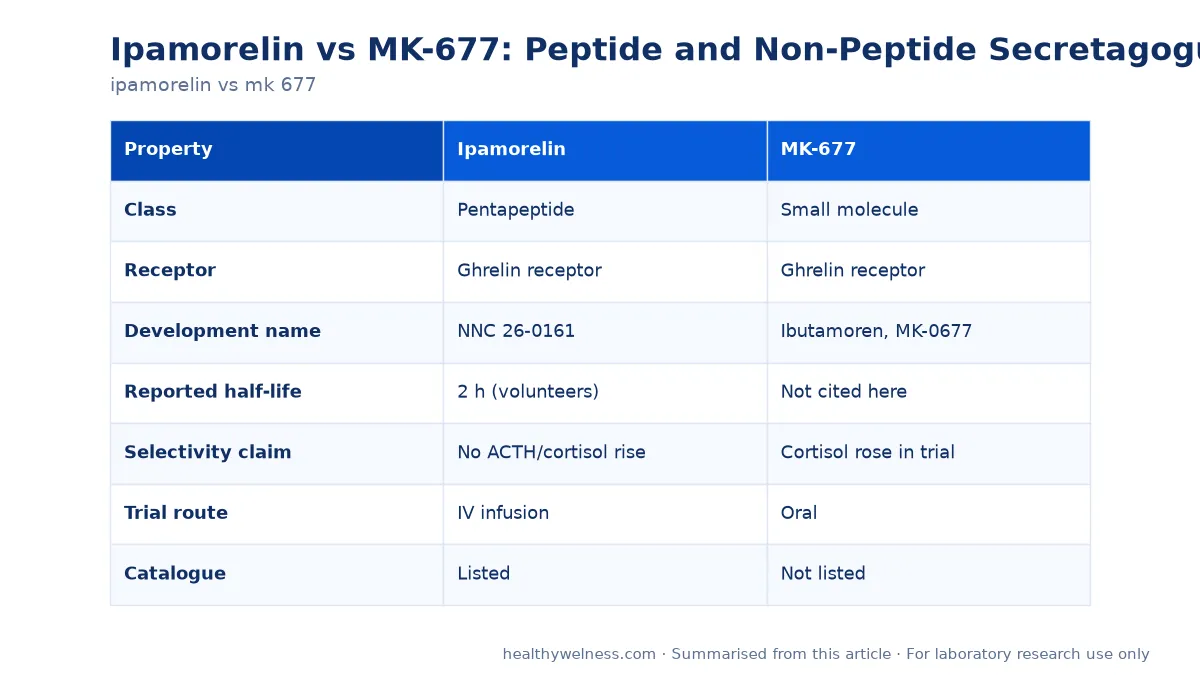
Head-to-head properties
| Property | Ipamorelin | MK-677 |
|---|---|---|
| Class | Pentapeptide | Small molecule |
| Receptor | Ghrelin receptor | Ghrelin receptor |
| Development name | NNC 26-0161 | Ibutamoren, MK-0677 |
| Reported half-life | 2 h (volunteers) | Not cited here |
| Selectivity claim | No ACTH/cortisol rise | Cortisol rose in trial |
| Trial route | IV infusion | Oral |
| Catalogue | Listed | Not listed |
The selectivity row is the main scientific difference, and it rests on two different kinds of evidence: animal hormone profiling for ipamorelin, and a two-year human trial for MK-677. Our ipamorelin research peptide is listed for laboratory use; MK-677 is not in our catalogue.
Where ipamorelin came from
Ipamorelin was the product of a chemistry programme at Novo Nordisk built around the GHRP family. Raun and colleagues describe it as emerging from compounds lacking the central Ala-Trp dipeptide of GHRP-1, and they profiled it against GHRP-6 and GHRP-2 in three systems (Raun et al., 1998).
| System | Ipamorelin | GHRP-6 | GHRP-2 |
|---|---|---|---|
| Rat pituitary EC50 | 1.3 nmol/L | 2.2 nmol/L | Not reported |
| Anaesthetised rat ED50 | 80 nmol/kg | 115 nmol/kg | Not reported |
| Conscious swine ED50 | 2.3 nmol/kg | 3.9 nmol/kg | 0.6 nmol/kg |
GHRP-2 was more potent in swine but had lower maximal efficacy. Ipamorelin matched GHRP-6 in potency and efficacy. The property that earned it the label “selective” was what it did not do: in swine it did not change FSH, LH, prolactin or TSH, and it did not raise ACTH or cortisol to the extent seen with GHRP-6 and GHRP-2 (Raun et al., 1998).
The attempt to make it oral
The same group tried to push the series toward oral activity by reducing size and hydrogen-bonding sites. A tetrapeptide derivative, NNC 26-0235, reached 10% oral bioavailability in dogs, and both it and ipamorelin raised basal growth hormone more than ten-fold after oral administration at high amounts (Ankersen et al., 1998). The fact that a peptide series needed this much engineering to approach oral activity is exactly the gap MK-677 was designed to close.
Pharmacokinetics: where the two diverge
Gobburu and colleagues ran a dose-escalation infusion study in healthy men and modelled both the peptide and the growth hormone it released. Pharmacokinetics were dose-proportional, with a 2-hour terminal half-life. Each infusion produced a single growth hormone episode peaking at 0.67 hours and declining to negligible levels, and the concentration for half-maximal stimulation was 214 nmol/L (Gobburu et al., 1999).
In rats, Johansen and colleagues found ipamorelin’s systemic clearance about five-fold lower than GHRP-6’s, with predominantly urinary excretion; 60–80% of an administered amount was recovered intact in bile and urine across the peptides tested. Nasal bioavailability of ipamorelin was about 20% (Johansen et al., 1998).
MK-677’s profile is different in kind. Chapman and colleagues sampled every 20 minutes over 24 hours after two weeks of oral administration in older adults and saw a sustained elevation of mean growth hormone, achieved through higher pulses and a higher nadir between them (Chapman et al., 1996). Ipamorelin, given as an infusion, produced a single discrete episode. One looks like a pulse; the other looks like a raised baseline.
What the longer MK-677 data add
The two-year trial by Nass and colleagues in 65 adults aged 60 to 81 is the largest controlled dataset in this comparison. Growth hormone and IGF-1 rose to young-adult levels. The trial also recorded higher fasting glucose, lower insulin sensitivity, higher cortisol, transient appetite increase and mild oedema (Nass et al., 2008). The cortisol finding is relevant because ipamorelin’s original distinguishing feature was the absence of that signal in animal profiling.
There is no comparable long-duration controlled dataset for ipamorelin. Its human evidence is the infusion PK/PD study; its other published work is preclinical, including a rat postoperative ileus model in which repeated intravenous ipamorelin increased faecal pellet output and food intake (Venkova et al., 2009).
Same receptor, different exposure shapes
It is tempting to treat two agonists at one receptor as interchangeable once their potencies are matched. The published data on these two compounds argue against that, because what reaches the receptor over time is very different.
| Exposure feature | Ipamorelin (infusion) | MK-677 (oral, repeated) |
|---|---|---|
| GH pattern reported | Single episode | Higher pulses and nadir |
| GH peak timing | 0.67 h | Spread over 24 h |
| Pulse number | Not applicable | Not significantly changed |
| Study length | Single session | Weeks to two years |
Sources: Gobburu et al., 1999 for ipamorelin; Chapman et al., 1996 and Nass et al., 2008 for MK-677. A receptor exposed intermittently and a receptor exposed continuously can adapt differently, through internalisation, desensitisation or changes in expression, so a downstream readout after weeks of MK-677 is not a scaled-up version of a single ipamorelin response.
For the same reason, the cortisol contrast should be read with its context attached. Raun and colleagues measured acute hormone responses in swine (Raun et al., 1998); Nass and colleagues measured cortisol after months of oral exposure in older adults (Nass et al., 2008). The finding that one compound raised cortisol and the other did not comes from studies that differ in species, route and duration as well as in compound, and a direct comparison under matched conditions has not been published.
Practical points for a design
- Choose ipamorelin when a discrete, short secretagogue signal is wanted, or when cortisol and prolactin need to stay out of the readout.
- MK-677 produces a sustained elevation; that is a different experimental condition, not a stronger version of the same one.
- Gut-motility effects are a ghrelin-receptor property and can confound feeding or body-mass readouts with either compound.
- As of 2026-11-03, no head-to-head study was found in PubMed under “ipamorelin ibutamoren”.
One last caution concerns the term “selective” itself. In Raun’s usage it means that ipamorelin’s endocrine profile in swine resembled GHRH’s, with no ACTH or cortisol rise even at amounts more than 200-fold above the ED50 for growth hormone release (Raun et al., 1998). It does not mean the compound acts only on the pituitary; the ghrelin receptor is also expressed in the gut, as the ileus work shows.
Handling and related reading
Ipamorelin is supplied lyophilised; solution preparation is covered in ipamorelin reconstitution and longer-term storage in ipamorelin stability and storage. The half-life calculator can plot the 2-hour figure for sampling plans. For the peptide family context see the ipamorelin overview and hexarelin versus ipamorelin.
Frequently asked questions
Do ipamorelin and MK-677 act on the same receptor?
Yes. Both are growth hormone secretagogues acting at the ghrelin receptor. Ipamorelin released growth hormone through a GHRP-like receptor in antagonist profiling (Raun et al., 1998), and MK-677 is described as an oral ghrelin mimetic (Nass et al., 2008).
What is the structural difference?
Ipamorelin is a pentapeptide, Aib-His-D-2-Nal-D-Phe-Lys-NH2 (Raun et al., 1998). MK-677 (ibutamoren) is a non-peptide small molecule, which is the reason it was studied as an orally active compound.
What half-life has been reported for ipamorelin?
In healthy male volunteers given ipamorelin by 15-minute infusion, the terminal half-life was 2 hours, with clearance of 0.078 L/h/kg and a steady-state volume of distribution of 0.22 L/kg (Gobburu et al., 1999).
Why is ipamorelin called selective?
In swine, none of the secretagogues tested by Raun and colleagues affected FSH, LH, prolactin or TSH, and ipamorelin was the compound singled out as the first selective growth hormone secretagogue because it did not raise ACTH or cortisol beyond the levels seen with GHRH (Raun et al., 1998).
Has any study compared ipamorelin and MK-677 head to head?
As of 2026-11-03, a PubMed search for “ipamorelin ibutamoren” returned review articles and a medicinal-chemistry paper on hybrid secretagogues, but no head-to-head study. That reflects one search, not proof that none exists.
For laboratory research use only. The research materials supplied by HealthyWelness are not approved medicines, foods or cosmetics and are not for human or veterinary use. This article summarises published research and is not medical advice.
Sources
- Raun K, et al. Ipamorelin, the first selective growth hormone secretagogue. Eur J Endocrinol. 1998. PMID: 9849822
- Gobburu JV, et al. Pharmacokinetic-pharmacodynamic modeling of ipamorelin, a growth hormone releasing peptide, in human volunteers. Pharm Res. 1999. PMID: 10496658
- Johansen PB, et al. Pharmacokinetic evaluation of ipamorelin and other peptidyl growth hormone secretagogues with emphasis on nasal absorption. Xenobiotica. 1998. PMID: 9879640
- Ankersen M, et al. A new series of highly potent growth hormone-releasing peptides derived from ipamorelin. J Med Chem. 1998. PMID: 9733495
- Nass R, et al. Effects of an oral ghrelin mimetic on body composition and clinical outcomes in healthy older adults: a randomized trial. Ann Intern Med. 2008. PMID: 18981485
- Chapman IM, et al. Stimulation of the growth hormone (GH)-insulin-like growth factor I axis by daily oral administration of a GH secretogogue (MK-677) in healthy elderly subjects. J Clin Endocrinol Metab. 1996. PMID: 8954023
- Venkova K, et al. Efficacy of ipamorelin, a novel ghrelin mimetic, in a rodent model of postoperative ileus. J Pharmacol Exp Ther. 2009. PMID: 19289567