L-Glutathione vs Glutathione: One Molecule, Two Labels
L-glutathione and glutathione name the same tripeptide. The distinctions that do matter in a lab are reduced vs oxidised form and altered stereoisomers.

Cover illustration: AI-generated editorial artwork. Conceptual only; not an exact molecular structure, actual laboratory result or evidence of clinical effects.
L-glutathione and glutathione are the same molecule: the tripeptide gamma-L-glutamyl-L-cysteinyl-glycine. The “L” only states the stereochemistry that natural glutathione already has. The distinctions that change a result are reduced (GSH) versus oxidised (GSSG) form, and synthetic analogues with altered stereochemistry.
For laboratory research use only. The research materials supplied by HealthyWelness are not approved medicines, foods or cosmetics and are not for human or veterinary use. This article summarises published research and is not medical advice.
- Glutathione is gamma-L-glutamyl-L-cysteinyl-glycine, a low-molecular-weight thiol described as the central redox agent of most aerobic organisms (Lapenna, 2023).
- Glycine has no stereocentre, so the “L” in L-glutathione refers to its glutamate and cysteine residues, which are L in the natural molecule.
- Reduced glutathione (GSH) can make up as much as 98% of cellular glutathione under normal conditions (Owen and Butterfield, 2010).
- Gamma-glutamyl transpeptidase shows relatively low stereospecificity at the alpha-stereocentre of its donor substrates but marked stereospecificity at other positions (Lherbet and Keillor, 2004).
- Native glutathione’s oral bioavailability is reported to be below 1% because of enzymatic degradation and poor gastrointestinal absorption (Yin et al., 2025).
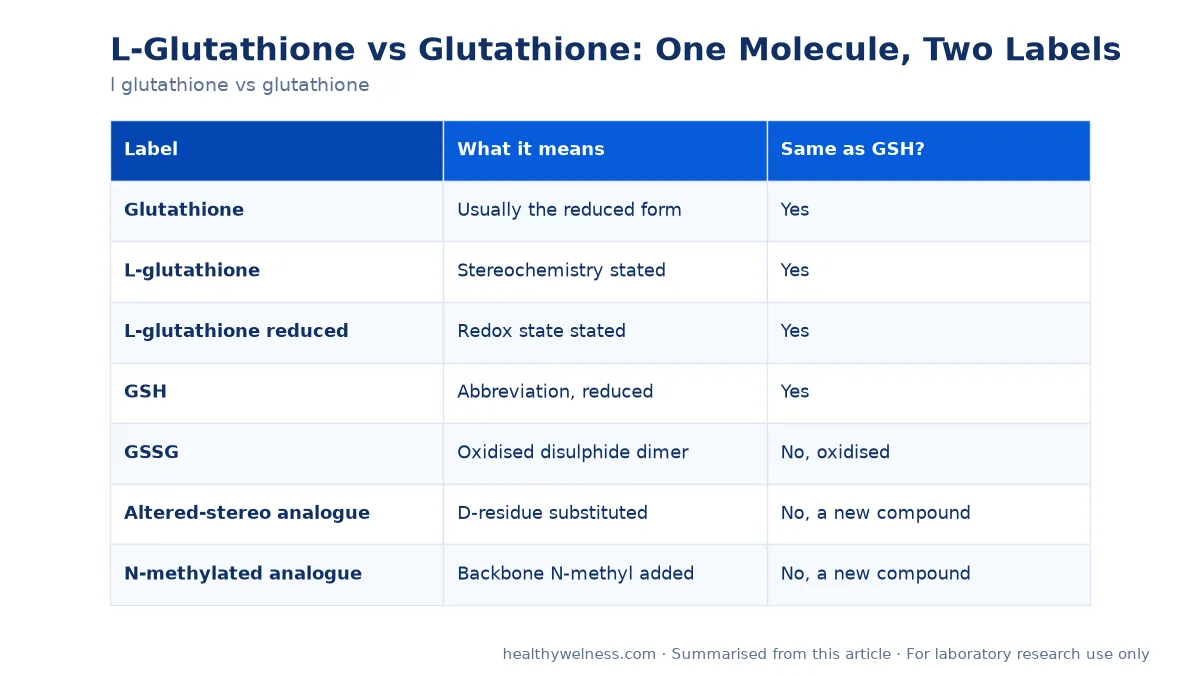
The names in one table
| Label | What it means | Same as GSH? |
|---|---|---|
| Glutathione | Usually the reduced form | Yes |
| L-glutathione | Stereochemistry stated | Yes |
| L-glutathione reduced | Redox state stated | Yes |
| GSH | Abbreviation, reduced | Yes |
| GSSG | Oxidised disulphide dimer | No, oxidised |
| Altered-stereo analogue | D-residue substituted | No, a new compound |
| N-methylated analogue | Backbone N-methyl added | No, a new compound |
The first four rows describe one substance. The last three are chemically different and would behave differently in any assay. Our glutathione research material is the reduced L-tripeptide.
Certificates are available for listed products — contact us for the latest report.
Where the “L” comes from
Amino acids other than glycine have a chiral alpha-carbon and occur in two mirror-image forms, L and D. Proteins and nearly all natural peptides are built from L-amino acids. Glutathione is synthesised in the cytosol by glutamate-cysteine ligase, which joins L-glutamate and L-cysteine, and glutathione synthase, which adds glycine (Lapenna, 2023). The product therefore has two stereocentres, both L. Writing “L-glutathione” adds no information that “glutathione” lacks, but it is a common convention on chemical labels, where stereochemistry is often spelled out by default.
Commercial labels sometimes use “L-glutathione” in a way that implies superiority over plain “glutathione”. There is no chemical basis for that: an analytical method cannot find a difference between two samples that differ only in their name. The real quality questions for a glutathione sample are its purity, its oxidised fraction and its water content, which are covered below.
Why stereochemistry would matter if it changed
Enzymes that handle glutathione recognise its shape. Gamma-glutamyl transpeptidase (GGT), the ectoenzyme that begins extracellular glutathione breakdown, was found by Lherbet and Keillor to be relatively tolerant at the alpha-stereocentre of its donor substrates but strikingly selective elsewhere: of two separated diastereoisomers of L-methionine sulfoxide, it bound one with a Ki of 3.5 mM and did not recognise the other (Lherbet and Keillor, 2004). The same study used a sulfoxide as a new pharmacophore to make a glutathione analogue that inhibited GGT with a Ki of 53 micromolar. A real stereochemical change to glutathione would therefore be expected to change how it is processed, which is exactly why altered-stereochemistry analogues are made as research tools.
Synthetic analogues that genuinely differ
Yin and colleagues set out to overcome glutathione’s poor oral availability by chemical modification. They used Fmoc solid-phase synthesis to make native glutathione plus six analogues: three with altered stereochemistry and three N-methylated derivatives, and characterised them by RP-HPLC, electrospray mass spectrometry, FTIR and NMR (Yin et al., 2025).
| Compound set | Modification | Reported outcome |
|---|---|---|
| Native GSH | None | Reference |
| Three stereo-analogues | Altered stereochemistry | Not the lead candidate |
| N-methylated set | Backbone N-methylation | Included the lead |
| Lead (N-methyl Cys) | Methylated cysteine N | 16.8x plasma t1/2 in vivo |
The lead compound, with an N-methylated cysteine, showed greater resistance to enzymatic degradation, better antioxidant activity in UVA-irradiated fibroblasts, a 16.8-fold longer plasma half-life and a 16.1-fold higher oral bioavailability than native glutathione in the authors’ in vivo model (Yin et al., 2025). Those analogues are new chemical entities. None of them is “L-glutathione”, and none should be confused with the natural tripeptide in an experiment.
The distinction that matters most: reduced versus oxidised
The label that actually changes behaviour is the redox state. Reduced glutathione carries a free thiol on its cysteine. Two molecules can lose a pair of electrons and join through a disulphide bond, giving GSSG with roughly twice the mass. Glutathione reductase converts GSSG back to GSH inside cells (Lapenna, 2023).
Owen and Butterfield describe GSH as present in micromolar concentrations in body fluids and millimolar concentrations in tissue, with the reduced form up to 98% of the cellular total under normal conditions. They present the GSH/GSSG ratio as an indicator of cellular health that falls in conditions such as Parkinson’s and Alzheimer’s disease, and describe a plate-reader method for measuring it in many samples (Owen and Butterfield, 2010).
A caution about interpreting the ratio
Flohe’s critique is worth reading alongside any ratio measurement. He argues that the GSSG/GSH concentration ratio reflects little more than a steady state produced by fast enzymatic reactions, that GSH-using enzymes respond to the concentration of GSH rather than to its square as the Nernst equation would predict, and that a calculated GSSG/GSH redox potential is irrelevant to the steering of biological processes. He allows that it can still be useful as an analytical tool for detecting disturbances (Flohe, 2013). In practice, report the concentrations of both species, not only the ratio or a derived potential.
What to check on a glutathione certificate
Since the name tells you nothing beyond “this is glutathione”, the useful information about a sample is on its certificate of analysis. The general points below apply to any reduced glutathione material and are about reading the document in hand, not about any particular supplier.
| Field | Why it matters for GSH | What to look for |
|---|---|---|
| Identity method | Confirms the tripeptide | MS, NMR or IR named |
| Assay or purity | Fraction that is GSH | Method and value stated |
| Oxidised glutathione | GSSG is a known impurity | Listed separately |
| Water content | Affects net mass | Karl Fischer or LOD |
| Batch number | Links report to vial | Matches the label |
| Test date | Thiols age | Recent relative to use |
Two of these fields are specific to glutathione. The oxidised fraction matters because GSSG forms from GSH on storage and is the main way the material degrades; a purity value that does not separate the two can overstate how much active thiol is present. The test date matters for the same reason: a report produced long before a vial is opened describes the material as it was, not as it is.
Stereochemical purity is rarely reported for glutathione, and for good reason. Biosynthetic and fermentation routes give the natural L,L-form, and a D-residue would need a deliberate synthetic step. If a laboratory has reason to suspect a stereoisomer, for instance when working with the synthetic analogues described above, chiral chromatography is the appropriate test. Mass spectrometry cannot see stereochemistry at all, since stereoisomers have identical mass, and ordinary reversed-phase HPLC separates some diastereomers but not mirror-image pairs.
Handling in the lab
For the dry material, the relevant checks are the oxidised fraction and the water content. A reduced glutathione sample that has been exposed to air and moisture accumulates GSSG, and the GSH content falls without any visible change in the powder. Reversed-phase HPLC separates GSH from GSSG, and mass spectrometry distinguishes them by mass, around 307 versus 613.
In solution, oxidation accelerates. Prepare solutions close to use, keep them cold, and use high-purity water, since trace metals catalyse thiol oxidation. Concentration is calculated from net mass and volume with the peptide calculator. A worked example for a common vial size is in reconstituting 600 mg glutathione.
Related research
The parent overview is what is glutathione. Its precursor is compared in NAC versus glutathione, and the physical form of the dry material is discussed in glutathione powder.
Frequently asked questions
Is L-glutathione different from glutathione?
No. Natural glutathione is gamma-L-glutamyl-L-cysteinyl-glycine, built from L-glutamate and L-cysteine plus glycine, which has no stereocentre. “L-glutathione” is the same molecule with its stereochemistry stated in the name.
Why do some labels say L-glutathione reduced?
Because glutathione exists in two redox states. Reduced glutathione (GSH) has a free thiol; oxidised glutathione (GSSG) is two GSH molecules joined by a disulphide bond, with roughly twice the molecular weight. “Reduced” tells you which one the material is meant to be.
Does a D-form of glutathione exist?
Synthetic analogues with altered stereochemistry have been made. Yin and colleagues synthesised three such analogues alongside N-methylated derivatives to study resistance to enzymatic breakdown; an N-methylated cysteine analogue, not a stereoisomer, performed best in their tests (Yin et al., 2025).
How much of cellular glutathione is normally reduced?
Reduced GSH can make up as much as 98% of cellular glutathione under normal conditions, and the GSH/GSSG ratio is widely used as an indicator of redox state (Owen and Butterfield, 2010).
Is the GSH/GSSG ratio a true measure of redox potential?
It is debated. Flohe argued that the ratio reflects a steady state set by fast enzymatic reactions and that a Nernst-derived GSSG/GSH potential does not steer biological processes, although it can flag disturbances in redox metabolism (Flohe, 2013).
For laboratory research use only. The research materials supplied by HealthyWelness are not approved medicines, foods or cosmetics and are not for human or veterinary use. This article summarises published research and is not medical advice.
Sources
- Lapenna D. Glutathione and glutathione-dependent enzymes: From biochemistry to gerontology and successful aging. Ageing Res Rev. 2023. PMID: 37683986
- Owen JB, et al. Measurement of oxidized/reduced glutathione ratio. Methods Mol Biol. 2010. PMID: 20700719
- Flohé L. The fairytale of the GSSG/GSH redox potential. Biochim Biophys Acta. 2013. PMID: 23127894
- Lherbet C, et al. Probing the stereochemistry of the active site of gamma-glutamyl transpeptidase using sulfur derivatives of l-glutamic acid. Org Biomol Chem. 2004. PMID: 14737648
- Yin N, et al. Enhancing the Oral Bioavailability of Glutathione Using Innovative Analogue Approaches. Pharmaceutics. 2025. PMID: 40143049