MK-677 vs Sermorelin: Ghrelin Mimetic or GHRH Analogue
MK-677 is an oral non-peptide ghrelin-receptor agonist; sermorelin is a GHRH peptide fragment. Receptors, second messengers and trial evidence compared.


Cover illustration: AI-generated editorial artwork. Conceptual only; not an exact molecular structure, actual laboratory result or evidence of clinical effects.
MK-677 is an orally active, non-peptide ghrelin-receptor agonist; sermorelin is a peptide fragment of GHRH that acts on the GHRH receptor. Both raise growth hormone output from the same pituitary cells, but through different receptors and different second messengers, and their trial evidence covers different questions.
For laboratory research use only. The research materials supplied by HealthyWelness are not approved medicines, foods or cosmetics and are not for human or veterinary use. This article summarises published research and is not medical advice.
- MK-677 (ibutamoren) is described as an orally active ghrelin mimetic that raised growth hormone and IGF-1 into young-adult ranges in a two-year trial in adults aged 60 to 81 (Nass et al., 2008).
- Sermorelin is GHRH(1-29)-NH2, which acts on the family B-III GHRH receptor of pituitary somatotrophs (Mayo et al., 2000).
- GHRH raises cAMP in somatotrophs, whereas growth hormone secretagogues raise intracellular calcium (Anderson et al., 2005).
- MK-677 increased growth hormone pulse height and interpulse nadir without significantly changing pulse number in healthy elderly subjects (Chapman et al., 1996).
- A 12-month randomised trial of MK-677 in 563 people with mild to moderate Alzheimer disease found no clinical effect on progression (Sevigny et al., 2008).
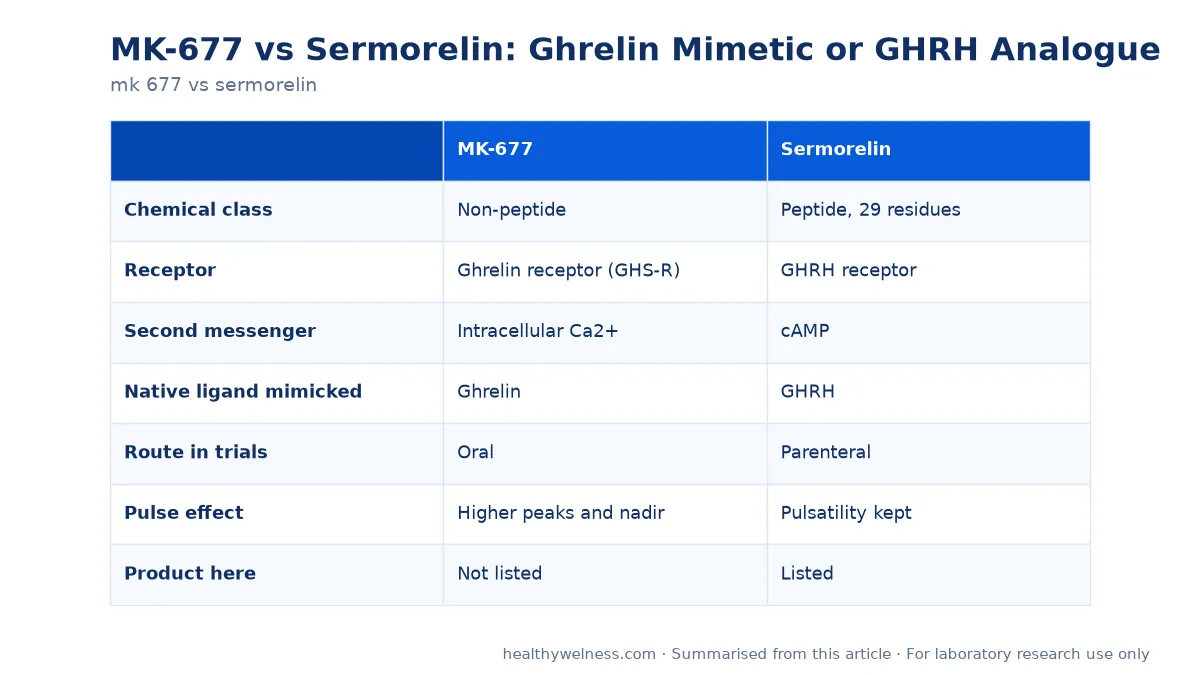
Receptor, messenger and route compared
| MK-677 | Sermorelin | |
|---|---|---|
| Chemical class | Non-peptide | Peptide, 29 residues |
| Receptor | Ghrelin receptor (GHS-R) | GHRH receptor |
| Second messenger | Intracellular Ca2+ | cAMP |
| Native ligand mimicked | Ghrelin | GHRH |
| Route in trials | Oral | Parenteral |
| Pulse effect | Higher peaks and nadir | Pulsatility kept |
| Product here | Not listed | Listed |
MK-677 is not in our catalogue; it appears here because the comparison is commonly searched. Our sermorelin acetate research peptide is listed for laboratory work.
Two receptors on one cell
Growth hormone release from the pituitary is controlled by at least two stimulatory inputs and one inhibitory one. Hypothalamic GHRH stimulates, somatostatin inhibits, and ghrelin, the natural ligand of the growth hormone secretagogue receptor, adds a third input. Anderson and colleagues summarise the discovery sequence: Bowers’ synthetic GHRP-6 came first, the search for a receptor distinct from the GHRH receptor followed, and ghrelin was identified as that receptor’s native ligand (Anderson et al., 2005).
MK-677 belongs to the non-peptide end of that secretagogue search. Sermorelin belongs to the GHRH lineage. They reach the same somatotroph from different sides.
Why the second messenger matters
The GHRH receptor couples to Gs and raises cAMP, which both releases stored hormone and, through CREB and Pit-1, increases synthesis (Mayo et al., 2000). The ghrelin receptor raises intracellular calcium (Anderson et al., 2005). Two signals arriving through different messengers can combine more than additively on a single cell, which is the rationale behind experiments that pair a GHRH analogue with a secretagogue. That rationale is discussed for the peptide secretagogues in GHRP versus GHRH analogues.
What the MK-677 trials actually reported
MK-677 has a larger controlled-trial record than sermorelin in adults, and it is worth stating what those trials measured rather than what is said about them.
| Trial | Population | Primary endpoints | Reported outcome |
|---|---|---|---|
| Chapman 1996 | 32 adults, 64–81 y | 24-h GH profile | Pulse height rose |
| Nass 2008 | 65 adults, 60–81 y | Fat-free mass, visceral fat | FFM rose; VAT unchanged |
| Sevigny 2008 | 563 with Alzheimer | CIBIC-plus, ADAS-Cog | No effect on progression |
Nass and colleagues also reported adverse events and metabolic changes in the MK-677 group: an increase in fasting blood glucose, decreased insulin sensitivity, a rise in cortisol, transient appetite increase and mild lower-extremity oedema (Nass et al., 2008). These are part of the record and belong in any honest comparison.
The Alzheimer trial is a useful counterweight. MK-677 raised IGF-1, the mechanism hypothesised to matter for amyloid clearance in animals, yet clinical progression did not differ from placebo over 12 months (Sevigny et al., 2008). Engaging a pathway and changing an outcome are separate claims.
Sermorelin’s evidence is older and narrower
The most informative human data for sermorelin’s sequence come from paediatric studies of GHRH(1-29)NH2. In eight pre-pubertal children with partial growth hormone insufficiency, continuous infusion for up to a year produced sustained augmentation of pulsatile secretion without desensitisation, and responsiveness to a supramaximal bolus stayed constant (Brain et al., 1990).
Pharmacokinetically, the fragment is short-lived. In rats, GRF(1-29)-amide had an intravenous half-life of 6.2 minutes and about 5% of a subcutaneous administration reached the circulation (Rafferty et al., 1988). MK-677’s oral activity is the obvious contrast, and it is the main practical reason the two are compared.
Where each compound acts in the axis
A useful way to frame the comparison is to place both compounds on the hypothalamic-pituitary map and ask what each one bypasses and what each one still depends on.
| Level | MK-677 relies on | Sermorelin relies on |
|---|---|---|
| Hypothalamus | Not addressed here | Bypassed |
| Pituitary receptor | Ghrelin receptor | GHRH receptor |
| Somatostatin tone | Still modulates output | Still sets pulse timing |
| Somatotroph mass | Required | Required |
| Liver response | Needed for IGF-1 | Needed for IGF-1 |
The somatostatin row is the one most often overlooked. Neither compound removes the inhibitory input. Brain and colleagues interpreted the persistence of pulses during continuous GHRH(1-29)NH2 infusion as evidence that somatostatin determines pulse frequency (Brain et al., 1990), and Chapman and colleagues found that MK-677 raised pulse height without significantly changing pulse number (Chapman et al., 1996). In both cases the rhythm survived; what changed was how much hormone each pulse carried.
The somatotroph row matters for model choice. The GHRH receptor regulates somatotroph proliferation as well as secretion, and a mouse with a non-binding receptor mutation shows severe somatotroph hypoplasia (Mayo et al., 2000). A model with reduced somatotroph mass will under-respond to both compounds, and a difference between them in such a model may reflect the cell population more than the receptor.
Reading the comparison correctly
- Not a potency contest. The two act on different receptors, so a stronger growth hormone response from one does not make it a better tool for every question.
- Pulse shape differs in detail. MK-677 raised both peaks and troughs (Chapman et al., 1996); a GHRH analogue works within the somatostatin-set rhythm (Brain et al., 1990).
- Off-target hormones. Secretagogue-receptor agonism has been associated with cortisol rises in the MK-677 trial; GHRH receptor expression is largely pituitary-restricted (Mayo et al., 2000).
- Direct comparison is missing. As of 2026-11-03, a PubMed search for “sermorelin ibutamoren” returned two reviews and no head-to-head study.
What a fair comparison would need
Because no head-to-head study was found, it is worth spelling out what one would have to control for before any statement of the form “MK-677 produces more growth hormone than sermorelin” could be made. Route is the first problem: the MK-677 trials used oral administration (Nass et al., 2008), while sermorelin’s sequence has been studied by infusion and parenteral routes with low systemic availability in rats (Rafferty et al., 1988). Duration is the second: the MK-677 data span weeks to two years, whereas much of the GHRH(1-29) data come from acute or infusion studies. The third is the readout window, since a discrete pulse and a raised baseline need different sampling to be compared at all. A study that matched all three, in the same population, would be the minimum for a direct comparison, and until one exists each compound’s evidence has to be read on its own terms.
Handling in the lab
MK-677 is a small molecule and behaves like one: solubility and pH, not peptide degradation, are the main constraints. Sermorelin is a lyophilised peptide; its solution handling and concentration arithmetic with the peptide calculator are covered in sermorelin reconstitution and storage.
Related research
The receptor pathway behind sermorelin is set out in how sermorelin works. For the peptide side of the secretagogue family, see ipamorelin versus MK-677 and the GHRP-6 overview.
Frequently asked questions
What is the basic difference between MK-677 and sermorelin?
MK-677 (ibutamoren) is an orally active, non-peptide growth hormone secretagogue that acts on the ghrelin receptor (Nass et al., 2008). Sermorelin is GHRH(1-29)-NH2, a peptide that acts on the GHRH receptor (Mayo et al., 2000). They converge on the somatotroph through different receptors.
Do they use the same second messenger?
No. GHRH raises cAMP in somatotrophs, whereas growth hormone secretagogues raise intracellular calcium, and the two act through distinct G protein-coupled receptors (Anderson et al., 2005).
What did the MK-677 trials in older adults measure?
A two-year randomised placebo-controlled trial in 65 healthy adults aged 60 to 81 measured growth hormone, IGF-1, fat-free mass and abdominal visceral fat as primary endpoints, and reported increases in growth hormone and IGF-1 alongside a rise in fasting glucose and a fall in insulin sensitivity (Nass et al., 2008).
How does each affect the growth hormone pulse pattern?
In older adults, MK-677 increased pulse height and interpulse nadir without significantly changing pulse number (Chapman et al., 1996). Continuous GHRH(1-29)NH2 infusion in children likewise preserved pulsatile secretion (Brain et al., 1990).
Has anyone compared MK-677 and sermorelin directly?
As of 2026-11-03, a PubMed search for “sermorelin ibutamoren” returned two review articles and no head-to-head study. That reflects one search; it does not prove no comparison exists.
For laboratory research use only. The research materials supplied by HealthyWelness are not approved medicines, foods or cosmetics and are not for human or veterinary use. This article summarises published research and is not medical advice.
Sources
- Nass R, et al. Effects of an oral ghrelin mimetic on body composition and clinical outcomes in healthy older adults: a randomized trial. Ann Intern Med. 2008. PMID: 18981485
- Chapman IM, et al. Stimulation of the growth hormone (GH)-insulin-like growth factor I axis by daily oral administration of a GH secretogogue (MK-677) in healthy elderly subjects. J Clin Endocrinol Metab. 1996. PMID: 8954023
- Anderson LL, et al. Physiology of ghrelin and related peptides. Domest Anim Endocrinol. 2005. PMID: 15927771
- Mayo KE, et al. Regulation of the pituitary somatotroph cell by GHRH and its receptor. Recent Prog Horm Res. 2000. PMID: 11036940
- Brain CE, et al. Continuous subcutaneous GHRH(1-29)NH2 promotes growth over 1 year in short, slowly growing children. Clin Endocrinol (Oxf). 1990. PMID: 2140733
- Sevigny JJ, et al. Growth hormone secretagogue MK-677: no clinical effect on AD progression in a randomized trial. Neurology. 2008. PMID: 19015485
- Rafferty B, et al. Pharmacokinetic evaluation of superactive analogues of growth hormone-releasing factor (1-29)-amide. Peptides. 1988. PMID: 2896343