How Does Sermorelin Work? The GHRH Receptor Pathway
Sermorelin is GHRH(1-29)-NH2. It binds the pituitary GHRH receptor, raises cAMP and leaves pulse timing to somatostatin. The pathway, step by step.

Cover illustration: AI-generated editorial artwork. Conceptual only; not an exact molecular structure, actual laboratory result or evidence of clinical effects.
Sermorelin works by binding the GHRH receptor on pituitary somatotroph cells, which raises cAMP and triggers growth hormone release and synthesis. It is the 1–29 amide fragment of native growth hormone-releasing hormone, so it uses the same receptor and leaves the timing of pulses to somatostatin.
For laboratory research use only. The research materials supplied by HealthyWelness are not approved medicines, foods or cosmetics and are not for human or veterinary use. This article summarises published research and is not medical advice.
- Sermorelin corresponds to GHRH(1-29)-NH2, the N-terminal 29 residues of human growth hormone-releasing hormone with a C-terminal amide.
- The GHRH receptor is a family B-III G protein-coupled receptor expressed predominantly in pituitary somatotroph cells (Mayo et al., 2000).
- GHRH receptor signalling runs mainly through cAMP, protein kinase A and CREB, with Pit-1 as a downstream target (Mayo et al., 1995).
- During continuous GHRH(1-29)NH2 infusion in children, growth hormone secretion remained pulsatile, implicating somatostatin in pulse timing (Brain et al., 1990).
- GHRH(1-29)-NH2 had a disappearance half-time of 4.3 minutes during intravenous infusion in normal men (Soule et al., 1994).
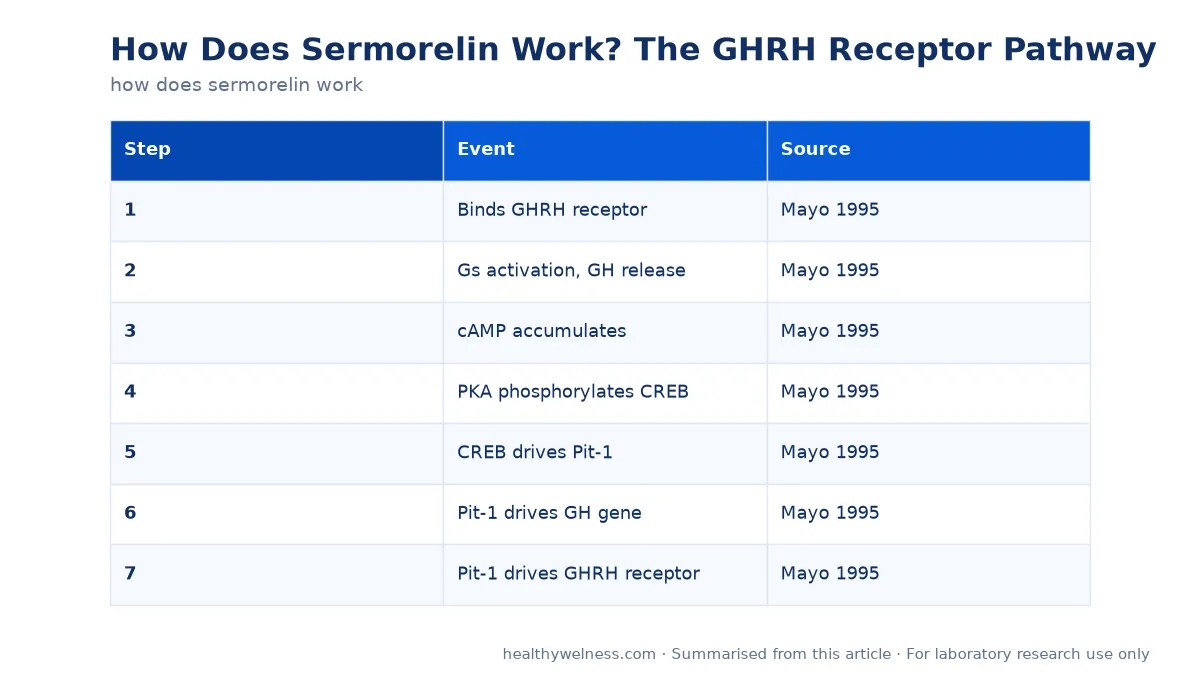
The pathway from receptor to hormone
| Step | Event | Source |
|---|---|---|
| 1 | Binds GHRH receptor | Mayo 1995 |
| 2 | Gs activation, GH release | Mayo 1995 |
| 3 | cAMP accumulates | Mayo 1995 |
| 4 | PKA phosphorylates CREB | Mayo 1995 |
| 5 | CREB drives Pit-1 | Mayo 1995 |
| 6 | Pit-1 drives GH gene | Mayo 1995 |
| 7 | Pit-1 drives GHRH receptor | Mayo 1995 |
This is the model laid out by Mayo and colleagues from their work on the cloned receptor. Two features matter for anyone designing an experiment around sermorelin. First, the pathway does two things at once: it releases stored hormone from secretory granules and it increases synthesis of new hormone. Second, the same transcription factor that turns on the growth hormone gene also turns on the receptor gene, so the system reinforces its own responsiveness (Mayo et al., 1995).
Why a 29-residue fragment is enough
Native GHRH is 44 residues long. The biological activity sits in the N-terminal portion, and GHRH(1-29)-NH2 is the fragment that retains it. The C-terminal amide matters: it mimics the native peptide’s terminus and contributes to receptor recognition. This is why sermorelin is described as an analogue of GHRH rather than a fragment in the loose sense.
What the short sequence does not do is resist degradation. The native peptide is cleaved at its N-terminus, and sermorelin carries the same vulnerable sequence. That explains its brief circulating lifetime, covered in the next section, and it is the problem that later analogues such as tesamorelin and CJC-1295 were built to address. The structural lineage is traced in sermorelin versus CJC-1295.
For material identity, the sequence and salt form appear on the specification of our sermorelin acetate research peptide; the acetate counter-ion changes the weight figure, not the active sequence.
What the receptor biology adds
The receptor itself is regulated in ways that affect how any GHRH analogue behaves. Mayo and colleagues report that its gene promoter is selectively active in pituitary cells and controlled by Pit-1, that rat pituitary expression shows a sexual dimorphism suggesting gonadal-steroid regulation, and that glucocorticoids are potent positive regulators of receptor expression (Mayo et al., 2000).
| Factor | Effect on GHRH receptor | Experimental consequence |
|---|---|---|
| Pit-1 | Required for expression | Pit-1-deficient models lack it |
| Glucocorticoids | Potent up-regulation | Stress state is a variable |
| Sex (rat) | Dimorphic expression | Sex must be balanced |
| Splice variant | Binds, does not signal | Binding is not activity |
The last row deserves emphasis. A variant receptor with an insertion in the third intracellular loop binds GHRH but fails to signal (Mayo et al., 2000). An assay that measures binding alone could therefore report engagement where no downstream response occurs.
The proliferation side of the signal
GHRH is not only a secretagogue. It stimulates somatotroph proliferation during development, and the dwarf little mouse, whose receptor carries a mutation abolishing hormone binding, shows severe somatotroph hypoplasia. Mice overexpressing GHRH show the opposite, hyperplasia, and GHRH activates the MAP kinase pathway in somatotrophs (Mayo et al., 2000). Long exposures in cell or animal models may therefore change cell number as well as output per cell.
Why sermorelin does not flatten the rhythm
Growth hormone is released in pulses. A reasonable question is whether flooding the receptor with an agonist would turn those pulses into a plateau. The clearest human data come from a paediatric study in which GHRH(1-29)NH2 was given by continuous subcutaneous infusion for up to a year.
Twenty-four-hour profiles taken every three months showed sustained augmentation of pulsatile secretion without evidence of desensitisation, and the response to a supramaximal bolus stayed constant (Brain et al., 1990). The authors concluded that somatostatin, not GHRH, determines pulse frequency. Mayo’s model fits this: somatostatin suppresses the same cAMP pathway through an inhibitory G protein (Mayo et al., 1995).
For research design, that means sermorelin tends to change pulse amplitude more than pulse number, and readouts should be built to capture amplitude.
How long the signal lasts
Sermorelin’s circulating life is short. Infused into normal men, GHRH(1-29)-NH2 had a disappearance half-time of 4.3 minutes and a metabolic clearance rate of 39.7 mL/kg per minute (Soule et al., 1994). In rats its intravenous half-life was 6.2 minutes, and only about 5% of a subcutaneous administration reached the circulation intact (Rafferty et al., 1988).
The hormone response outlasts the peptide because released growth hormone and the IGF-1 it induces have their own kinetics. A commentary on sermorelin’s clinical history argued that working through the pituitary rather than replacing growth hormone preserves feedback control (Walker, 2006); that is an argument about physiology, and it should be read as opinion rather than trial evidence.
Checkpoints for an experiment built on this pathway
Because the pathway has several measurable steps, an experiment can test where a response stops rather than only whether growth hormone rose. Each step has a natural readout.
| Checkpoint | Readout | What a negative result means |
|---|---|---|
| Receptor present | GHRH-R mRNA or protein | No target in the model |
| Second messenger | Intracellular cAMP | Binding without signalling |
| Transcription | Phospho-CREB, Pit-1 | Release without synthesis |
| Hormone output | GH in medium or plasma | Downstream block |
| Peripheral marker | IGF-1 | Liver or timing issue |
The second row is where the splice-variant finding becomes practical: a receptor isoform that binds but does not signal would produce a positive binding assay and a flat cAMP trace (Mayo et al., 2000). The third row separates the two arms of the response that Mayo’s model describes, acute release from stored granules and longer-term gene expression (Mayo et al., 1995). A short exposure may move the first without the second.
The last row needs patience. IGF-1 is produced mainly downstream of growth hormone action on the liver and changes on a slower timescale than the pituitary signal, so a sampling window designed around sermorelin’s minutes-long presence in plasma will usually miss it.
Contrast with the secretagogue route
Sermorelin is often grouped with ipamorelin, GHRP-6 and MK-677, but the mechanism is different. GHRH and the growth hormone secretagogues act through distinct G protein-coupled receptors; GHRH raises cAMP in somatotrophs while the secretagogues raise intracellular calcium (Anderson et al., 2005). The two routes converge on the same cell but enter it through different doors, which is why combined-receptor experiments exist at all. A side-by-side treatment is in GHRP versus GHRH analogues and in the overview what sermorelin is.
Handling in the lab
Short plasma half-life and bench stability are unrelated questions. Sermorelin solution handling, including concentration arithmetic with the peptide calculator, is covered in sermorelin reconstitution and storage.
Frequently asked questions
What receptor does sermorelin act on?
Sermorelin corresponds to GHRH(1-29)-NH2, the shortest fully active fragment of growth hormone-releasing hormone, and acts on the GHRH receptor of pituitary somatotroph cells. That receptor belongs to family B-III of the G protein-coupled receptor superfamily and is expressed predominantly in the pituitary (Mayo et al., 2000).
What happens inside the somatotroph after binding?
The GHRH receptor couples to Gs and raises intracellular cAMP. Protein kinase A then phosphorylates the transcription factor CREB, which drives expression of Pit-1, and Pit-1 regulates both the growth hormone gene and the GHRH receptor gene itself (Mayo et al., 1995).
Does sermorelin override the normal pulsatile pattern?
The published human data suggest not. During continuous GHRH(1-29)NH2 infusion in children, 24-hour profiles still showed pulsatile growth hormone secretion, which the authors took as strong evidence that somatostatin sets pulse frequency (Brain et al., 1990).
How long does sermorelin last in circulation?
Minutes. GHRH(1-29)-NH2 had a disappearance half-time of 4.3 minutes during intravenous infusion in normal men (Soule et al., 1994), and in rats the parent peptide’s intravenous half-life was 6.2 minutes (Rafferty et al., 1988).
How is sermorelin different from a ghrelin-receptor secretagogue?
It uses a different receptor and second messenger. GHRH and the growth hormone secretagogues act through distinct G protein-coupled receptors; GHRH increases cAMP in somatotrophs, whereas the secretagogues increase intracellular calcium (Anderson et al., 2005).
For laboratory research use only. The research materials supplied by HealthyWelness are not approved medicines, foods or cosmetics and are not for human or veterinary use. This article summarises published research and is not medical advice.
Sources
- Mayo KE, et al. Regulation of the pituitary somatotroph cell by GHRH and its receptor. Recent Prog Horm Res. 2000. PMID: 11036940
- Mayo KE, et al. Growth hormone-releasing hormone: synthesis and signaling. Recent Prog Horm Res. 1995. PMID: 7740167
- Brain CE, et al. Continuous subcutaneous GHRH(1-29)NH2 promotes growth over 1 year in short, slowly growing children. Clin Endocrinol (Oxf). 1990. PMID: 2140733
- Soule S, et al. Incorporation of D-Ala2 in growth hormone-releasing hormone-(1-29)-NH2 increases the half-life and decreases metabolic clearance in normal men. J Clin Endocrinol Metab. 1994. PMID: 7962295
- Rafferty B, et al. Pharmacokinetic evaluation of superactive analogues of growth hormone-releasing factor (1-29)-amide. Peptides. 1988. PMID: 2896343
- Anderson LL, et al. Physiology of ghrelin and related peptides. Domest Anim Endocrinol. 2005. PMID: 15927771
- Walker RF. Sermorelin: a better approach to management of adult-onset growth hormone insufficiency? Clin Interv Aging. 2006. PMID: 18046908