MOTS-c Amino Acid Sequence: 16 Residues, Read One by One
MOTS-c is MRWQEMGYIFYPRKLR, 16 residues encoded in mitochondrial 12S rRNA. Its composition, charge, the K14Q variant and what the sequence means for handling.


Cover illustration: AI-generated editorial artwork. Conceptual only; not an exact molecular structure, actual laboratory result or evidence of clinical effects.
The amino acid sequence of MOTS-c is MRWQEMGYIFYPRKLR: Met-Arg-Trp-Gln-Glu-Met-Gly-Tyr-Ile-Phe-Tyr-Pro-Arg-Lys-Leu-Arg, 16 residues in all. It is encoded in the mitochondrial 12S rRNA gene, and a natural variant changes lysine 14 to glutamine.
For laboratory research use only. The research materials supplied by HealthyWelness are not approved medicines, foods or cosmetics and are not for human or veterinary use. This article summarises published research and is not medical advice.
- MOTS-c (mitochondrial open reading frame of the 12S rRNA type-c) is a 16-amino-acid peptide encoded by a short open reading frame in mitochondrial DNA (Lee et al., 2015).
- MOTS-c is encoded in the 12S rRNA gene (MT-RNR1) on the heavy strand, whereas humanin and the small humanin-like peptides are encoded in the 16S rRNA gene (Kal et al., 2024).
- The mitochondrial DNA variant m.1382A>C produces K14Q-MOTS-c, which lacked the glucose-tolerance effect of native MOTS-c in high-fat-fed male mice (Zempo et al., 2021).
- MOTS-c’s formula is C101H152N28O22S2, about 2174.6 g/mol, with both sulphur atoms in its two methionines.
- Mitochondria use a modified genetic code in which AGA and AGG are stop codons and UGA encodes tryptophan (Kal et al., 2024).
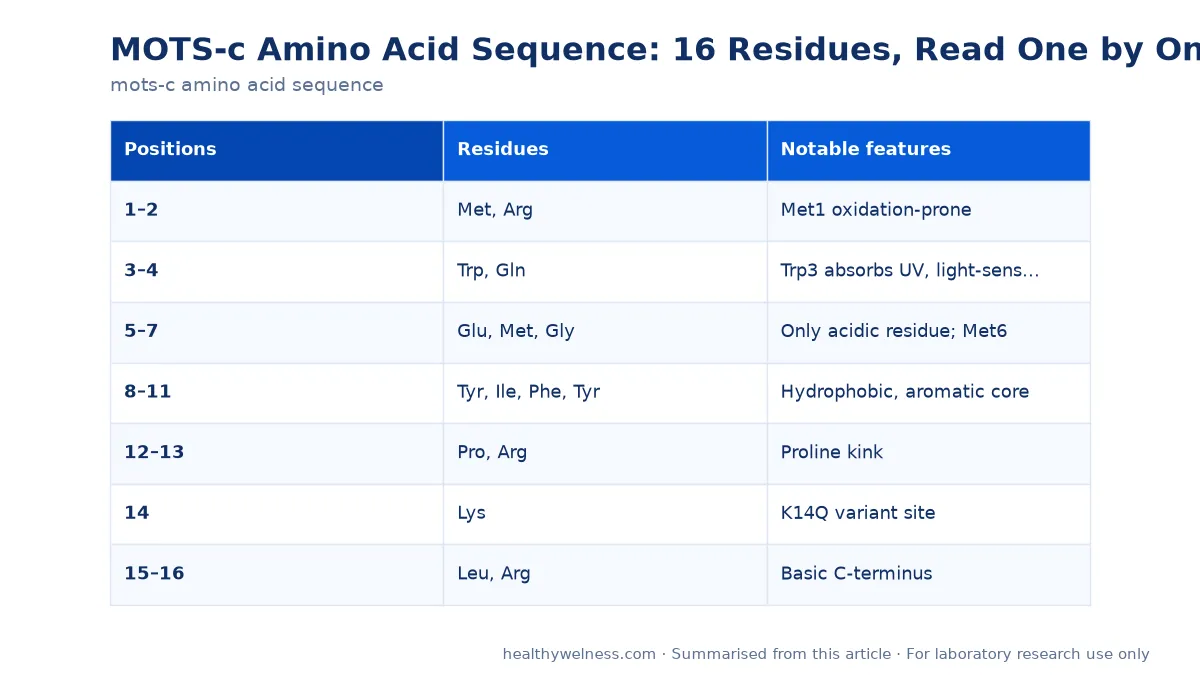
The sequence, residue by residue
| Positions | Residues | Notable features |
|---|---|---|
| 1–2 | Met, Arg | Met1 oxidation-prone |
| 3–4 | Trp, Gln | Trp3 absorbs UV, light-sensitive |
| 5–7 | Glu, Met, Gly | Only acidic residue; Met6 |
| 8–11 | Tyr, Ile, Phe, Tyr | Hydrophobic, aromatic core |
| 12–13 | Pro, Arg | Proline kink |
| 14 | Lys | K14Q variant site |
| 15–16 | Leu, Arg | Basic C-terminus |
Read as a whole, the sequence has a short basic and aromatic N-terminal segment, a hydrophobic aromatic stretch in the middle, and a strongly basic C-terminal tail. Our MOTS-c research peptide is the synthetic 16-residue sequence.
Certificates are available for listed products — contact us for the latest report.
Composition and charge
| Residue type | Count | Positions |
|---|---|---|
| Basic (Arg, Lys) | 4 | 2, 13, 14, 16 |
| Acidic (Glu) | 1 | 5 |
| Aromatic (Trp, Tyr, Phe) | 4 | 3, 8, 10, 11 |
| Sulphur-containing (Met) | 2 | 1, 6 |
| Other | 5 | 4, 7, 9, 12, 15 |
At neutral pH, the four basic side chains and the free N-terminal amine carry positive charge, while the glutamate side chain and the C-terminal carboxylate carry negative charge. The net charge is therefore about +3. A positively charged peptide with several aromatic residues tends to adsorb to negatively charged surfaces such as untreated glass, which is relevant when working at low concentrations.
Where the sequence comes from
Mitochondria have their own genome, and Lee and colleagues reasoned that if humanin was encoded by a short reading frame in mitochondrial DNA, others might exist. They found one within the 12S rRNA gene encoding a 16-amino-acid peptide, named it MOTS-c, and showed that it regulates insulin sensitivity and metabolic homeostasis, with skeletal muscle as its apparent primary target (Lee et al., 2015).
Kal and colleagues place MOTS-c among the mitochondria-derived peptides. MOTS-c is encoded in MT-RNR1, while humanin and SHLP1 to 6 come from MT-RNR2; MOTS-c, humanin and SHLP6 are on the heavy strand and SHLP1 to 5 on the light strand. They also note the special features of the mitochondrial genetic code, including ATA and ATT as start codons, AGA and AGG as stops and UGA as tryptophan, and discuss the evolutionary pressures that conserve these peptides’ sequences (Kal et al., 2024).
That genetic code matters for anyone expressing MOTS-c recombinantly. A sequence read with the standard nuclear code would mistranslate tryptophan as a stop, so the 16-residue product is defined by the mitochondrial reading. Synthetic MOTS-c sidesteps the issue, being made directly by solid-phase synthesis.
The K14Q variant
Position 14 is the best-studied site in the sequence. Zempo and colleagues identified an Asian-specific mitochondrial DNA variant, m.1382A>C, that changes lysine 14 to glutamine. In a meta-analysis of three cohorts totalling 27,527 people, men but not women carrying the C allele had a higher prevalence of type 2 diabetes, and in one cohort the association appeared only among the least physically active men (Zempo et al., 2021).
| Form | Residue 14 | High-fat-fed male mice | In vitro |
|---|---|---|---|
| MOTS-c | Lys (+) | Lower weight, better glucose | Insulin-sensitising |
| K14Q-MOTS-c | Gln (neutral) | No such effect | Diminished activity |
In mice, native MOTS-c reduced weight and improved glucose tolerance in high-fat-fed males, whereas K14Q-MOTS-c did not, and female mice were unaffected by either; in vitro, K14Q showed diminished insulin sensitisation (Zempo et al., 2021). Swapping one positive charge for a neutral amide was enough to change the activity, which suggests the basic C-terminal region is functionally important. It also means a laboratory studying “MOTS-c” should confirm which variant it has: the two differ by about 0.04 Da in mass (Lys 128.09 versus Gln 128.06 residue masses), too little for routine mass spectrometry to resolve, so sequencing or a high-resolution method is needed.
Sequence and function: what is known
Beyond position 14, the link between specific residues and function is not well mapped. Functionally, MOTS-c inhibits the folate pathway and associated purine synthesis, leading to AMPK activation (Lee et al., 2015), and under metabolic stress it moves into the nucleus to regulate genes with antioxidant response elements, interacting with NRF2 (Kim et al., 2018). Reviews describe the main route as the folate-AICAR-AMPK pathway (Wan et al., 2023). The abstracts reviewed for this article do not assign these actions to particular sequence segments.
That gap is an opportunity for structure-activity work. The K14Q result shows that a single charge change near the C-terminus is enough to alter activity in mice. Systematic substitutions, such as alanine scanning of each position, truncations from either end, or replacement of the two methionines with an oxidation-resistant analogue such as norleucine, would map which residues are essential. Until such data exist, any modified or truncated “MOTS-c” should be treated as a distinct compound rather than assumed to share the native peptide’s activity.
Expected masses for identity checks
The sequence also tells a laboratory what a mass spectrum should contain. Electrospray ionisation of a 16-residue basic peptide produces several charge states, and the four basic residues make the higher charge states prominent. The values below are calculated from the average molecular weight of about 2174.6 by adding one proton mass per charge.
| Species | Change | Calculated value |
|---|---|---|
| [M+2H]2+ | Intact | ~1088.3 |
| [M+3H]3+ | Intact | ~725.9 |
| [M+4H]4+ | Intact | ~544.7 |
| One Met oxidised | +16 Da | ~2190.6 |
| Both Met oxidised | +32 Da | ~2206.6 |
| K14Q variant | −0.04 Da | ~2174.6 |
Two practical points follow. First, a +16 Da peak shows that one methionine has oxidised but not which one; tandem mass spectrometry, which fragments the peptide along its backbone, can locate the change to Met1 or Met6. Second, the K14Q row shows why mass alone cannot confirm the native sequence. Fragmentation can, because the b- and y-ion series around position 14 differ in their exact masses and in how the basic lysine directs cleavage. For most purposes the synthetic native sequence is what is supplied, but laboratories comparing the two forms deliberately should build a sequence-level check into their method.
Handling in the lab
The sequence predicts the main liabilities. Two methionines make oxidation the leading concern, each adding 16 Da; tryptophan adds light sensitivity; and the net positive charge favours adsorption to glass at low concentration. Prepare solutions close to use, keep them cold and dark, consider low-binding plastics for dilute work, and confirm identity by mass spectrometry against about 2174.6. Concentrations are calculated from net content with the peptide calculator.
Related research
The compound overview is what is MOTS-c, and another mitochondria-derived peptide is profiled in what is humanin. MOTS-c is compared with a mitochondria-targeted tetrapeptide in SS-31 versus MOTS-c.
Frequently asked questions
What is the amino acid sequence of MOTS-c?
MOTS-c is the 16-residue peptide Met-Arg-Trp-Gln-Glu-Met-Gly-Tyr-Ile-Phe-Tyr-Pro-Arg-Lys-Leu-Arg, written MRWQEMGYIFYPRKLR in one-letter code. It is encoded by a short open reading frame in the mitochondrial 12S rRNA gene (Lee et al., 2015).
Where in the genome is MOTS-c encoded?
In the mitochondrial 12S ribosomal RNA gene, MT-RNR1, on the heavy strand of mitochondrial DNA. Humanin and the small humanin-like peptides are encoded in the 16S rRNA gene instead (Kal et al., 2024).
What is the K14Q variant of MOTS-c?
An Asian-specific mitochondrial DNA variant, m.1382A>C, changes lysine 14 to glutamine. In high-fat-fed male mice, native MOTS-c reduced weight and improved glucose tolerance but K14Q-MOTS-c did not, and K14Q showed diminished insulin-sensitising activity in vitro (Zempo et al., 2021).
What is the molecular weight of MOTS-c?
The formula C101H152N28O22S2 gives a molecular weight of about 2174.6 g/mol. The two sulphur atoms come from the two methionine residues at positions 1 and 6.
Does the sequence suggest how MOTS-c reaches the nucleus?
The sequence is rich in basic residues, three arginines and one lysine, which is a common feature of peptides that interact with nucleic acids or cross membranes. Experimentally, MOTS-c translocated to the nucleus under metabolic stress in an AMPK-dependent manner (Kim et al., 2018); the specific sequence elements responsible were not identified in the abstract.
For laboratory research use only. The research materials supplied by HealthyWelness are not approved medicines, foods or cosmetics and are not for human or veterinary use. This article summarises published research and is not medical advice.
Sources
- Lee C, et al. The mitochondrial-derived peptide MOTS-c promotes metabolic homeostasis and reduces obesity and insulin resistance. Cell Metab. 2015. PMID: 25738459
- Kal S, et al. Mitochondrial-derived peptides: Antidiabetic functions and evolutionary perspectives. Peptides. 2024. PMID: 38160808
- Zempo H, et al. A pro-diabetogenic mtDNA polymorphism in the mitochondrial-derived peptide, MOTS-c. Aging (Albany NY). 2021. PMID: 33468709
- Kim KH, et al. The Mitochondrial-Encoded Peptide MOTS-c Translocates to the Nucleus to Regulate Nuclear Gene Expression in Response to Metabolic Stress. Cell Metab. 2018. PMID: 29983246
- Wan W, et al. Mitochondria-derived peptide MOTS-c: effects and mechanisms related to stress, metabolism and aging. J Transl Med. 2023. PMID: 36670507