Comparisons
NAD+, MOTS-c and 5-Amino-1MQ: Three Different Levers
A cofactor, a mitochondrially encoded peptide and an enzyme inhibitor. Why no co-administration literature exists and what a blend arm can show.
Comparisons
A cofactor, a mitochondrially encoded peptide and an enzyme inhibitor. Why no co-administration literature exists and what a blend arm can show.
Comparisons
AICAR mimics AMP and activates AMPK directly. MOTS-c is AMPK-linked but has no identified receptor. Two very different kinds of evidence.
Comparisons
NAD+ is a nucleotide coenzyme; MOTS-c a 16-residue peptide encoded in mitochondrial DNA. Both connect to mitochondria, but through quite different routes.
Comparisons
Tesamorelin works through the GH axis; incretin peptides through GIP, GLP-1 and glucagon receptors; MOTS-c through AMPK. Four different mechanisms compared.
Comparisons
SS-31 accumulates in mitochondria and binds cardiolipin; MOTS-c is encoded by mitochondrial DNA. Opposite relationships to the same organelle.
Comparisons
MOTS-c is a mitochondrially encoded peptide with no established receptor; retatrutide is a triple incretin receptor agonist. Two different sciences.
Comparisons
Three metabolic research compounds with three different mechanisms: a nuclear receptor agonist, a mitochondrial peptide and an enzyme inhibitor.
Peptide Profiles
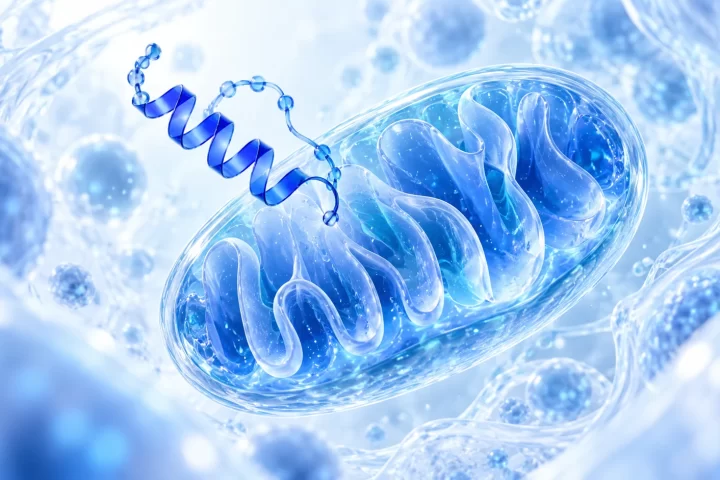
MOTS-c is a 16-amino-acid peptide encoded in mitochondrial 12S rRNA. Its discovery, AMPK and folate-cycle mechanism, exercise and ageing research, and handling.