NAD+, MOTS-c and 5-Amino-1MQ: Three Different Levers
A cofactor, a mitochondrially encoded peptide and an enzyme inhibitor. Why no co-administration literature exists and what a blend arm can show.

Cover illustration: AI-generated editorial artwork. Conceptual only; not an exact molecular structure, actual laboratory result or evidence of clinical effects.
These three are sold and searched together as a metabolic set. They are three different kinds of molecule acting at three different points, and no published study has tested them in combination that we can find. That absence is the central fact, and the useful content here is what a combination experiment would have to look like to mean anything.
For laboratory research use only. The research materials supplied by HealthyWelness are not approved medicines, foods or cosmetics and are not for human or veterinary use. This article summarises published research and is not medical advice.
- NAD+ is a dinucleotide coenzyme, supplied directly as the cofactor itself.
- 5-Amino-1MQ is a quaternary ammonium small molecule that inhibits nicotinamide N-methyltransferase.
- MOTS-c is a 16-residue peptide encoded in mitochondrial DNA, with AMPK-linked effects and no identified receptor.
- No co-administration study of these three appears in the indexed literature.
- Interventions converging on a shared downstream output produce a ceiling rather than a sum.
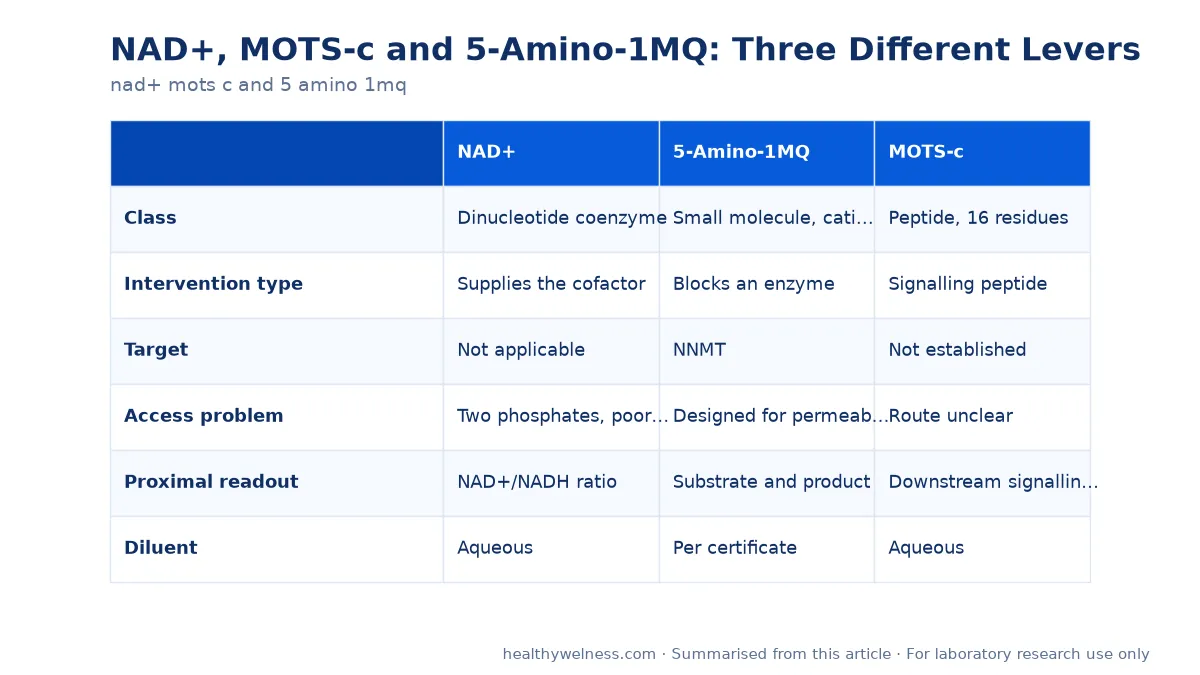
What kind of molecule is each?
| NAD+ | 5-Amino-1MQ | MOTS-c | |
|---|---|---|---|
| Class | Dinucleotide coenzyme | Small molecule, cation | Peptide, 16 residues |
| Intervention type | Supplies the cofactor | Blocks an enzyme | Signalling peptide |
| Target | Not applicable | NNMT | Not established |
| Access problem | Two phosphates, poor permeability | Designed for permeability | Route unclear |
| Proximal readout | NAD+/NADH ratio | Substrate and product | Downstream signalling only |
| Diluent | Aqueous | Per certificate | Aqueous |
Only one of the three is a peptide. That matters for handling, for analytical verification and for the vehicle controls each arm needs, and it is invisible from the catalogue heading they share.
Where does each one enter the chemistry?
They are adjacent rather than overlapping, and the adjacency is what makes the set look like a system.
- Nicotinamide is a precursor in NAD+ salvage — the junction point.
- NNMT methylates nicotinamide, routing it away from salvage. 5-Amino-1MQ blocks that diversion.
- NAD+ is the cofactor itself, added directly rather than made.
- MOTS-c is not in that pathway at all. It is a mitochondrially encoded peptide whose documented effects are AMPK-linked, which puts it in adjacent metabolism rather than in NAD+ chemistry.
So two of the three touch the same pathway from opposite directions, and the third is somewhere else nearby. A blend of all three is not three settings on one dial.
Why does the absence of combination literature matter?
Because the usual rationale for a blend is complementarity, and complementarity is a claim that can be tested.
Published work on a different peptide pair is instructive here. A 2026 four-arm rat study of BPC-157 and TB-500 found that the combination conferred no additional benefit over either agent alone, which the authors discussed as possible convergence on shared pathways — covered in the BPC-157 and TB-500 combination study.
That is a useful precedent rather than a verdict on this set. Two or three agents acting on one downstream output can produce a ceiling, and a ceiling is a legitimate finding rather than a failed experiment. What it argues against is assuming additivity in the absence of evidence.
What would a sound combination experiment look like?
- Run each component alone, at the same molar concentration it has in the blend. Without this, nothing in a combined result identifies which component contributed what.
- Run the blend, and compare it against the sum of the single arms rather than against vehicle alone. Comparing to vehicle only answers a question nobody is asking.
- Use molar equivalence. A coenzyme, a small-molecule salt and a 16-residue peptide have very different molecular weights, so a blend specified by mass is not specified by molarity.
- Give each arm its own controls. If the small molecule needs a co-solvent, its vehicle must be matched and the other arms must not inherit it.
- Confirm the preconditions per arm. NNMT expression for the inhibitor; uptake into the relevant compartment for the cofactor; a scrambled-sequence control for the peptide.
- Measure at the pathway level. If the hypothesis concerns NAD+ availability, measure the NAD+/NADH ratio rather than a functional endpoint alone.
That last point rests on a general principle from the NAD+ literature: the 2015 review by Bilan and colleagues establishes that the ratio of oxidised to reduced forms, not either concentration, is the quantity of interest. The framing is developed in NAD+ to NADH: reduction or oxidation.
Why compartments complicate a blend further
Because there is not one NAD+ pool in a cell.
The 2018 study by Goodman and colleagues examined spatiotemporal compartmentalisation of hepatic NADH and NADPH metabolism. Cytosolic and mitochondrial pools are maintained at different ratios and connected only by shuttle systems rather than free diffusion of the cofactor.
For a three-component experiment that has a concrete consequence: the three interventions may not reach the same compartment. An added cofactor, a membrane-permeable inhibitor and a peptide of unclear uptake route each face a different access problem, so a whole-cell measurement averages compartments that the three agents may be affecting unequally.
What is each component’s own evidence base?
Unequal, and worth knowing before weighting a result.
- NAD+ biology is mature, with compartment-resolved measurement work and a clear methodological consensus that ratios matter more than levels.
- MOTS-c has a substantial preclinical literature across mitochondrial biology, metabolism and exercise physiology — the 2016 review by Lee and colleagues and the 2023 review by Zheng and colleagues are the orientations — but no established proximal receptor.
- 5-Amino-1MQ has the 2018 mouse study plus the wider NNMT target literature, with no human trials and no published pharmacokinetics that we can find.
The three-way mechanistic comparison including another metabolic compound is in metabolic research compounds compared, and the pairwise case in 5-Amino-1MQ compared with NAD+.
How should the components be prepared?
Separately, and combined at the point of use. Two practical reasons rather than purism: each component stays verifiable, and single-agent arms then cost nothing extra in material.
- NAD+: hygroscopic, degrades in solution, and the oxidised and reduced forms are labile in opposite pH directions so no single buffer suits both. Prepare close to use — see does NAD+ need refrigeration.
- 5-Amino-1MQ: a salt, often iodide, which is light-sensitive and darkens as iodide oxidises. Use the formula weight of the supplied salt. See handling 5-Amino-1MQ.
- MOTS-c: a short unmodified peptide, aqueous diluent, aliquot on first reconstitution, molarity from net peptide content — our reconstitution calculator applies that correction.
Our NAD+ research material is supplied for laboratory research use. Certificates are available for listed products — contact us for the latest report.
Why a ceiling result is worth publishing internally
Combination experiments that find no additivity tend to be shelved, which is why the literature on blends is thinner than the market for them. Within a laboratory that is a mistake: a ceiling result tells you the components converge, which is mechanistic information about where they act. It also prevents the same combination being tried again by someone else six months later.
Recording the negative outcome with its molar concentrations and readout is cheap, and it is the single most useful thing a blend experiment usually produces.
Scope note
This material is supplied for laboratory research use only. It is not a medicine, not a supplement, and not for human or veterinary use. The combinations discussed are experimental designs rather than recommendations, and nothing here describes administration to any organism.
Open questions
- Would blocking the NNMT exit and supplying NAD+ together be additive or reach a ceiling?
- Do the three reach the same subcellular compartment?
- What is MOTS-c’s proximal binding partner?
Related research
Frequently asked questions
Do these three act on the same pathway?
They touch overlapping metabolism but at different points and as different kinds of molecule. NAD+ is a cofactor supplied directly, 5-Amino-1MQ inhibits an enzyme that diverts a precursor, and MOTS-c is a peptide with AMPK-linked effects and no identified receptor.
Is there published evidence for combining them?
Not that we can find. There is no co-administration study of these three as a blend in the indexed literature, so any combination experiment is exploratory and should be described that way.
Which of the three is a peptide?
Only MOTS-c. NAD+ is a dinucleotide coenzyme and 5-Amino-1MQ is a quaternary ammonium small molecule. All three appear in peptide catalogues because of the research area, not because of shared chemistry.
Could combining them be additive?
It could also reach a ceiling. If two interventions converge on the same downstream output, combining them produces a plateau rather than a sum. Published work on a different peptide pair found exactly that, attributed to shared pathways.
What would a sound combination experiment need?
Single-component arms at the same molar concentrations as in the blend, plus the blend, compared against the sum of the single arms rather than against vehicle alone.
References
- Lee C, et al. MOTS-c: A novel mitochondrial-derived peptide regulating muscle and fat metabolism. Free Radic Biol Med. 2016. PMID: 27216708 https://pubmed.ncbi.nlm.nih.gov/27216708/
- Neelakantan H, et al. Selective and membrane-permeable small molecule inhibitors of nicotinamide N-methyltransferase reverse high fat diet-induced obesity in mice. Biochem Pharmacol. 2018. PMID: 29155147 https://pubmed.ncbi.nlm.nih.gov/29155147/
- Goodman RP, et al. Spatiotemporal compartmentalization of hepatic NADH and NADPH metabolism. J Biol Chem. 2018. PMID: 29514978 https://pubmed.ncbi.nlm.nih.gov/29514978/
- Bilan DS, et al. Main Cellular Redox Couples. Bioorg Khim. 2015. PMID: 26615634 https://pubmed.ncbi.nlm.nih.gov/26615634/
- Zheng Y, et al. MOTS-c: A promising mitochondrial-derived peptide for therapeutic exploitation. Front Endocrinol (Lausanne). 2023. PMID: 36761202 https://pubmed.ncbi.nlm.nih.gov/36761202/
For laboratory research use only. The research materials supplied by HealthyWelness are not approved medicines, foods or cosmetics and are not for human or veterinary use. This article summarises published research and is not medical advice.
Sources
- Lee C, et al. MOTS-c: A novel mitochondrial-derived peptide regulating muscle and fat metabolism. Free Radic Biol Med. 2016. PMID: 27216708
- Neelakantan H, et al. Selective and membrane-permeable small molecule inhibitors of nicotinamide N-methyltransferase reverse high fat diet-induced obesity in mice. Biochem Pharmacol. 2018. PMID: 29155147
- Goodman RP, et al. Spatiotemporal compartmentalization of hepatic NADH and NADPH metabolism. J Biol Chem. 2018. PMID: 29514978
- Bilan DS, et al. Main Cellular Redox Couples. Bioorg Khim. 2015. PMID: 26615634
- Zheng Y, et al. MOTS-c: A promising mitochondrial-derived peptide for therapeutic exploitation. Front Endocrinol (Lausanne). 2023. PMID: 36761202