Tirzepatide and NAD+: What the Research Actually Connects
Tirzepatide is a dual incretin agonist; NAD+ is a coenzyme. Two mouse studies link tirzepatide to NAD+ and mitochondrial readouts. What they show and do not.

Cover illustration: AI-generated editorial artwork. Conceptual only; not an exact molecular structure, actual laboratory result or evidence of clinical effects.
Tirzepatide and NAD+ are unrelated molecules, a dual incretin receptor agonist and a redox coenzyme, but one mouse study reports that tirzepatide restored NAD+ levels through the salvage enzyme NAMPT. No peer-reviewed study of the two given together was found; the published link is mechanistic, not a combination.
For laboratory research use only. The research materials supplied by HealthyWelness are not approved medicines, foods or cosmetics and are not for human or veterinary use. This article summarises published research and is not medical advice.
- Tirzepatide (LY3298176) is a dual GIP and GLP-1 receptor agonist with greater engagement of the GIP receptor and cAMP-biased signalling at the GLP-1 receptor (Willard et al., 2020).
- NAD+ is a coenzyme for redox reactions and a substrate consumed by sirtuins, PARPs and CD38/157 ectoenzymes (Imai and Guarente, 2014).
- In a mouse model of cisplatin-induced acute kidney injury, tirzepatide pretreatment raised NAD+ levels through NAMPT, and NAMPT inhibition abolished its protective effect (Han et al., 2026).
- In MPTP-treated mice, tirzepatide was reported to preserve mitochondrial morphology and modulate Drp1 and mitophagy proteins in the substantia nigra (Tian et al., 2025).
- As of 2026-11-03, a PubMed search for “tirzepatide NAD” returned three records, none of which studied tirzepatide administered together with NAD+.
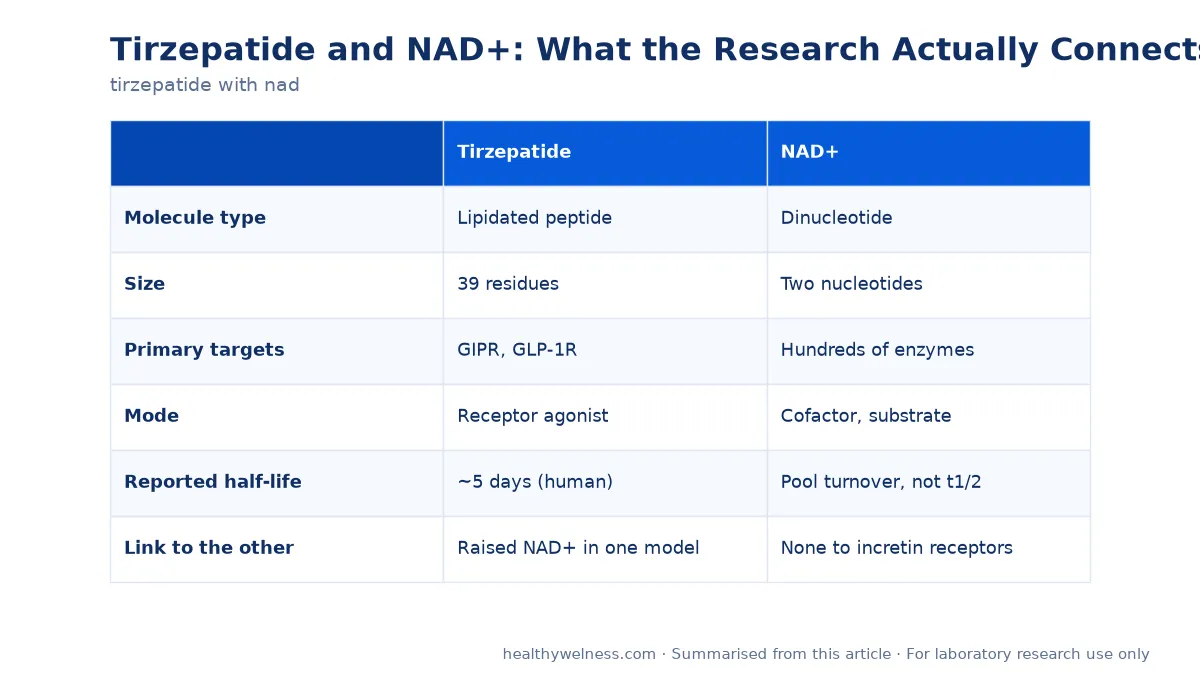
The two compounds compared
| Tirzepatide | NAD+ | |
|---|---|---|
| Molecule type | Lipidated peptide | Dinucleotide |
| Size | 39 residues | Two nucleotides |
| Primary targets | GIPR, GLP-1R | Hundreds of enzymes |
| Mode | Receptor agonist | Cofactor, substrate |
| Reported half-life | ~5 days (human) | Pool turnover, not t1/2 |
| Link to the other | Raised NAD+ in one model | None to incretin receptors |
The half-life row is not a like-for-like comparison. Tirzepatide’s ~5-day figure comes from a population model built on 19 pooled studies (Schneck and Urva, 2024). NAD+ has no single half-life: its level in each compartment is a balance between synthesis and consumption (Stromland et al., 2021). Our tirzepatide research material and NAD+ research material are separate reagents.
The kidney injury study in detail
The most direct published link comes from Han and colleagues, who used three systems: metabolomics, a mouse model of cisplatin-induced acute kidney injury, and cisplatin-injured HK-2 human proximal tubule cells. Tirzepatide pretreatment reduced renal dysfunction, tubular injury and mitochondrial damage. Metabolomic profiling showed strong regulation of energy metabolism and autophagy, with NAD+ homeostasis standing out (Han et al., 2026).
| Finding | System | What it establishes |
|---|---|---|
| NAD+ raised | Mouse kidney, HK-2 | Association |
| Via NAMPT | Mechanistic work | Proposed route |
| Pink1-Parkin mitophagy up | Mouse, cells | Downstream effect |
| NAMPT inhibition blocks it | Inhibitor experiment | Necessity in this model |
| Autophagy inhibition blocks it | Inhibitor experiment | Necessity in this model |
The last two rows are what make this more than a correlation. Removing NAMPT activity, or autophagy, removed the effect. That is evidence that, in this model, tirzepatide’s protective action required the NAD+ salvage pathway. It does not show that the same happens in other tissues, other injuries or without cisplatin, and it does not show that supplying NAD+ from outside would reproduce the effect.
Why NAMPT is the point of contact
NAMPT is the rate-limiting enzyme that recycles nicotinamide back toward NAD+ in the salvage pathway. Imai and Guarente place NAMPT-mediated synthesis and SIRT1 together at the centre of NAD+ regulation of metabolism and circadian rhythm (Imai and Guarente, 2014). Reduced NAMPT is one of the two sides of the imbalance proposed to explain age-related NAD+ decline, the other being greater consumption by PARPs and CD38 (Stromland et al., 2021). A compound that raises NAMPT activity raises the cell’s own production rate rather than adding NAD+ from outside, and that distinction matters for anyone reading these studies as an argument for co-administration.
The Parkinson’s model
Tian and colleagues treated MPTP-induced subacute Parkinson’s model mice with tirzepatide, semaglutide or levodopa. Tirzepatide reduced the loss of tyrosine hydroxylase in the substantia nigra, and electron microscopy, ATP measurement and Western blots for Drp1 and mitophagy proteins pointed to effects on mitochondrial homeostasis; follow-up experiments used a Drp1 inhibitor, a mitophagy activator and SY5Y cells with autophagy and lysosome inhibitors (Tian et al., 2025).
The abstract does not report NAD+ itself. It is related to the kidney study by theme, mitochondrial quality control, rather than by a shared measurement. Grouping the two under “tirzepatide and NAD+” overstates what the second one measured.
Why receptor pharmacology could reach NAD+ at all
A reasonable question is how an incretin receptor agonist could touch an enzyme in the NAD+ salvage pathway. The published receptor work offers a starting point without answering it. Tirzepatide engages the GIP receptor more than the GLP-1 receptor at clinically relevant exposures and favours cAMP over beta-arrestin at the GLP-1 receptor (Willard et al., 2020). cAMP signalling reaches transcription and metabolism in many cell types. Whether the NAMPT effect in kidney tubule cells runs through either receptor, or through systemic changes such as glucose and insulin, was not resolved in the abstract, and would need receptor-specific antagonists or knockout models to establish.
How to read “raised NAD+” in a disease model
The kidney study measured NAD+ in tissue that had been injured by cisplatin, a drug that damages mitochondria and activates DNA-repair pathways. Both processes are known to change NAD+ handling: PARP activity consumes NAD+ during DNA repair, and the balance between synthesis and consumption sets the level that remains (Stromland et al., 2021). A treatment that reduces injury could therefore raise NAD+ partly by reducing consumption, separately from any direct action on synthesis.
| Possible route to higher NAD+ | Tested in the abstract? |
|---|---|
| More NAMPT-driven synthesis | Yes, inhibitor blocked effect |
| Less PARP consumption | Not reported |
| Less CD38 activity | Not reported |
| Better mitochondrial pool | Mitophagy measured |
The NAMPT inhibitor result shows that synthesis was necessary, not that it was the only change. The CD38 work in mice is a reminder that consumption matters as much as production for steady-state levels (Camacho-Pereira et al., 2016). A full account would measure both sides in the same animals.
What would be needed to study them together
Because no combined study was found, it is worth stating what one would require.
- Separate arms first. Tirzepatide alone already moved NAD+ in one model, so any combined arm needs a tirzepatide-only comparator measured for NAD+.
- Compartment-aware measurement. Whole-tissue NAD+ can hide changes in the mitochondrial pool, which is the one tied to dysfunction in the CD38 work (Camacho-Pereira et al., 2016).
- Precursor degradation. CD38 was identified as the main enzyme degrading NMN in vivo (Camacho-Pereira et al., 2016), so exogenous NAD+ or its precursors may not reach target cells intact.
- Time scales. Tirzepatide exposure persists for days (Schneck and Urva, 2024), whereas NAD+ pools respond on the scale of synthesis and consumption rates.
Handling in the lab
The two materials need different handling. Tirzepatide is a lyophilised peptide whose fatty-diacid chain encourages adsorption in dilute solution; NAD+ is a nucleotide whose pyrophosphate and glycosidic bonds are the labile points. Neither should be mixed into a single stock. Preparation notes are in tirzepatide reconstitution and NAD+ reconstitution, and the peptide calculator handles the concentration arithmetic for both.
Related research
For each compound alone see how tirzepatide works and the NAD+ overview. The structure of the coenzyme is set out in NAD+ structure, and a comparison with another GH-axis peptide in sermorelin and tirzepatide.
Frequently asked questions
Is there published research on tirzepatide and NAD+?
Yes, but not on combining them. As of 2026-11-03, a PubMed search for “tirzepatide NAD” returned three records. One reported that tirzepatide restored NAMPT-dependent NAD+ levels in a mouse cisplatin kidney injury model (Han et al., 2026); none studied tirzepatide given together with NAD+.
How could tirzepatide change NAD+ levels?
In the kidney injury study, metabolomics showed tirzepatide regulating NAD+ homeostasis, and the effect ran through NAMPT, the rate-limiting enzyme of the salvage pathway. Inhibiting NAMPT abolished the protective effect in that model (Han et al., 2026).
What kind of molecule is each?
Tirzepatide (LY3298176) is a 39-residue lipidated peptide that acts on the GIP and GLP-1 receptors (Willard et al., 2020). NAD+ is a dinucleotide coenzyme for redox reactions and a substrate for sirtuins, PARPs and CD38 (Imai and Guarente, 2014).
Does the mouse Parkinson's model involve NAD+?
Not directly. That study reported tirzepatide affecting mitochondrial morphology, ATP levels, Drp1 and mitophagy proteins in MPTP-treated mice (Tian et al., 2025). Mitochondrial homeostasis is related to NAD+ biology, but NAD+ itself was not the measured endpoint in the abstract.
Why are tirzepatide and NAD+ searched together?
Search phrasing such as “tirzepatide/nad+/cyanocobalamin” suggests interest in combined preparations. The peer-reviewed literature cited here does not evaluate such combinations, and this article does not address them; it covers the mechanistic links that have been published.
For laboratory research use only. The research materials supplied by HealthyWelness are not approved medicines, foods or cosmetics and are not for human or veterinary use. This article summarises published research and is not medical advice.
Sources
- Han C, et al. Tirzepatide ameliorates cisplatin-induced acute kidney injury by restoring NAMPT/NAD + homeostasis and enhancing Pink1-Parkin-mediated mitophagy. Biochem Pharmacol. 2026. PMID: 42114682
- Tian R, et al. GLP-1/GIP dual agonist tirzepatide alleviates mice model of Parkinson's disease by promoting mitochondrial homeostasis. Int Immunopharmacol. 2025. PMID: 40886502
- Willard FS, et al. Tirzepatide is an imbalanced and biased dual GIP and GLP-1 receptor agonist. JCI Insight. 2020. PMID: 32730231
- Schneck K, Urva S. Population pharmacokinetics of the GIP/GLP receptor agonist tirzepatide. CPT Pharmacometrics Syst Pharmacol. 2024. PMID: 38356317
- Imai S, Guarente L. NAD+ and sirtuins in aging and disease. Trends Cell Biol. 2014. PMID: 24786309
- Stromland O, et al. The balance between NAD(+) biosynthesis and consumption in ageing. Mech Ageing Dev. 2021. PMID: 34509469
- Camacho-Pereira J, et al. CD38 Dictates Age-Related NAD Decline and Mitochondrial Dysfunction through an SIRT3-Dependent Mechanism. Cell Metab. 2016. PMID: 27304511