Peptide Policy and Research: Week to 9 November 2026
Peptide research brief: Novo and Lilly updates, NNC0130 and LL-37 papers, and the HHS comment window, with dated primary sources and evidence limits.


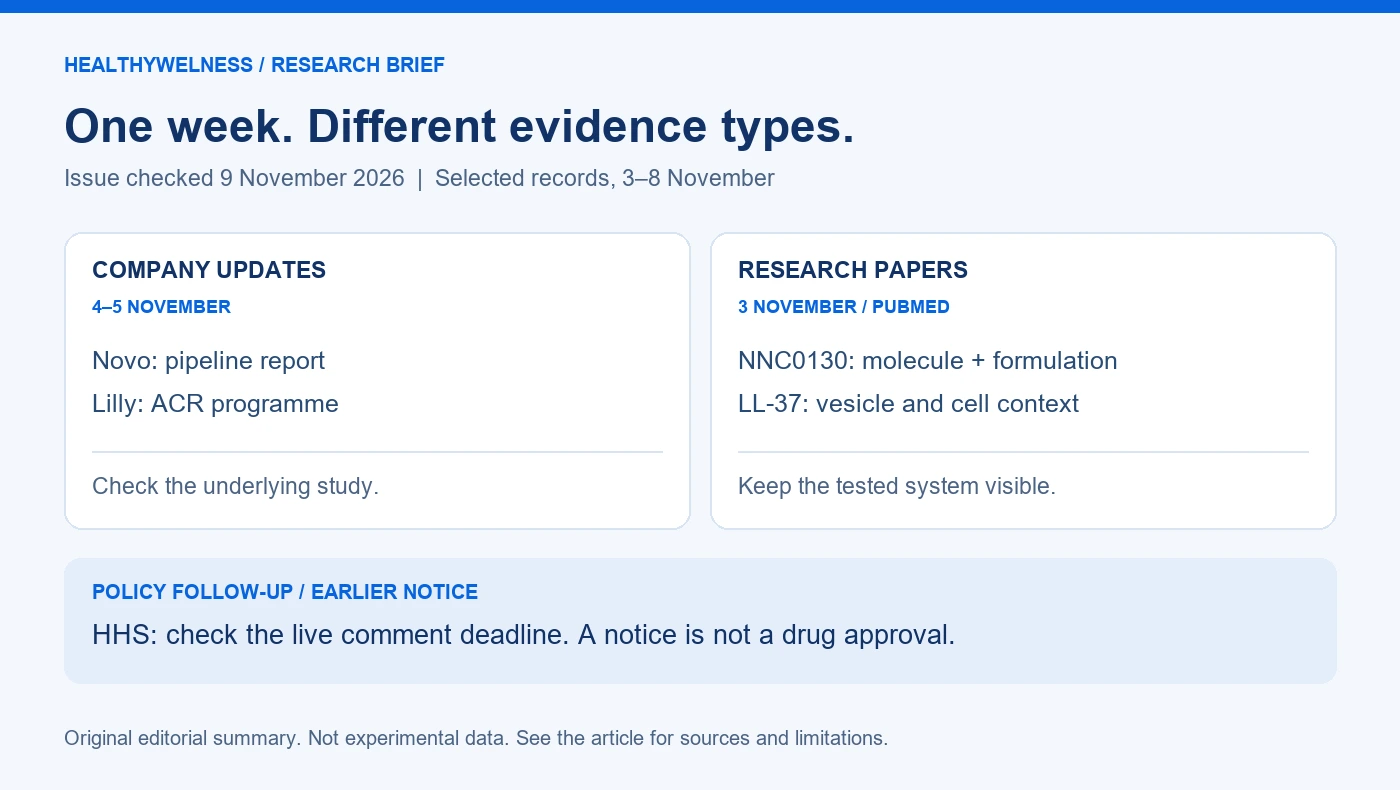
This week’s peptide research brief separates company pipeline updates from new literature: Novo published its quarterly development update on 4 November, Lilly announced its ACR programme on 5 November, and two papers entered PubMed on 3 November. An upcoming HHS comment deadline remains a watch item, rather than a new approval announcement. Coverage was checked on 9 November 2026; source dates and evidence types are distinguished below.
- Novo’s 4 November 2026 report includes a phase 3 development update; the report says the AMAZE 9 study began in September, not during this reporting week. [1]
- Lilly’s 5 November 2026 announcement describes an ACR Convergence programme spanning 6–11 November; a scheduled presentation is different from a completed publication review. [2]
- PubMed records 42977258 and 42976050 entered its database on 3 November 2026. One concerns a designed dual-agonist peptide; the other examines LL-37-associated extracellular vesicles. [3] [4]
1. The week’s records answer different questions
| Record date | Source | Evidence type | Reading priority |
|---|---|---|---|
| 4 Nov | Novo report | Company update | Event vs report date |
| 5 Nov | Lilly programme | Company announcement | Scheduled vs published |
| 3 Nov | NNC0130 paper | Research article | Formulation and model |
| 3 Nov indexed | LL-37 / EV paper | Mechanistic study | Cargo and context |
| 30 Oct notice | HHS policy | Earlier policy record | Comment deadline |
The table is a reading map, not a ranking of compounds or an assessment of commercial materials. Its dates refer to the record identified in each row. A database-entry date, a company announcement date and the date an experiment began are not interchangeable. Keeping those fields separate prevents an older event from acquiring a misleading new timestamp.
2. Novo’s 4 November report updates development activity, not laboratory-material specifications
Novo’s quarterly report includes pipeline information concerning CagriSema and oral zenagamtide. It states that the AMAZE 9 phase 3 trial began in September. The new item this week is the dated company report; the trial initiation itself is an earlier event. The same document presents forward-looking development and launch expectations subject to regulatory decisions. [1]
For a research reader, this is a reason to follow the associated programme and eventual full study record. A company update is a primary source for what that company announced, but it is not independent evaluation of its conclusions. It also does not describe the analytical identity, composition or quality of a similarly named material offered by an unrelated supplier.
When maintaining a literature table, record the programme name and document date in separate fields. Keep an announced milestone distinct from a verified completed milestone. That small documentation step makes a later update easier to assess without silently rewriting the history of the programme.
3. Lilly’s ACR announcement identifies presentations to examine individually
On 5 November, Lilly announced an ACR Convergence programme involving retatrutide research and work involving ixekizumab and tirzepatide. The meeting runs from 6 to 11 November. Its selected presentations include TRIUMPH-1, TRIUMPH-4 and TOGETHER-PsA research. This brief treats the release as a company-authored programme announcement, not as confirmation that every scheduled session had taken place at the time of writing. [2]
The practical next step is to inspect each abstract and, when available, the corresponding complete report. Check the population, comparison, prespecified endpoint and analysis before comparing claims across programmes. A conference timetable can tell you where to look; it cannot supply missing methodological details.
This issue deliberately does not repeat numerical clinical-effect headlines. They cannot establish the properties or suitability of materials in our catalog. The distinction between an announcement, a study report and a supplier’s material record should remain visible even when several documents use the same compound name.
4. NNC0130 illustrates why a molecule and its formulation must be assessed together
Mowery and colleagues’ Molecular Metabolism paper was dated 3 November and entered PubMed that day. The authors describe selecting NNC0130 from a panel of fatty-acylated peptide agonists using cell-based receptor assays, followed by phase 1 investigation of different formulations. NNC0130 is a peptide candidate, not a non-peptide small molecule. [3]
The abstract reports that oral delivery remained a limitation and motivated further development work. That is a finding about the studied candidate and formulations. It should not be converted into a general instruction about preparing or using another peptide. No administration details or clinical-effect percentages are reproduced here.
The paper is useful for interpreting evidence at several levels: receptor-assay findings, molecular design and formulation-dependent observations concern related but different questions. Researchers comparing a receptor-active molecule with a formulated investigational product should preserve those distinctions. A shared receptor target does not make two finished materials equivalent.
5. The LL-37 paper places the peptide inside a specific vesicle-and-cell system
Keshri and colleagues’ Journal of Extracellular Vesicles paper entered PubMed on 3 November. It examines extracellular vesicles released by neutrophils in an H. pylori infection context and their effects in gastric epithelial cell systems. The authors associate LL-37-containing vesicle cargo with cellular stress and apoptosis-related observations, and also examine vesicles from infected patients. [4]
This is not a clinical trial of a commercial LL-37 preparation. A vesicle, its mixed cargo and the receiving cell model form the tested system. Reporting the name of one cargo component without the experimental context would lose a central part of what the paper investigated.
For literature extraction, record the carrier or matrix beside the molecular entity. Then ask which comparison supports a proposed role for that component and which alternatives remain. Our guide to experimental controls and replicates explains why an observed signal and a target-specific interpretation require different supporting comparisons.
6. The HHS comment window is a follow-up, not this week’s new policy
Last week’s issue covered the HHS notice published on 30 October. The notice permits written comments for two weeks after publication through docket HHS-OASH-2026-0496. Calendar calculation places that period at 13 November; readers should check the live docket for its submission deadline and any subsequent update. We did not obtain a reliable live comment count for this issue and do not report one. [5]
The notice describes draft enforcement-policy language while the 503A list is developed through rulemaking. It is not a new drug-approval record. FDA separately describes conditions applicable to bulk substances used in 503A compounding, including documentation and establishment requirements. These are regulatory-source observations, not a statement that our research materials qualify for that pathway. [6]
The next update worth reporting is a verifiable change to an original document or proceeding. Another commentary article discussing the same notice would not, by itself, constitute a new regulatory action.
7. A useful record keeps four kinds of evidence apart
As an editorial reading aid, maintain separate entries for the molecule’s specification, the submitted sample’s analytical record, the experiment and any regulatory document. This is an organisation method, not a substitute for the underlying evidence. It helps expose gaps rather than filling them with assumptions.
For a hypothetical literature spreadsheet, a row saying only “peptide X: positive study” would be insufficient. A more useful row states the entity, system, comparator, measured outcome, source type and date. Mark missing information explicitly. Where a company’s summary and the full paper differ in detail, return to the original methods and analysis rather than merging the two into a stronger-sounding claim.
Transparent reporting is also important when assessing the research itself. NIH’s preclinical-reporting principles address methods, experimental design and the distinction between independent biological observations and technical repeats. Those principles are background guidance for this issue, not newly issued news. [7]
Questions raised by this week’s records
Are company updates and peer-reviewed papers the same evidence type?
No. A company release directly documents its announcement; a research article provides a different record. Both need context, and neither establishes the quality of an unrelated supplier’s material.
Does PubMed entry on 3 November prove that experiments happened that week?
No. Database-entry, publication and experimental dates describe different events. This issue identifies entry dates explicitly and gives an article date when the reviewed record supplies one.
Does a study involving patient-derived samples automatically become a clinical trial?
No. The experimental question and design determine that description. A cell-system experiment using patient-derived vesicles should not be relabelled as a trial of a commercial peptide preparation.
What can a research buyer request about a particular material?
Request the actual molecular specification and any available analytical documentation, with the sample and report scope identified. Our COA reading guide explains how to separate identity, purity and content questions.
Scope note
This issue reviews selected announcements and PubMed entries from 3–8 November, checked on 9 November, and an explicitly labelled earlier policy follow-up. It is not an exhaustive news survey, clinical guidance, legal advice or an endorsement. Company statements remain attributed to their issuers. HealthyWelness is a commercial research-material supplier; catalog materials are for laboratory research use only.
Open questions
- What additional methodological detail will complete conference reports provide?
- What formulation-specific questions remain after the NNC0130 study?
- Will the HHS docket or policy text change after the comment period?
Related research
- Previous issue: week to 2 November 2026
- Distinguishing research systems and evidence
- What mass-spectrometric identity evidence establishes
- Peptide science reading guide
Cover: AI-generated conceptual editorial illustration, not an exact molecular structure or a photograph of HealthyWelness facilities.
Sources
- Novo. Quarterly report and pipeline update, 4 November 2026.
- Lilly. ACR Convergence research programme announcement, 5 November 2026.
- Mowery SA, et al. NNC0130 discovery, optimisation and phase 1 evaluation. Molecular Metabolism. 2026. PMID: 42977258.
- Keshri AK, et al. H. pylori and neutrophil-derived extracellular vesicles. Journal of Extracellular Vesicles. 2026. PMID: 42976050.
- HHS. Notice of availability, 30 October 2026. Docket HHS-OASH-2026-0496. Federal Register 91:68526–68527.
- FDA. Bulk substances used in compounding under section 503A.
- NIH. Preclinical research reporting principles; background guidance.