Peptide Microfiltration: Pore Size Versus Recovery
Interpret peptide microfiltration through membrane interactions, liquid hold-up, fraction history and amount recovery rather than pore size alone.

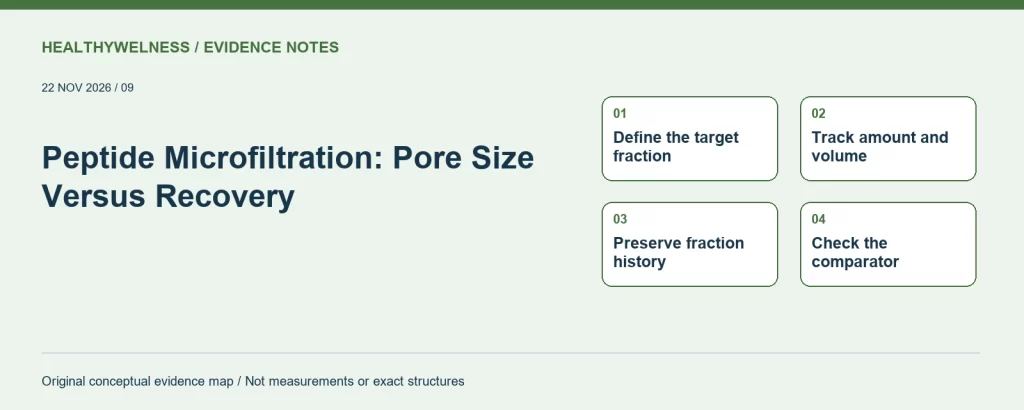
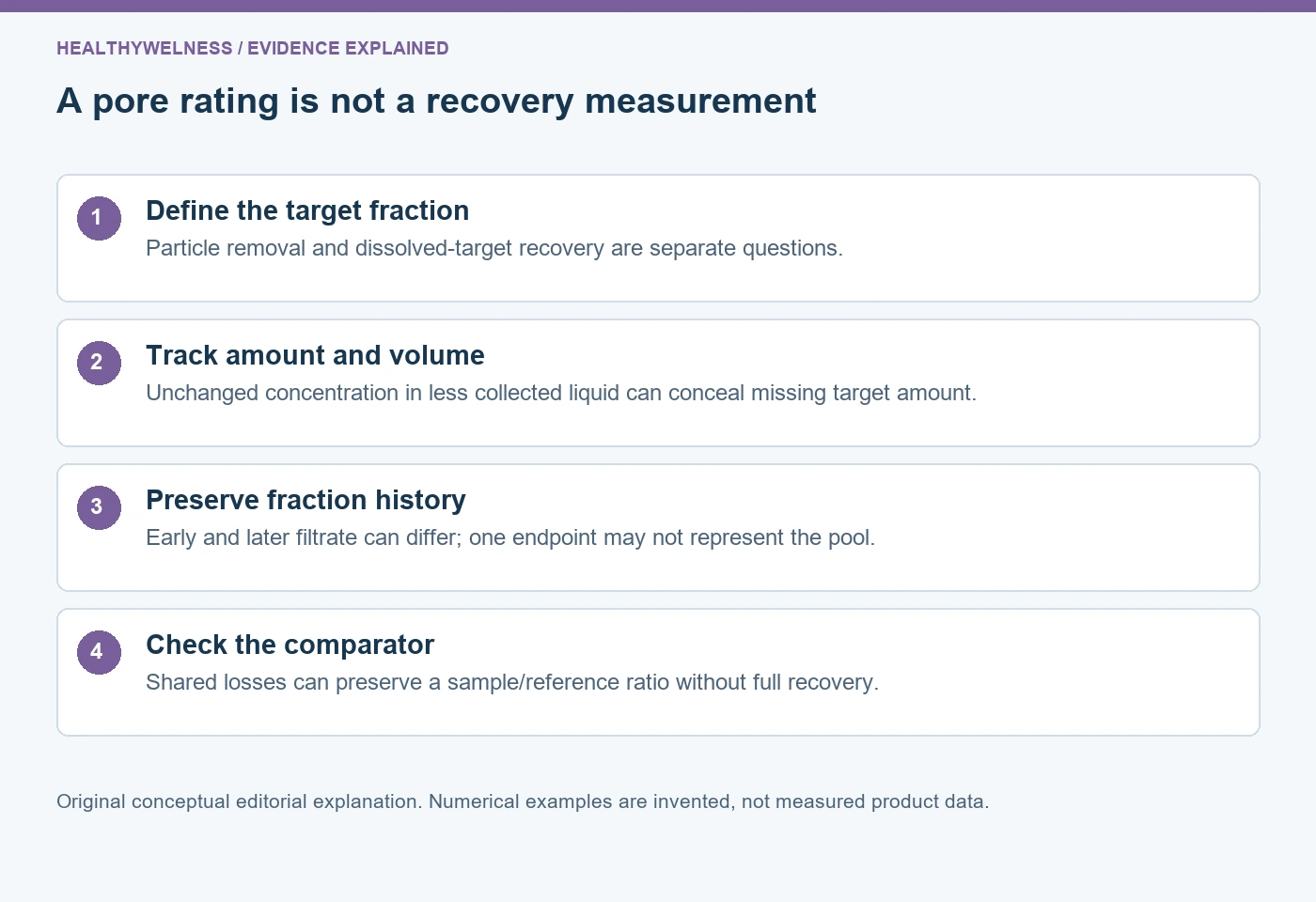
A microfilter’s pore-size rating does not establish quantitative peptide recovery. A dissolved peptide may pass through available pores yet be lost through adsorption, retained liquid or removal of peptide-containing particles. Compare target amount and analytical response in defined fractions; a clear filtrate or a matching concentration alone cannot establish complete recovery.
For laboratory research use only. This guide concerns analytical sample preparation, not human or veterinary use. All worked quantities below are invented and describe no HealthyWelness testing or filter validation.
- Microfiltration pore ratings and dialysis molecular-weight cutoffs are different descriptors.
- Membrane chemistry and the complete device can influence analyte recovery.
- Collected concentration multiplied by collected volume gives recovered amount on the stated analytical basis.
- Filtering a reference and sample identically can conceal a shared absolute loss in their ratio.
Separate particle removal from target recovery
A laboratory filters a peptide preparation before analysis and sees a cleaner chromatogram. That can be useful: removing suspended material can change what reaches the instrument. However, cleaner does not mean compositionally unchanged. The filtrate is an operational fraction selected by the device and preparation conditions. Its relationship to the original whole must be established for the intended analytical question.
A nominal 0.22 micrometre rating concerns a filtration characteristic. It does not promise that every dissolved peptide molecule is recovered in the receiving vial. Size-based passage and surface interaction are separate possibilities. So are target remaining in liquid held inside the device and target carried by particles that the filter was intended to remove.
| Question | Relevant observation | Not established alone |
|---|---|---|
| Were particles removed? | Defined particle measurement | Dissolved-target recovery |
| Was liquid recovered? | Collected volume | Target concentration |
| Was target recovered? | Amount in fractions | Cause of any deficit |
| Was analysis unaffected? | Matched analytical controls | Unchanged original whole |
The dialysis MWCO guide concerns diffusion and retention across a different separation format. A microfilter pore label should not be converted into a peptide mass cutoff by borrowing a dialysis number. The method, rated property and collected fraction must remain explicit.
Membrane chemistry matters even when a molecule fits
Merck’s first-party analyte-binding study examines several small-molecule formulations, membranes, concentrations and collected fractions. It documents that analyte response can depend on membrane–analyte interactions and processing. The study is useful as a demonstration of that dependence, not a ranking validated for all peptide sequences or solvents. Merck, Factors Affecting Analyte Binding on Membrane Filters.
A peptide’s interaction with a device can depend on charge, hydrophobic features, medium and concentration. The membrane is only part of the contact path; housing and upstream or downstream labware can also matter. A result described by the membrane abbreviation alone may omit differences in area, surface modification and geometry.
The same vendor’s original binding-properties page presents BSA and IgG observations and compares frontal with internal membrane surface area. Those model proteins and devices establish that a porous surface offers binding opportunities beyond its visible face. They do not supply a numerical binding capacity for an unrelated research peptide. No comparative percentages from that vendor page are transferred here. Merck, Binding Properties of Filters.
For the broader surface-loss problem, see peptide adsorption to labware. The present question is narrower: a filtration event adds selective collection, hold-up and potentially fraction-dependent response to those surface interactions.
A worked amount balance reveals loss hidden by concentration
Invented example: begin with 1.00 mL of a research preparation containing 100 micrograms/mL of an analytically defined intact target. Its starting target amount is 100 micrograms. Suppose a filter yields 0.80 mL of filtrate. Assume a suitable method independently measures the concentration in that collected liquid; the values below are stipulated, not predicted from a filter specification.
| Outcome | Collected concentration | Collected volume | Recovered amount |
|---|---|---|---|
| A | 100 micrograms/mL | 0.80 mL | 80 micrograms |
| B | 80 micrograms/mL | 0.80 mL | 64 micrograms |
| C | 125 micrograms/mL | 0.80 mL | 100 micrograms |
A has unchanged concentration but only 80% of the starting amount in the receiving vessel. B has 64% amount recovery. C has 100% amount recovery under the stipulated measurements, despite a higher concentration. The last case would require an explanation for the concentration change; it is not an assertion that routine filtration concentrates dissolved peptides.
The arithmetic does not say where a deficit went. In A, target could remain in 0.20 mL of held liquid at the same concentration, but that is an additional hypothesis. In B, adsorption, excluded particles, altered analytical response or other losses could contribute. A deficit inferred from one receiving-vial measurement cannot partition those mechanisms.
A complete balance can examine relevant collected fractions and remaining device-associated material using methods suited to each. Recovery from a device wash establishes recovery under that wash condition; it does not prove that the original bound or retained state was unchanged. Likewise, chemically extracting a residue may answer a different question from recovering the intended soluble preparation.
Early and later fractions can tell different stories
Finite surface sites can make the first collected liquid differ from later liquid. A later fraction with a response close to the input does not establish that the earlier fractions were equally recovered. Pooling may hide this time or volume dependence, while discarding initial liquid changes which target amount is being counted.
Merck’s analyte-binding study explicitly compares filtrate fractions and concentrations. Those results support checking fraction history where relevant. They do not authorize a universal discard volume: the relationship was dependent on the tested analyte, device and conditions. A fixed volume borrowed from another method could consume most of a small peptide sample without demonstrating suitability.
For an invented accounting exercise, collect three successive 0.20 mL fractions with concentrations of 50, 90 and 100 micrograms/mL. Their target amounts are 10, 18 and 20 micrograms, totaling 48 micrograms in 0.60 mL. The pooled concentration is 80 micrograms/mL. Reporting only the final fraction’s concentration would overstate the composition of that pool.
The example isolates concentration weighting. Real fraction collection also needs appropriate timing, volume measurement and a quantitative method that behaves consistently across those fractions. Different matrix composition or extractables can alter detection, so an apparent recovery trend should not be assigned to membrane saturation without supporting comparisons.
A matched reference ratio can hide shared preparation loss
Suppose an invented sample and reference each start with 100 units of the same analyte and each loses 20% during their respective preparation. An instrument response proportional to recovered amount gives 80 units for both. Their ratio remains one. Relative agreement has survived while neither preparation retained the full starting amount.
This can be appropriate for a method whose justified purpose is a matched relative comparison, but it is insufficient evidence for absolute recovery. Merck’s study describes how the preparation of standards and samples affected calculated recovery in its tested system. The lesson is to state the reference basis rather than assume that a satisfactory ratio resolves every preparation question.
Include an independently justified comparison when absolute recovery is the claim. An unfiltered preparation is not automatically an ideal reference if particles, detector interference or sample heterogeneity make it analytically incomparable. The reference needs its own evidence. Moving uncertainty into the comparator does not remove it.
Device documentation informs selection without replacing evaluation
The vendor’s filtration product guide lists pore size, diameter, membrane, housing and hold-up information separately. Its syringe-filter section also presents protein-binding comparisons. This first-party technical record is useful for identifying variables that a pore label omits; it is not independent validation of the vendor’s promotional ranking or evidence for a HealthyWelness sample. MilliporeSigma, Sterile Filtration Product Guide, syringe-filter section.
Record the exact device, membrane, area, medium, target concentration, volume history and collected fraction. Preserve whether the purpose was particle removal, analytical clarification or another defined task. The word sterile in a device catalog does not establish that the final research preparation is sterile or that every contaminant was removed.
The analytical-document lookup helps locate available material reports. A report from filtered liquid characterizes the analyzed fraction according to its actual methods. It should not be silently extended into complete recovery or characterization of excluded material.
Questions about peptide microfiltration
Does a pore size much larger than a peptide ensure full recovery?
No. Size-based passage does not exclude adsorption, retained liquid, removed peptide-containing particles or altered analytical response.
Does unchanged filtrate concentration mean no peptide was lost?
No. The recovered amount also depends on collected volume. In the invented example, unchanged concentration in 80% of the original volume gives 80% amount recovery.
Can a low-binding label be transferred between all peptide sequences?
No. The actual device, molecular properties, medium and concentration determine whether the tested behavior is relevant. A label is a selection clue, not universal recovery evidence.
Does a clean chromatogram establish that filtration preserved the sample?
No. Removing material can improve appearance while changing the analyzed fraction. Identity, amount recovery and intended particle removal need separate assessment.
Does equal loss from sample and reference cancel every problem?
It can preserve a relative ratio under suitable assumptions. It does not establish absolute recovery or demonstrate that all relevant sample components behave like the reference.
For laboratory research use only. The examples explain analytical reasoning and provide no product-specific filter qualification, sterility certification or human or veterinary advice.
Cover and evidence map: original conceptual editorial schematics, not measured results, exact molecular structures, or photographs of HealthyWelness facilities.