CJC-1295 With GHRP-2 or GHRP-6: Why They Are Paired
A GHRH analogue and a GHRP act at two different receptors, which is the stated rationale for pairing them. What the literature does and does not show.

Cover illustration: AI-generated editorial artwork. Conceptual only; not an exact molecular structure, actual laboratory result or evidence of clinical effects.
The stated reason for pairing CJC-1295 with a GHRP is real and mechanical: they act at two different receptors with two different natural ligands. The honest counterpart is that we cannot find published co-administration studies for these specific pairings, so the rationale is mechanistic rather than demonstrated. Both halves matter, and this article covers both.
For laboratory research use only. The research materials supplied by HealthyWelness are not approved medicines, foods or cosmetics and are not for human or veterinary use. This article summarises published research and is not medical advice.
- CJC-1295 is a GHRH analogue and acts at the GHRH receptor; GHRP-2 and GHRP-6 act at the growth hormone secretagogue receptor GHS-R1a.
- GHS-R1a’s natural ligand is ghrelin, a different hormone from GHRH, so the two compound classes engage separate inputs.
- Growth hormone secretagogue binding sites are present in peripheral human tissues, not only the pituitary (Papotti et al., 2000, PMID 11061542).
- Pulsatile secretion was reported to persist during continuous stimulation by a long-acting GHRH analogue (Ionescu et al., 2006, PMID 17018654).
- IGF-1 LR3 is a downstream element, not another upstream stimulus, so adding it changes the kind of combination rather than its size.
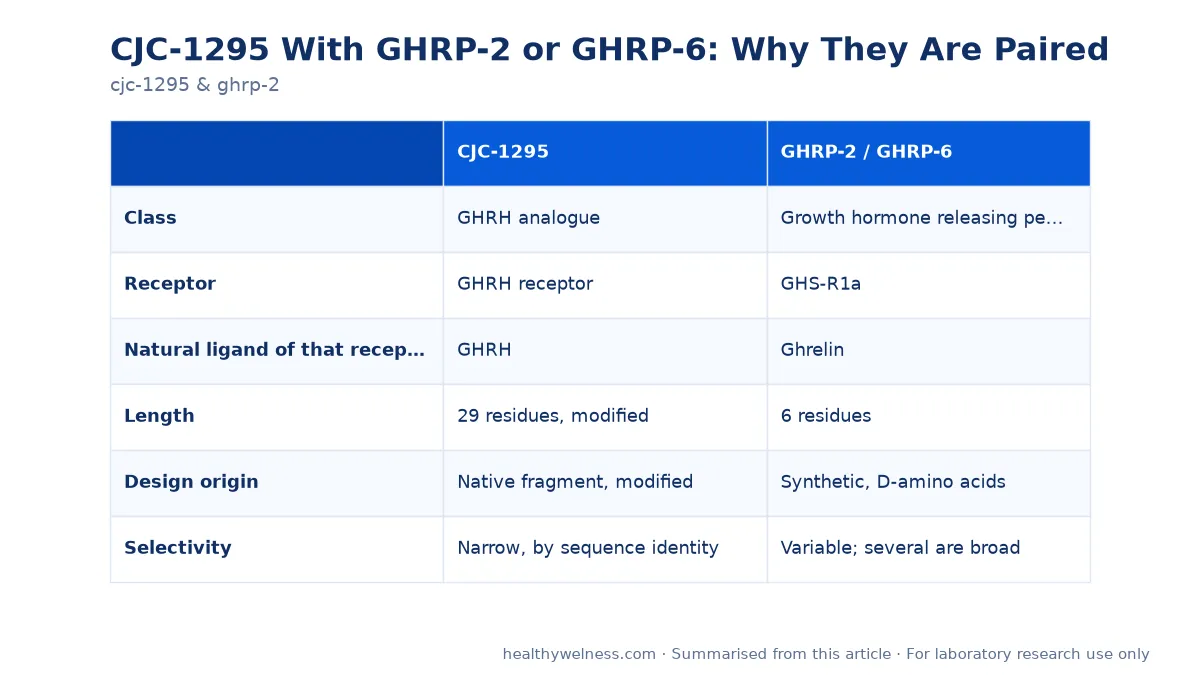
What are the two receptors, and why does that matter?
| CJC-1295 | GHRP-2 / GHRP-6 | |
|---|---|---|
| Class | GHRH analogue | Growth hormone releasing peptide |
| Receptor | GHRH receptor | GHS-R1a |
| Natural ligand of that receptor | GHRH | Ghrelin |
| Length | 29 residues, modified | 6 residues |
| Design origin | Native fragment, modified | Synthetic, D-amino acids |
| Selectivity | Narrow, by sequence identity | Variable; several are broad |
Two receptors with two natural ligands converging on one axis is an unusual and genuinely interesting arrangement. It is also the entire mechanistic argument for pairing: an agent at each receptor engages the axis at two points rather than pushing harder at one.
The family-level comparison is in GHRP compared with GHRH analogues.
What does the published literature actually cover?
Each component separately, and in reasonable depth.
For CJC-1295, the two 2006 studies in the Journal of Clinical Endocrinology and Metabolism are the anchors. Teichman and colleagues characterised prolonged stimulation; Ionescu and colleagues reported the more interesting finding, that pulsatile secretion persisted despite continuous stimulation — the pulse generator kept working rather than being flattened by a long-acting input.
For the GHRPs, the 1998 review by Bowers is written from inside the period when the series was developed, and the 2000 study by Papotti and colleagues documented secretagogue binding sites across peripheral human tissues — which means the receptor population is not confined to the pituitary and a peripheral effect is not evidence of a pituitary mechanism.
What the literature does not contain, as far as we can find, is a co-administration study of these specific blends as research material. That absence is worth stating plainly rather than papering over with the individual papers.
What does adding IGF-1 LR3 change?
It changes the kind of combination, not its magnitude.
CJC-1295 and a GHRP are both upstream agents: they act on the pituitary end of the axis and let the system produce its own output. IGF-1 LR3 is a modified form of what the axis eventually produces, applied directly, and its modifications exist to reduce capture by IGF binding proteins.
- Two upstream agents engage two receptors but keep the downstream steps and their regulation inside the experiment.
- Adding a downstream agent bypasses those steps for that component, so the combination is no longer testing the axis as a system.
- The regulation that is removed is not incidental. Binding proteins are a control layer, and a variant engineered to evade them is a tool for bypassing it.
The upstream-versus-downstream framing is developed in IGF-1 LR3 compared with sermorelin.
How should a combination experiment be designed?
With single-component arms, or the result cannot be interpreted. This is the practical core of the article.
- Run each component alone, at the same molar concentration it has in the blend. Without this, nothing in the combined result identifies which component contributed what.
- Run the blend. Compare against the sum of the single arms rather than against vehicle alone, since the question is usually whether the combination exceeds its parts.
- Use molar equivalence throughout. A 29-residue peptide and a six-residue peptide differ greatly in molecular weight, so a blend specified by mass is not specified by molarity.
- Confirm receptor expression for both receptors in the system. If one receptor is absent, the blend is a single-agent experiment with extra steps.
- Expect a ceiling rather than a sum where pathways converge. Published work on a different peptide pair found no additional benefit from combination, attributed to convergence on shared pathways — see the BPC-157 and TB-500 combination study.
That last point is the one worth carrying into any blend experiment. Two agents acting on one downstream output can produce a ceiling, and a ceiling is a legitimate finding rather than a failed experiment.
How should blend material be handled?
Preferably as separate components combined at the point of use, for two reasons that are practical rather than purist.
- Each component stays verifiable. A pre-mixed preparation cannot be checked arm by arm, and if a result is anomalous there is no way to tell which component was at fault.
- Single-agent arms become free. If the components are separate, the controls described above cost nothing extra in material.
The handling requirements also differ between them. A GHRP is a tryptophan-rich hexapeptide that is light- and oxidation-sensitive, covered in GHRP reconstitution. CJC-1295’s storage depends on whether the DAC version is involved, because that version carries a maleimide group designed to react with a thiol — a reactive group is useful in an experiment and a liability in a freezer, as set out in CJC-1295 storage.
Concentrations for every component should be computed from net peptide content rather than vial weight, each with its own molecular weight; our reconstitution calculator takes those inputs. Our CJC-1295 no DAC research material is supplied for laboratory research use. Certificates are available for listed products — contact us for the latest report.
What the pulse finding implies for blends
One detail from the CJC-1295 literature deserves to be carried into any blend design. Ionescu and colleagues found that pulsatile secretion persisted during continuous stimulation by a long-acting GHRH analogue — the system kept generating its own rhythm rather than being overridden by a steady input.
That is reassuring and complicating at once. Reassuring, because an upstream agent does not simply flatten the axis into a constant output. Complicating, because the downstream result of a blend then depends on how two inputs interact with a generator that is still running, rather than on their arithmetic sum.
So the question a blend experiment should ask is narrower than whether the combination is stronger: it is whether engaging two receptors changes the pattern of output as well as its size. Answering that needs sampling across time rather than a single endpoint, and it is the measurement most blend comparisons leave out.
Scope note
This material is supplied for laboratory research use only. It is not a medicine, not a supplement, and not for human or veterinary use. Nothing here describes administration to any organism, and the combinations discussed are experimental designs rather than recommendations.
Open questions
- Does engaging both receptors exceed the effect of engaging either one alone, in any published system?
- Does the selectivity difference between GHRP-2, GHRP-6 and ipamorelin change the outcome of a pairing?
- Is the pulse pattern preserved when two upstream agents are present together?
Related research
Frequently asked questions
Why are CJC-1295 and a GHRP paired?
Because they act at two different receptors. CJC-1295 is a GHRH analogue acting at the GHRH receptor; GHRP-2 and GHRP-6 act at the growth hormone secretagogue receptor GHS-R1a, whose natural ligand is ghrelin. Pairing them engages two separate inputs to the same axis.
Is there published evidence for the combination itself?
Not that we can find for these specific pairings as research material. The individual compounds have their own literatures, and the rationale for combining them is mechanistic rather than demonstrated in a published co-administration study of this exact blend.
What does adding IGF-1 LR3 change?
It adds a downstream element. GHRH analogues and GHRPs both act upstream, on the pituitary; IGF-1 LR3 is a modified form of an axis output applied directly. A combination of all three spans the axis rather than stimulating one point in it.
Can the contribution of each component be separated?
Only with single-component arms in the same experiment. A blend tested alone produces a result attributable to the blend, and nothing in that result identifies which component did what.
Should a blend be prepared as one solution?
Preferably not in the laboratory. Preparing components separately and combining them at the point of use keeps each one verifiable and lets a single-component arm be run from the same material.
For laboratory research use only. The research materials supplied by HealthyWelness are not approved medicines, foods or cosmetics and are not for human or veterinary use. This article summarises published research and is not medical advice.
Sources
- Teichman SL, et al. Prolonged stimulation of growth hormone (GH) and insulin-like growth factor I secretion by CJC-1295, a long-acting analog of GH-releasing hormone, in healthy adults. J Clin Endocrinol Metab. 2006. PMID: 16352683
- Ionescu M, et al. Pulsatile secretion of growth hormone (GH) persists during continuous stimulation by CJC-1295, a long-acting GH-releasing hormone analog. J Clin Endocrinol Metab. 2006. PMID: 17018654
- Bowers CY. Growth hormone-releasing peptide (GHRP). Cell Mol Life Sci. 1998. PMID: 9893708
- Papotti M, et al. Growth hormone secretagogue binding sites in peripheral human tissues. J Clin Endocrinol Metab. 2000. PMID: 11061542
- Raun K, et al. Ipamorelin, the first selective growth hormone secretagogue. Eur J Endocrinol. 1998. PMID: 9849822