5-Amino-1MQ Structure, CAS and Mechanism of Action
5-Amino-1MQ is a permanently charged quinolinium cation that inhibits NNMT. Why the charge, the salt form and the CAS number all matter.


Cover illustration: AI-generated editorial artwork. Conceptual only; not an exact molecular structure, actual laboratory result or evidence of clinical effects.
5-Amino-1MQ is 5-amino-1-methylquinolinium: a quaternary ammonium cation carrying a permanent positive charge, supplied as a salt. That single structural fact explains the counterion on the label, the CAS ambiguity people run into, the solubility behaviour and half of the handling rules. The mechanism — inhibition of nicotinamide N-methyltransferase — is the other half.
For laboratory research use only. The research materials supplied by HealthyWelness are not approved medicines, foods or cosmetics and are not for human or veterinary use. This article summarises published research and is not medical advice.
- 5-Amino-1MQ is a quinolinium cation with a methyl group on the ring nitrogen and an amino group at position 5.
- The ring nitrogen carries a permanent positive charge, so there is no neutral form and the compound is always a salt.
- It inhibits nicotinamide N-methyltransferase (NNMT), which transfers a methyl group to nicotinamide.
- Nicotinamide is a precursor in NAD+ salvage, which is why an NNMT inhibitor is discussed alongside NAD+ chemistry.
- No human trials or published pharmacokinetics for this compound appear in the indexed literature that we can find.
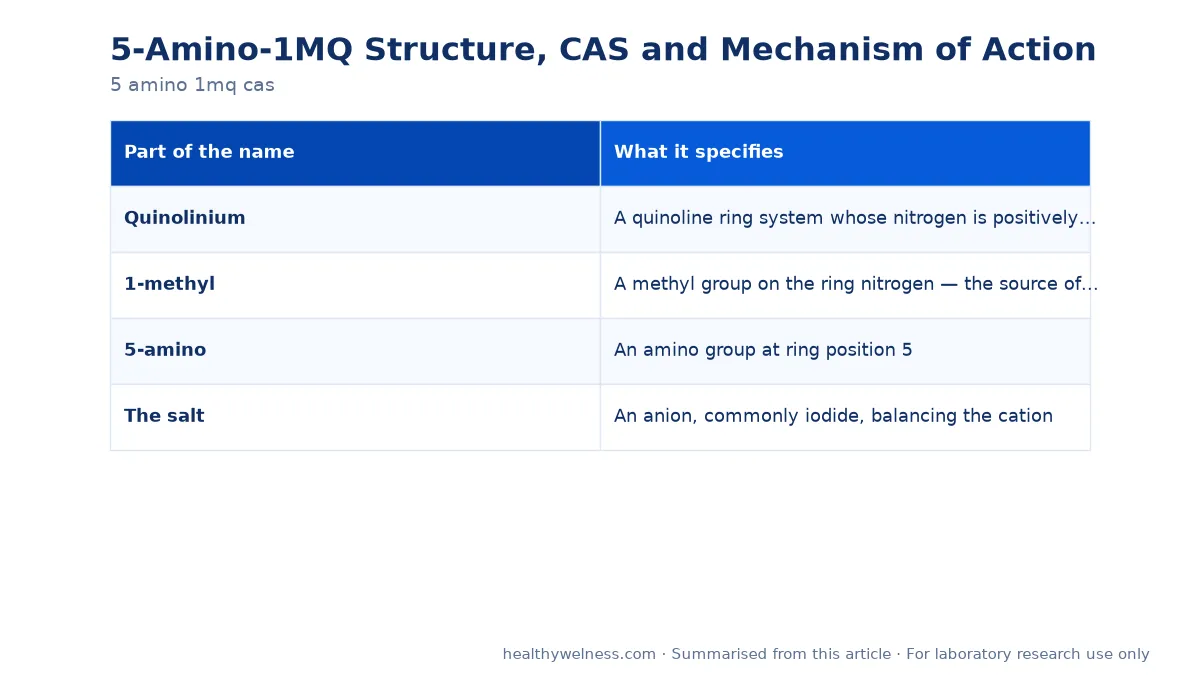
What does the name describe?
| Part of the name | What it specifies |
|---|---|
| Quinolinium | A quinoline ring system whose nitrogen is positively charged |
| 1-methyl | A methyl group on the ring nitrogen — the source of the permanent charge |
| 5-amino | An amino group at ring position 5 |
| The salt | An anion, commonly iodide, balancing the cation |
The methylation at the ring nitrogen is the structurally decisive step. A quinoline nitrogen with a methyl group on it has used all four of its bonding positions and carries a permanent formal positive charge. No change in pH removes it, which is why this compound behaves differently from an ordinary ionisable base.
Why is the CAS number ambiguous without the salt form?
Because a CAS registry number identifies a specific substance, and a cation plus different anions gives different substances.
The free cation, the iodide salt and any other salt form each correspond to distinct registry entries with distinct formula weights. So a CAS number quoted on its own does not tell you what is in the vial unless the salt it refers to is stated alongside it.
This has a direct arithmetic consequence. Iodide has an atomic mass of about 127, which for a small cation is a substantial fraction of the formula weight of the salt. Calculating molarity from the cation’s mass alone overstates the concentration considerably, and the error is systematic rather than random. The figure to use is the molecular weight of the supplied salt, which our reconstitution calculator takes as an explicit input.
How does the mechanism work?
By blocking a diversion rather than by adding anything.
NNMT transfers a methyl group to nicotinamide. Nicotinamide is a precursor in NAD+ salvage, so methylating it routes that molecule away from the salvage pathway. An NNMT inhibitor blocks that exit, and the proposition is that less nicotinamide is diverted and more remains available.
Two things are worth separating in how that is usually described:
- The enzymatic step is well defined. NNMT is a named enzyme with a known reaction, and inhibition of it is measurable as substrate and product levels.
- The downstream consequence is a hypothesis. Whether blocking the diversion produces a measurable change in NAD+ availability depends on the system, and it is an empirical question rather than a deduction.
The 2018 study by Neelakantan and colleagues in Biochemical Pharmacology describes selective, membrane-permeable small-molecule NNMT inhibitors in a mouse model. Both adjectives in that description are chemistry claims tested in vitro, and they are the paper’s most transferable contribution: an inhibitor that cannot cross a membrane cannot reach a cytosolic enzyme.
What does the 2025 Nature paper establish, and what does it not?
It establishes that the target matters. The study by Heide and colleagues reported that NNMT inhibition in cancer-associated fibroblasts restores antitumour immunity — strong work in a major journal.
What it does not do is validate this particular compound. Target validation and compound validation are separate claims, and they are frequently cited together in a way that blurs the difference. A reader evaluating a purchase is usually asking the second question.
The honest way to hold both: NNMT is a real enzyme with a growing literature establishing it as a meaningful target, and 5-Amino-1MQ is one tool compound used to probe it whose own characterisation is thinner than the target’s. The gaps are set out in what the 5-Amino-1MQ evidence actually contains.
What does the permanent charge do at the bench?
| Property | Consequence |
|---|---|
| Cannot be neutral | Always supplied as a salt; an anion is always present |
| Charged at every pH | Solubility less pH-dependent than for an ionisable base |
| Cationic | Adsorbs to negatively charged glass and plastic |
| Iodide counterion | Light-sensitive — iodide oxidises to iodine |
| Membrane crossing | By design rather than simple diffusion |
The light-sensitivity row is unusually convenient as quality indicators go. Iodide salts darken on exposure to light and air because iodide oxidises to iodine, so a discoloured solid is direct visible evidence of oxidative change. Most degradation in research compounds is invisible and detectable only analytically. Here the sensible response to yellowing or browning is to discard the lot rather than proceed and hope. The handling detail is in handling 5-Amino-1MQ.
What should the analytical report contain?
Small-molecule data, not peptide data. The 2024 review by Kuril and colleagues is written about peptides but its framework transfers: characterisation is a set of measurements rather than one number.
- Purity with the method stated. A percentage without a method cannot be interpreted.
- Mass matching the cation, confirming the identity of the active species.
- Counterion named, which fixes the molecular weight and the CAS entry.
- Residual solvent, since small molecules are crystallised from organic solvents and residues contribute mass.
- Appearance described, because discolouration is meaningful for an iodide salt.
Where the laboratory has access to an NNMT activity assay, running a new lot alongside a retained reference lot is the single best quality practice available — for an enzyme inhibitor, inhibition of the target is more informative than any chromatographic percentage.
The relationship to NAD+ chemistry, including why a cofactor and an inhibitor are opposite interventions, is covered in 5-Amino-1MQ compared with NAD+, and the wider precursor picture in the 2021 review by Palmer and colleagues. The redox framing is in the 2015 review by Bilan and colleagues and in NAD+ to NADH.
Our 5-Amino-1MQ research material is supplied for laboratory research use. Certificates are available for listed products — contact us for the latest report.
Why a tool compound deserves a reference lot
Where a compound has a named enzyme target but no published disposition data, the most reliable quality practice is comparative rather than absolute. Keep a retained aliquot of a lot that behaved as expected and run each new lot against it in the same assay on the same day. A chromatographic percentage cannot tell you whether inhibitory activity has been lost; a side-by-side activity comparison can.
Scope note
This material is supplied for laboratory research use only. It is not a medicine, not a supplement, and not for human or veterinary use. The published work described above is in cells and animal models.
Open questions
- How selective is the compound against related methyltransferases that share cofactor chemistry?
- Does NNMT inhibition measurably change the NAD+/NADH ratio in any published system?
- How much inhibitory activity is lost in a visibly discoloured lot?
Related research
Frequently asked questions
What is 5-Amino-1MQ, structurally?
A quaternary ammonium cation: 5-amino-1-methylquinolinium. The quinoline nitrogen carries a methyl group and a permanent positive charge, so the molecule cannot exist as a neutral species and is always supplied as a salt with an anion.
Why does a CAS number matter for this compound?
Because a CAS number identifies a specific substance, and a permanently charged cation plus different anions gives different substances with different registry numbers. A CAS number quoted without the salt form it refers to is ambiguous.
What is 5-Amino-1MQ's mechanism of action?
It inhibits nicotinamide N-methyltransferase, an enzyme that transfers a methyl group to nicotinamide. Because nicotinamide is a precursor in NAD+ salvage, methylating it diverts that molecule away from the salvage route.
Does the permanent charge help or hinder?
Both. A charged molecule is more water-tolerant than a neutral heteroaromatic compound, which helps with solubility. It also adsorbs to negatively charged surfaces and its membrane crossing depends on design rather than on simple diffusion.
Is the mechanism established or proposed?
The target is named and the compound class is characterised as selective and membrane-permeable in published work. What is missing is compound-level pharmacokinetics and any human trial, so mechanism is better supported than disposition.
For laboratory research use only. The research materials supplied by HealthyWelness are not approved medicines, foods or cosmetics and are not for human or veterinary use. This article summarises published research and is not medical advice.
Sources
- Neelakantan H, et al. Selective and membrane-permeable small molecule inhibitors of nicotinamide N-methyltransferase reverse high fat diet-induced obesity in mice. Biochem Pharmacol. 2018. PMID: 29155147
- Heide J, et al. NNMT inhibition in cancer-associated fibroblasts restores antitumour immunity. Nature. 2025. PMID: 40702186
- Palmer RD, et al. Precursor comparisons for the upregulation of nicotinamide adenine dinucleotide. Novel approaches for better aging. Aging Med (Milton). 2021. PMID: 34553119
- Kuril AK, et al. Analytical considerations for characterization of generic peptide product: A regulatory insight. Anal Biochem. 2024. PMID: 39089363
- Bilan DS, et al. Main Cellular Redox Couples. Bioorg Khim. 2015. PMID: 26615634