Cagrilintide and Semaglutide: The CagriSema Trial Programme
Cagrilintide is a long-acting amylin analogue; semaglutide a GLP-1 receptor agonist. How the co-formulated pair was designed and what its trials measured.


Cover illustration: AI-generated editorial artwork. Conceptual only; not an exact molecular structure, actual laboratory result or evidence of clinical effects.
Cagrilintide is a long-acting amylin analogue and semaglutide a GLP-1 receptor agonist; given together they form the investigational pairing called CagriSema. The two act on different hormone receptors, and their joint evaluation comes from randomised phase 2 and phase 3 trials sponsored by their developer.
For laboratory research use only. The research materials supplied by HealthyWelness are not approved medicines, foods or cosmetics and are not for human or veterinary use. This article summarises published research and is not medical advice.
- Cagrilintide is a stable, lipidated, long-acting amylin analogue developed to overcome amylin’s tendency to form amyloid fibrils (Kruse et al., 2021).
- The amylin analogue pramlintide requires three daily administrations because of its short half-life, which motivated a long-acting design (Kruse et al., 2021).
- In a 32-week phase 2 trial in type 2 diabetes (NCT04982575), HbA1c fell more with CagriSema than with cagrilintide alone but not significantly more than with semaglutide alone (Frias et al., 2023).
- REDEFINE 1 (NCT05567796) randomised 3,417 adults without diabetes for 68 weeks, with single-agent and placebo arms (Garvey et al., 2025).
- REDEFINE 2 (NCT05394519) randomised 1,206 adults with type 2 diabetes for 68 weeks against placebo (Davies et al., 2025).
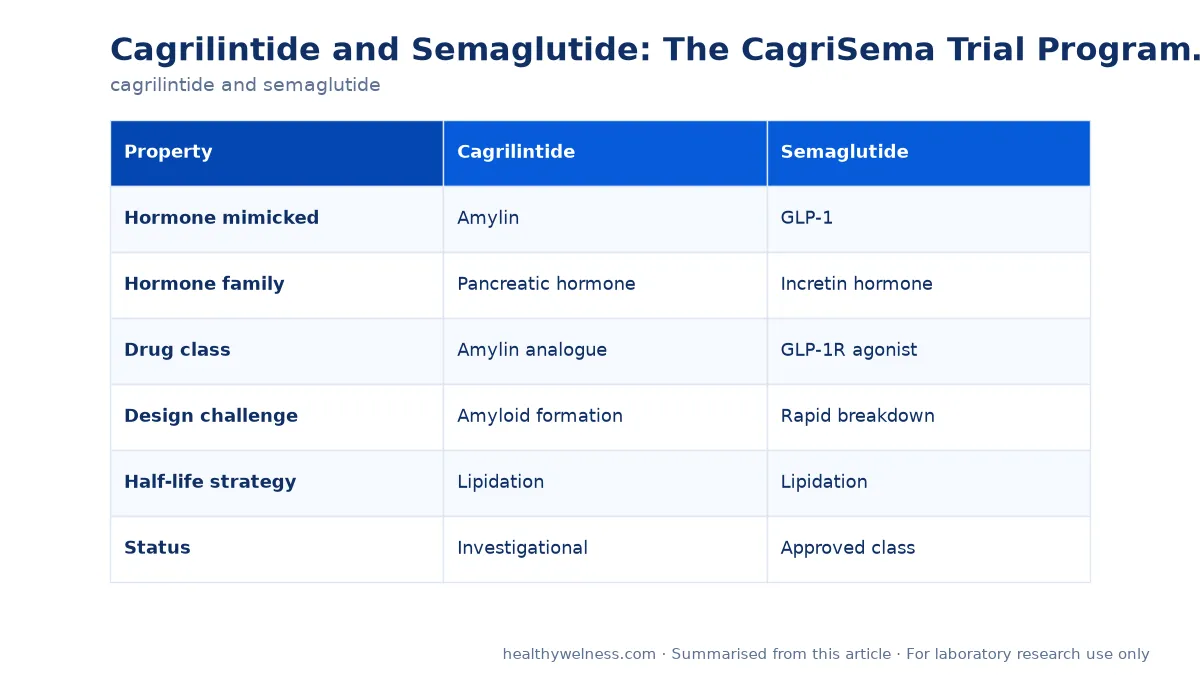
The two components compared
| Property | Cagrilintide | Semaglutide |
|---|---|---|
| Hormone mimicked | Amylin | GLP-1 |
| Hormone family | Pancreatic hormone | Incretin hormone |
| Drug class | Amylin analogue | GLP-1R agonist |
| Design challenge | Amyloid formation | Rapid breakdown |
| Half-life strategy | Lipidation | Lipidation |
| Status | Investigational | Approved class |
Both molecules use fatty-acid attachment to reach weekly exposure, but they mimic hormones with different jobs. Our cagrilintide research peptide is the amylin analogue alone; semaglutide is not stocked.
Certificates are available for listed products — contact us for the latest report.
Why amylin was difficult to turn into a drug
Amylin is a pancreatic hormone, and the native peptide aggregates into amyloid fibrils readily. Kruse and colleagues describe this as the hallmark problem for drug design. Their structure-activity work, which led to the selection of cagrilintide for clinical development in obesity, aimed at a molecule that was both stable in formulation and long-acting in circulation (Kruse et al., 2021). The earlier analogue pramlintide solved the aggregation problem but not the duration problem. The development story is told in more depth in what is cagrilintide.
Semaglutide’s receptor behaviour
Semaglutide is a selective GLP-1 receptor agonist. In live-cell imaging and BRET experiments, Novikoff and colleagues used it as one of the mono-agonist comparators against which dual agonists such as tirzepatide were measured, and found that the dual agonists produced less receptor internalisation than semaglutide and native peptides (Novikoff et al., 2021). The point for this comparison is that semaglutide’s single-receptor profile is well characterised, which made it a natural backbone to which a second hormone system could be added.
The trial programme
| Trial | Population | Duration | Primary endpoint |
|---|---|---|---|
| Phase 2, NCT04982575 | 92 adults, T2D | 32 weeks | HbA1c change |
| REDEFINE 1, NCT05567796 | 3,417 adults, no diabetes | 68 weeks | Body weight change |
| REDEFINE 2, NCT05394519 | 1,206 adults, T2D | 68 weeks | Body weight change |
Phase 2: separating the components
The phase 2 trial is the most informative for the question of what each component contributes, because it randomised 92 adults with type 2 diabetes on metformin to CagriSema, semaglutide alone or cagrilintide alone. Mean HbA1c change at 32 weeks was −2.2 percentage points with CagriSema, −1.8 with semaglutide and −0.9 with cagrilintide; the combination beat cagrilintide but the difference from semaglutide was not significant. Mean body-weight change was −15.6%, −5.1% and −8.1% respectively, and here the combination was greater than both components. Time in the target glucose range on continuous monitoring rose to 88.9%, 76.2% and 71.7% (Frias et al., 2023).
The pattern matters. For glycaemic control, adding cagrilintide to semaglutide did not clearly add to semaglutide; for body weight it did. Interpreting that requires caution: the trial was small and only 32 weeks long.
Phase 3: REDEFINE 1 and 2
REDEFINE 1 enrolled adults with obesity, or overweight with a related condition, but without diabetes, and randomised them 21:3:3:7 to the combination, semaglutide, cagrilintide or placebo, all with lifestyle intervention. The estimated mean change in body weight at 68 weeks was −20.4% with the combination versus −3.0% with placebo. Gastrointestinal adverse events affected 79.6% versus 39.9% (Garvey et al., 2025).
REDEFINE 2 enrolled adults with type 2 diabetes and randomised them 3:1 to the combination or placebo. Body weight changed by −13.7% versus −3.4%, and 73.5% versus 15.9% reached HbA1c of 6.5% or less; gastrointestinal events affected 72.5% versus 34.4% (Davies et al., 2025).
Adverse events across the programme
Tolerability findings were consistent in direction across all three trials. In phase 2, adverse events of any kind were reported by 68% of the CagriSema group, 71% of the semaglutide group and 80% of the cagrilintide group; mild or moderate gastrointestinal events were the most common, no level 2 or 3 hypoglycaemia occurred and there were no fatal adverse events (Frias et al., 2023). In both phase 3 trials, gastrointestinal events were roughly twice as frequent with the combination as with placebo and were described as mainly transient and mild to moderate (Garvey et al., 2025; Davies et al., 2025). It is notable that in the small phase 2 trial the cagrilintide-alone arm reported the highest overall rate, a reminder that the amylin component has its own tolerability profile rather than simply adding to semaglutide’s.
Reading the percentages: estimands
The headline figures from REDEFINE 1 and 2 were calculated with the treatment-policy estimand, which the REDEFINE 2 authors describe as consistent with the intention-to-treat principle (Davies et al., 2025). Under this approach, every randomised participant is analysed in the group they were assigned to, whether or not they kept taking the study drug. Discontinuation, rescue treatment and other intercurrent events are left in the data rather than modelled away.
That choice tends to give smaller, more conservative estimates than an efficacy or “trial product” estimand, which asks what would have happened had everyone stayed on treatment as planned. Comparisons between programmes are only meaningful when the same estimand is used on both sides. A treatment-policy figure for one agent set beside an efficacy figure for another overstates the gap, and this is one of the commonest errors in informal comparisons of incretin-class trials.
| Estimand | Question answered | Effect on estimate |
|---|---|---|
| Treatment-policy | Effect of assigning treatment | More conservative |
| Efficacy / hypothetical | Effect if adherent | Usually larger |
What the trials do not tell us
All of these studies were funded by the developer, and the single-agent arms in REDEFINE 1 were small relative to the combination arm, so they were not powered to compare the components with each other precisely. The trials also tested a fixed pairing at matched strengths; they do not describe the components prepared separately in a laboratory. For research use, cagrilintide is a separate reagent whose behaviour should be characterised on its own terms.
Handling in the lab
Cagrilintide is a lipidated peptide derived from a highly aggregation-prone hormone, so gentle dissolution, avoidance of vigorous agitation and cold storage of solutions are especially relevant, and turbidity is a warning sign. Concentrations are calculated from net peptide content with the peptide calculator. Storage principles for dry peptides are covered in lyophilised peptide storage.
Related research
Cagrilintide’s pairing with other incretin agents is discussed in cagrilintide with retatrutide or tirzepatide, and the published evidence is reviewed in the cagrilintide research review. A newer amylin agonist is compared in eloralintide versus incretin peptides.
Frequently asked questions
What is CagriSema?
CagriSema is the investigational co-administration of cagrilintide, a long-acting amylin analogue, with semaglutide, a GLP-1 receptor agonist, developed by Novo Nordisk. It has been tested in phase 2 and phase 3 trials such as REDEFINE 1 (NCT05567796) and REDEFINE 2 (NCT05394519).
Why pair an amylin analogue with a GLP-1 receptor agonist?
Amylin and GLP-1 are separate hormones acting on separate receptors. The trials were designed to test whether engaging both systems adds to what either does alone; the phase 2 diabetes trial included single-agent arms for that reason (Frias et al., 2023).
Why was cagrilintide hard to develop?
Native amylin has a strong tendency to form amyloid fibrils, which makes drug design difficult. The earlier analogue pramlintide needs administration three times a day because of its short half-life; cagrilintide was engineered as a stable, lipidated, long-acting analogue (Kruse et al., 2021).
Did the combination outperform its components?
In the 32-week phase 2 trial in type 2 diabetes, HbA1c fell more with CagriSema than with cagrilintide alone but not significantly more than with semaglutide alone, while the change in body weight was greater than with either component (Frias et al., 2023).
What adverse events were most common?
Gastrointestinal events. In REDEFINE 1 they affected 79.6% of the combination group and 39.9% of the placebo group, mostly transient and mild to moderate (Garvey et al., 2025).
For laboratory research use only. The research materials supplied by HealthyWelness are not approved medicines, foods or cosmetics and are not for human or veterinary use. This article summarises published research and is not medical advice.
Sources
- Kruse T, et al. Development of Cagrilintide, a Long-Acting Amylin Analogue. J Med Chem. 2021. PMID: 34288673
- Frias JP, et al. Efficacy and safety of co-administered once-weekly cagrilintide 2·4 mg with once-weekly semaglutide 2·4 mg in type 2 diabetes: a multicentre, randomised, double-blind, active-controlled, phase 2 trial. Lancet. 2023. PMID: 37364590
- Garvey WT, et al. Coadministered Cagrilintide and Semaglutide in Adults with Overweight or Obesity. N Engl J Med. 2025. PMID: 40544433
- Davies MJ, et al. Cagrilintide-Semaglutide in Adults with Overweight or Obesity and Type 2 Diabetes. N Engl J Med. 2025. PMID: 40544432
- Novikoff A, et al. Spatiotemporal GLP-1 and GIP receptor signaling and trafficking/recycling dynamics induced by selected receptor mono- and dual-agonists. Mol Metab. 2021. PMID: 33556643