MOTS-c and Tirzepatide: Mitochondrial Peptide vs Incretin Agonist
MOTS-c acts through the folate-AMPK axis in muscle; tirzepatide acts on GIP and GLP-1 receptors. How the two differ, and what PubMed holds on the pair.


Cover illustration: AI-generated editorial artwork. Conceptual only; not an exact molecular structure, actual laboratory result or evidence of clinical effects.
MOTS-c and tirzepatide have not been studied together; as of 2026-11-03 no PubMed record tests the pair. MOTS-c is a 16-residue mitochondria-encoded peptide that activates AMPK through the folate pathway in mouse muscle. Tirzepatide is a dual GIP and GLP-1 receptor agonist with a phase 3 trial record. They reach metabolism by unrelated routes.
For laboratory research use only. The research materials supplied by HealthyWelness are not approved medicines, foods or cosmetics and are not for human or veterinary use. This article summarises published research and is not medical advice.
- MOTS-c is a 16-amino-acid peptide encoded by a short open reading frame in the mitochondrial 12S rRNA gene (Lee et al., 2015).
- In the discovery study, MOTS-c inhibited the folate cycle and tethered de novo purine biosynthesis, leading to AMPK activation, with skeletal muscle as its apparent primary target (Lee et al., 2015).
- Under metabolic stress MOTS-c translocated to the nucleus in an AMPK-dependent manner and regulated genes with antioxidant response elements (Kim et al., 2018).
- Tirzepatide (LY3298176) engages the GIP receptor more than the GLP-1 receptor and favours cAMP generation over beta-arrestin recruitment at the GLP-1 receptor (Willard et al., 2020).
- As of 2026-11-03, a PubMed search for “MOTS-c tirzepatide” returned no records.
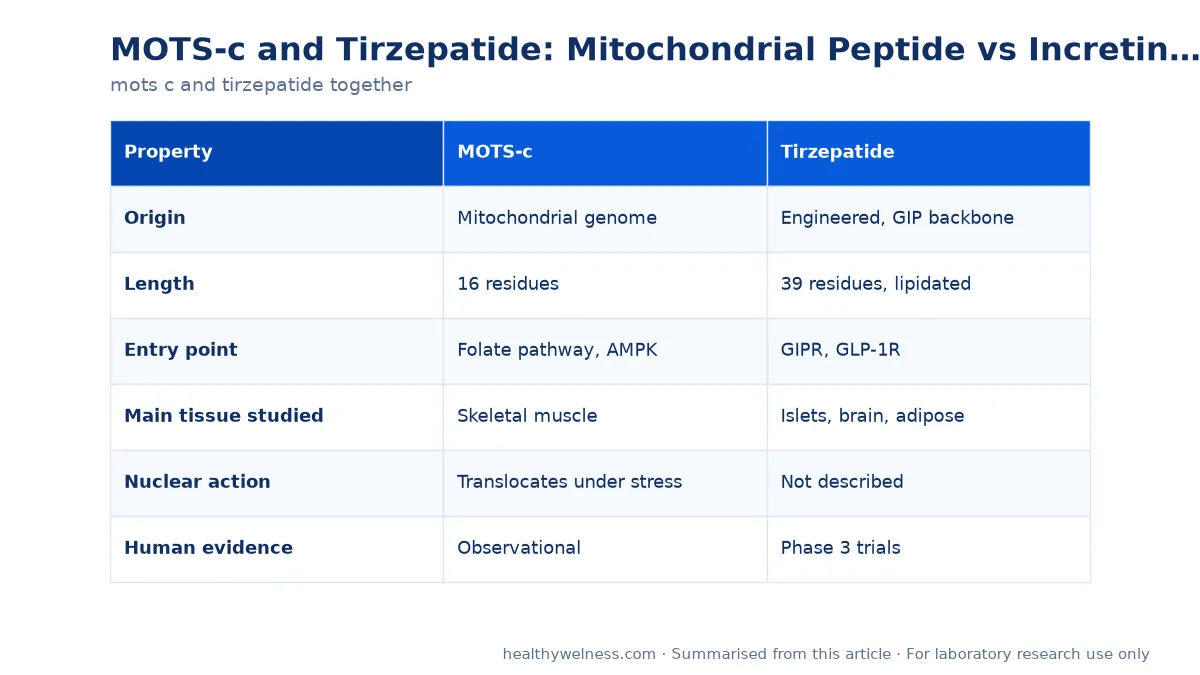
The two compared
| Property | MOTS-c | Tirzepatide |
|---|---|---|
| Origin | Mitochondrial genome | Engineered, GIP backbone |
| Length | 16 residues | 39 residues, lipidated |
| Entry point | Folate pathway, AMPK | GIPR, GLP-1R |
| Main tissue studied | Skeletal muscle | Islets, brain, adipose |
| Nuclear action | Translocates under stress | Not described |
| Human evidence | Observational | Phase 3 trials |
The columns describe two different kinds of molecule. MOTS-c is an endogenous signal whose level changes with physiological state; tirzepatide is a drug-like agonist designed for sustained receptor activation. Our MOTS-c research peptide and our tirzepatide research peptide are separate reagents.
Certificates are available for listed products — contact us for the latest report.
MOTS-c: a signal from the mitochondrial genome
Mitochondria carry their own small genome, and a few short open reading frames in it encode peptides. After humanin, Lee and colleagues identified a reading frame inside the 12S rRNA gene that encodes a 16-amino-acid peptide, which they named MOTS-c. Its actions inhibited the folate cycle and the de novo purine synthesis tied to it, which led to AMPK activation; later reviews summarise this route as the folate-AICAR-AMPK pathway (Wan et al., 2023). In mice, MOTS-c treatment prevented age-dependent and high-fat-diet-induced insulin resistance and diet-induced obesity (Lee et al., 2015).
Kim and colleagues extended the model. Under glucose restriction and other metabolic stresses, MOTS-c moved into the nucleus in an AMPK-dependent manner, regulated a broad set of genes including those with antioxidant response elements, and interacted with stress-responsive transcription factors such as NRF2 (Kim et al., 2018). That made MOTS-c one of the first mitochondria-encoded factors shown to regulate nuclear gene expression directly.
Reynolds and colleagues then linked MOTS-c to physical capacity. In mice aged 2, 12 and 22 months, MOTS-c enhanced physical performance; late-life intermittent treatment started at 23.5 months increased physical capacity; and in humans, exercise raised endogenous MOTS-c in skeletal muscle and in circulation (Reynolds et al., 2021). The human part of that study measured the body’s own peptide, not administered MOTS-c. More background is in what is MOTS-c.
Tirzepatide: receptor pharmacology with a clinical record
Tirzepatide’s discovery paper reported that it activated both incretin receptors in vitro, improved glucose tolerance through both in mice, and reduced body weight and food intake more than a selective GLP-1 receptor agonist; phase 1 work in 142 subjects found gastrointestinal events to be the most frequent, dose-dependent and mostly mild to moderate (Coskun et al., 2018). Willard and colleagues later showed that its receptor engagement is imbalanced toward GIP and biased toward cAMP at the GLP-1 receptor (Willard et al., 2020).
| Trial | Population | Primary endpoint | Result vs placebo |
|---|---|---|---|
| SURPASS-1, NCT03954834 | 478 adults, T2D, 40 wk | Change in HbA1c | −1.91 to −2.11 points |
In SURPASS-1, adults with type 2 diabetes inadequately controlled by diet and exercise were randomised to one of three tirzepatide doses or placebo for 40 weeks. All tirzepatide groups were superior to placebo for change in HbA1c, with estimated treatment differences of −1.91 to −2.11 percentage points; nausea, diarrhoea and vomiting were the most frequent adverse events, and no clinically significant hypoglycaemia was reported (Rosenstock et al., 2021).
Receptor trafficking adds a further layer. Novikoff and colleagues used BRET-based assays and live-cell microscopy to compare tirzepatide with native peptides, semaglutide and matched mono-agonists. Tirzepatide preserved maximal cAMP production despite only partial G-alpha-s recruitment, and produced less ligand-induced internalisation at both the GIP and GLP-1 receptors (Novikoff et al., 2021). In other words, tirzepatide’s action is shaped not only by which receptors it binds but by how long those receptors stay at the cell surface, a dimension with no counterpart in the MOTS-c literature, where no surface receptor has been identified.
Where an overlap could be hypothesised, and why it has not been tested
Both literatures report changes in insulin sensitivity, which is the only obvious meeting point. The routes are different. MOTS-c’s effect in the 2015 study was traced to muscle AMPK. Tirzepatide’s glycaemic effect involves insulin secretion through both incretin receptors, and its effects on body weight run through food intake (Coskun et al., 2018). One acts inside the muscle cell; the other mainly through pancreatic and central signals.
| Level | MOTS-c evidence | Tirzepatide evidence |
|---|---|---|
| Receptor | None identified | GIPR, GLP-1R |
| Second messenger | AICAR, AMPK | cAMP |
| Nucleus | Direct translocation | Downstream only |
| Whole animal | Insulin resistance prevented | Glucose, intake lowered |
A combined experiment would have to decide what it expected. If the hypothesis were additivity on insulin sensitivity, the design would need single-agent arms and a muscle-specific readout such as AMPK phosphorylation. If the hypothesis were interference, it would need to measure both pathways. Neither design appears in the literature, and the absence of a stated hypothesis is probably why: the two compounds sit in different research communities.
Different time scales
The two compounds also operate on very different time scales, which matters for any design that measures them side by side. Tirzepatide carries a C20 fatty diacid that binds albumin, giving a half-life of about five days that suits once-weekly administration in trials (Chavda et al., 2022). MOTS-c is an unmodified 16-residue peptide, and the mouse studies above used repeated treatment, such as three times a week in the late-life experiment (Reynolds et al., 2021). A single sampling time point would catch one compound near steady state and the other at an arbitrary phase of its exposure, so timing has to be planned around both.
A note on exercise as a confounder
MOTS-c rises with exercise in humans (Reynolds et al., 2021), and exercise also improves glycaemic control on its own. Any study pairing MOTS-c with another metabolic agent in living animals would need to control activity levels, or it could attribute to the peptide an effect driven by changes in movement. This is one of several reasons why the mouse MOTS-c findings, which include changes in physical capacity, cannot be read as simple pharmacology.
Handling in the lab
MOTS-c is a 16-residue peptide that contains two methionine residues, which makes oxidation a relevant concern; solutions are best prepared close to use, kept cold, and checked by mass spectrometry for the +16 Da sulphoxide. Tirzepatide is a lipidated peptide handled gently to avoid aggregation; see how to reconstitute tirzepatide. Each should be prepared separately, and concentrations calculated with the peptide calculator.
Related research
MOTS-c is compared with another metabolic agent in MOTS-c versus retatrutide and with the AMPK activator it resembles mechanistically in AICAR versus MOTS-c. Tirzepatide’s mechanism is detailed in how tirzepatide works.
Frequently asked questions
Have MOTS-c and tirzepatide been studied together?
As of 2026-11-03, a PubMed search for “MOTS-c tirzepatide” returned no records, and “MOTS-c GLP-1 receptor agonist” returned one record whose title concerns GLP-1 receptor agonists and SGLT2 inhibitors rather than MOTS-c. No joint experiment has been published.
How does MOTS-c act?
MOTS-c is a 16-amino-acid peptide encoded in the mitochondrial 12S rRNA gene. In the discovery study its cellular actions inhibited the folate cycle and linked de novo purine synthesis, leading to AMPK activation, with skeletal muscle as the apparent primary target (Lee et al., 2015).
How does tirzepatide act?
Tirzepatide (LY3298176) is a dual GIP and GLP-1 receptor agonist. It engages the GIP receptor more than the GLP-1 receptor and favours cAMP over beta-arrestin signalling at the GLP-1 receptor (Willard et al., 2020).
Do their mechanisms overlap anywhere?
Both literatures report effects on insulin sensitivity, but by different routes: MOTS-c through AMPK in muscle in mice (Lee et al., 2015), tirzepatide through incretin receptor signalling and insulin secretion (Coskun et al., 2018). A shared outcome is not a shared mechanism, and no study has tested whether the two interact.
What is the evidence base for each in humans?
Tirzepatide has large randomised trials such as SURPASS-1 (NCT03954834) in 478 adults with type 2 diabetes (Rosenstock et al., 2021). For MOTS-c, human data are observational: exercise raised endogenous MOTS-c in skeletal muscle and circulation (Reynolds et al., 2021).
For laboratory research use only. The research materials supplied by HealthyWelness are not approved medicines, foods or cosmetics and are not for human or veterinary use. This article summarises published research and is not medical advice.
Sources
- Lee C, et al. The mitochondrial-derived peptide MOTS-c promotes metabolic homeostasis and reduces obesity and insulin resistance. Cell Metab. 2015. PMID: 25738459
- Kim KH, et al. The Mitochondrial-Encoded Peptide MOTS-c Translocates to the Nucleus to Regulate Nuclear Gene Expression in Response to Metabolic Stress. Cell Metab. 2018. PMID: 29983246
- Reynolds JC, et al. MOTS-c is an exercise-induced mitochondrial-encoded regulator of age-dependent physical decline and muscle homeostasis. Nat Commun. 2021. PMID: 33473109
- Wan W, et al. Mitochondria-derived peptide MOTS-c: effects and mechanisms related to stress, metabolism and aging. J Transl Med. 2023. PMID: 36670507
- Novikoff A, et al. Spatiotemporal GLP-1 and GIP receptor signaling and trafficking/recycling dynamics induced by selected receptor mono- and dual-agonists. Mol Metab. 2021. PMID: 33556643
- Coskun T, et al. LY3298176, a novel dual GIP and GLP-1 receptor agonist for the treatment of type 2 diabetes mellitus: From discovery to clinical proof of concept. Mol Metab. 2018. PMID: 30473097
- Willard FS, et al. Tirzepatide is an imbalanced and biased dual GIP and GLP-1 receptor agonist. JCI Insight. 2020. PMID: 32730231
- Chavda VP, et al. Tirzepatide, a New Era of Dual-Targeted Treatment for Diabetes and Obesity: A Mini-Review. Molecules. 2022. PMID: 35807558
- Rosenstock J, et al. Efficacy and safety of a novel dual GIP and GLP-1 receptor agonist tirzepatide in patients with type 2 diabetes (SURPASS-1): a double-blind, randomised, phase 3 trial. Lancet. 2021. PMID: 34186022