Thymulin vs Thymosin Alpha-1: Zinc Nonapeptide and 28-mer
Thymulin vs thymosin alpha-1: a zinc-bound thymic nonapeptide and an N-acetylated 28-residue peptide from prothymosin alpha, compared by structure and models.

Cover illustration: AI-generated editorial artwork. Conceptual only; not an exact molecular structure, actual laboratory result or evidence of clinical effects.
Thymulin and thymosin alpha-1 are both thymic epithelial peptides, but thymulin is a zinc-dependent nonapeptide while thymosin alpha-1 is a 28-residue N-acetylated peptide cut from prothymosin alpha. They were characterised by different groups, Bach and Dardenne in Paris for thymulin and Goldstein for thymosin alpha-1, and their research literatures use different models.
For laboratory research use only. The research materials supplied by HealthyWelness are not approved medicines, foods or cosmetics and are not for human or veterinary use. This article summarises published research and is not medical advice.
- Thymulin has the sequence pGlu-Ala-Lys-Ser-Gln-Gly-Gly-Ser-Asn and needs zinc in an equimolar ratio for its biological activity (Dardenne et al., 1994).
- Thymulin binds one zinc ion with an apparent Kd of about 5 × 10⁻⁷ M at pH 7.5, and no binding is observed below pH 6.0 (Gastinel et al., 1984).
- Thymosin alpha-1 is a 28-amino-acid acetylated peptide whose consecutive beta-branched residues make stepwise solid-phase synthesis difficult (García-Ramos et al., 2009).
- Human prothymosin alpha contains 109-110 residues and carries the thymosin alpha-1 sequence at its N-terminus (Pan et al., 1986).
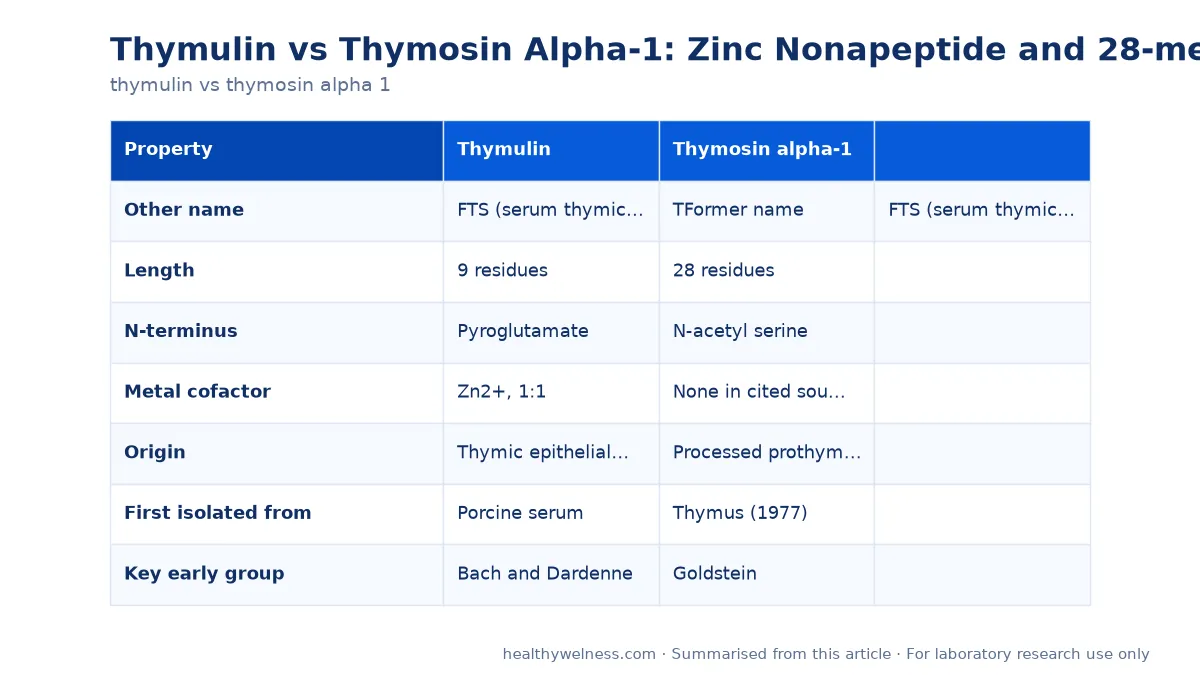
Thymulin and thymosin alpha-1 compared side by side
| Property | Thymulin | Thymosin alpha-1 |
|---|---|---|
| Other name | FTS (serum thymic factor) | T |
| Former name | FTS (serum thymic factor) | Fraction 5 component |
| Length | 9 residues | 28 residues |
| N-terminus | Pyroglutamate | N-acetyl serine |
| Metal cofactor | Zn2+, 1:1 | None in cited sources |
| Origin | Thymic epithelial cells | Processed prothymosin alpha |
| First isolated from | Porcine serum | Thymus (1977) |
| Key early group | Bach and Dardenne | Goldstein |
Calculated from residue masses, the zinc-free thymulin peptide is about 859 g/mol, roughly a quarter the size of thymosin alpha-1. The Thymosin Alpha-1 research peptide is supplied as lyophilised powder for in vitro and animal model work. A profile of the 28-residue peptide is in what thymosin alpha-1 is, and thymulin is set against the thymus extract thymalin in thymalin vs thymulin.
Certificates are available for listed products — contact us for the latest report.
Thymulin is a metallopeptide whose activity requires zinc
Thymulin was originally called facteur thymique sérique (FTS) because it was detected in serum. Dardenne and colleagues (1994) summarise its history: it was isolated from porcine serum, shown to be present in calf thymus extract, and sequenced as a nonapeptide with an N-terminal pyroglutamate. Its biological activity depends on zinc bound in an equimolar ratio, and the zinc-bound form adopts a specific three-dimensional conformation that yielded a new monoclonal antibody-defined epitope. Zinc and metallothionein were found inside the thymic epithelial cells that make the peptide, which led the authors to suggest it is secreted already carrying zinc.
The binding itself was characterised in Bach’s laboratory. Gastinel and colleagues (1984) used gel filtration of 65Zn2+ and found that the nonapeptide strongly binds one zinc ion, with binding dependent on pH and absent below pH 6.0. Ga3+, Al3+, Mn2+ and Cu2+ competed with zinc at pH 7.5, and their competition potencies correlated with the biological activity measured in an in vitro rosette assay. Structural analogues were used to map which residues form the binding site.
Without zinc the peptide is conformationally loose. Laussac and colleagues (1986) studied the free peptide by 1H and 13C NMR. In water, the data were compatible with a highly mobile equilibrium among different conformations; in dimethyl sulfoxide, a more rigid structure with three internal hydrogen bonds appeared. That flexibility is one reason the metal is regarded as part of the active molecule rather than an additive.
The zinc link has been tested in humans as a measurement, not an intervention with the peptide. Prasad and colleagues (1988) assayed serum thymulin activity in mildly zinc-deficient subjects, including volunteers made deficient by diet and adults with sickle cell anaemia. Thymulin activity fell with zinc deficiency and was corrected by zinc supplementation in vivo and in vitro, and the authors proposed it as a sensitive indicator of zinc status.
Thymosin alpha-1 is a processed fragment of prothymosin alpha
Thymosin alpha-1 comes from a different line of work. Garaci (2007) records that it was isolated from thymus and characterised by Allan Goldstein in 1977. It was one of the defined peptides purified from thymosin fraction 5, the calf thymus preparation discussed in thymosin alpha-1 vs beta-4 and the 17-23 fragment.
Its precursor was identified later. Pan and colleagues (1986) purified human prothymosin alpha from thymus and found that, like the rat protein, it carries the thymosin alpha-1 sequence at its N-terminus; the human protein has 109-110 residues against 111-112 for rat. Freire and colleagues (1985) found thymosin alpha-1 in isotonic extracts and supernatants of calf thymocytes, while prothymosin alpha was detected only under denaturing extraction, and concluded that the shorter peptide arises by natural processing of its precursor.
Synthetically, the peptide is demanding. García-Ramos and colleagues (2009) describe it as a 28-amino-acid acetylated peptide with consecutive beta-branched residues and a tendency toward beta-sheet structure during assembly, requiring up to 20 side-chain protecting groups. Synthesis had generally been convergent in solution until they reported a stepwise solid-phase route on a polyethylene glycol support.
Where do the two peptides meet in the thymus?
Different as they are, the two peptides come from the same cells. Savino and Dardenne (1984) used immunofluorescence on human thymus sections and cultured cells and found thymulin, thymopoietin and thymosin alpha-1 exclusively in the keratin-positive epithelial component, in normal and pathological thymuses. Double-labelling showed the same epithelial cells contained all three. Fabien and colleagues (1988) followed the three hormones in cultured mouse thymic reticuloepithelial cells and found that the number of positive cells rose from day 6 to day 12, with staining moving from cytoplasmic granules to diffuse cytosol and back as the culture aged.
The one study found that measured both in the same patients points in opposite directions. Rubinstein and colleagues (1986) studied 25 children with AIDS or AIDS-related complex: plasma thymulin was abnormally low and preceded peripheral T-cell abnormalities, whereas serum thymosin alpha-1 was elevated, in contrast to children with congenital T-cell deficiencies.
Which research models has each peptide been studied in?
| Peptide | Model | Reported finding |
|---|---|---|
| Thymulin | In vitro rosette assay | Activity tracks zinc binding |
| Thymulin | Mildly zinc-deficient humans | Serum activity falls, then restores |
| Thymulin analogue PAT | Rat endotoxin hyperalgesia | Lower IL-1β, IL-6, TNF-α |
| Thymosin alpha-1 | Mouse dendritic cells | MyD88/TLR-dependent maturation |
| Thymosin alpha-1 | Transplanted mice, aspergillosis | Th1 antifungal response |
For thymulin, Safieh-Garabedian and colleagues (2002) tested a peptide analogue of thymulin (PAT) in two rat models of endotoxin-induced inflammatory hyperalgesia. Pretreatment reduced mechanical and thermal hyperalgesia and lowered IL-1β, IL-6, TNF-α and NGF at the inflamed site. For thymosin alpha-1, Romani and colleagues (2004) reported that the peptide induced maturation and interleukin-12 production in fungus-pulsed dendritic cells through p38 MAPK/NF-κB and MyD88-dependent Toll-like receptor signalling, and protected highly susceptible mice that had received haematopoietic transplants from aspergillosis.
No study pitting the two against each other was found. As of 2026-11-06, a PubMed search for “thymulin thymosin alpha 1” returned ten records — reviews of thymic endocrinology, co-localisation studies and the 1986 paediatric measurement — but no experiment in which both peptides were given side by side. That one search cannot rule out a study indexed elsewhere.
Handling in the lab
Thymulin work has a variable that thymosin alpha-1 work does not: the zinc content of the preparation and of the buffer. Because binding is lost below pH 6.0 and other metal ions compete, buffer pH, chelators and trace metals all shape whether an assay sees the active metallopeptide. Thymosin alpha-1 is handled as a conventional lyophilised peptide; reconstitution steps are in thymosin alpha-1 reconstitution, and solution concentrations in mg/mL can be calculated with the peptide calculator.
Related research
Thymosin alpha-1 is also compared with the extract thymalin in thymalin vs thymosin alpha-1.
Frequently asked questions
What is the difference between thymulin and thymosin alpha-1?
Thymulin is a nine-residue peptide, pGlu-Ala-Lys-Ser-Gln-Gly-Gly-Ser-Asn, whose biological activity depends on binding one zinc ion (Dardenne et al., 1994). Thymosin alpha-1 is a 28-residue N-acetylated peptide (García-Ramos et al., 2009) whose sequence forms the N-terminus of the larger protein prothymosin alpha (Pan et al., 1986).
Is thymulin the same as FTS?
Yes. Thymulin was formerly called facteur thymique sérique (FTS), or serum thymic factor. It was first isolated from porcine serum and was shown to be present in calf thymus extract (Dardenne et al., 1994).
Does thymosin alpha-1 need zinc?
Zinc dependence is described for thymulin, not for thymosin alpha-1, in the sources cited here. Thymulin binds one zinc ion with an apparent Kd of about 5 x 10^-7 M at pH 7.5 and shows no binding below pH 6.0 (Gastinel et al., 1984).
Are thymulin and thymosin alpha-1 made by the same cells?
In human thymus sections and cultured cells, Savino and Dardenne (1984) found thymulin, thymopoietin and thymosin alpha-1 in the same keratin-positive epithelial cells. Fabien and colleagues (1988) followed all three in cultured mouse thymic reticuloepithelial cells.
Has anyone compared the two peptides directly?
Not as interventions, according to the search run for this article. On 2026-11-06, a PubMed search for “thymulin thymosin alpha 1” returned reviews, co-localisation studies and a 1986 measurement of both in children with AIDS, but no experiment giving both peptides side by side. Not finding one does not prove none exists.
For laboratory research use only. The research materials supplied by HealthyWelness are not approved medicines, foods or cosmetics and are not for human or veterinary use. This article summarises published research and is not medical advice.
Sources
- Dardenne M, et al. Interactions between zinc and thymulin. Met Based Drugs. 1994. PMID: 18476235
- Gastinel LN, et al. Studies on the zinc binding site to the serum thymic factor. Biochim Biophys Acta. 1984. PMID: 6538097
- Laussac JP, et al. NMR study of thymulin, a lymphocyte differentiating thymic nonapeptide. Conformational states of free peptide in solution. J Biol Chem. 1986. PMID: 3711109
- Prasad AS, et al. Serum thymulin in human zinc deficiency. J Clin Invest. 1988. PMID: 3262625
- Garaci E. Thymosin alpha1: a historical overview. Ann N Y Acad Sci. 2007. PMID: 17567941
- Pan LX, et al. Human prothymosin alpha: amino acid sequence and immunologic properties. Arch Biochem Biophys. 1986. PMID: 3532956
- Freire M, et al. Evidence for the synthesis of thymosin alpha 1 by calf thymocytes and the production of this peptide by natural processing. Arch Biochem Biophys. 1985. PMID: 3873909
- García-Ramos Y, et al. Optimized Fmoc solid-phase synthesis of Thymosin alpha1 by side-chain anchoring onto a PEG resin. Biopolymers. 2009. PMID: 19802821
- Savino W, et al. Thymic hormone-containing cells VI. Immunohistologic evidence for the simultaneous presence of thymulin, thymopoietin and thymosin alpha 1 in normal and pathological human thymuses. Eur J Immunol. 1984. PMID: 6389155
- Fabien N, et al. Immunolocalization of thymosin alpha 1, thymopoietin and thymulin in mouse thymic epithelial cells at different stages of culture: a light and electron microscopic study. Immunology. 1988. PMID: 3284819
- Rubinstein A, et al. Circulating thymulin and thymosin-alpha 1 activity in pediatric acquired immune deficiency syndrome: in vivo and in vitro studies. J Pediatr. 1986. PMID: 3018210
- Romani L, et al. Thymosin alpha 1 activates dendritic cells for antifungal Th1 resistance through toll-like receptor signaling. Blood. 2004. PMID: 14982877
- Safieh-Garabedian B, et al. Potent analgesic and anti-inflammatory actions of a novel thymulin-related peptide in the rat. Br J Pharmacol. 2002. PMID: 12110619