Peptide Centrifugation: RCF, RPM and Pellet Recovery
Read peptide research centrifugation records using RCF, rotor radius and timing, and distinguish supernatant concentration from pellet-associated recovery.

RCF describes centrifugal acceleration relative to gravity, whereas RPM describes rotational speed; the conversion requires the relevant rotor radius. Matching RCF alone does not guarantee equivalent peptide separation. Time, sedimentation path, medium and sample properties also matter. A supernatant is an operationally collected fraction, and a visible pellet does not establish peptide identity, complete recovery or chemical degradation.
- At a fixed radius, RCF is proportional to the square of RPM.
- A radius must retain its definition: maximum, average and minimum positions are different.
- A cleared supernatant is not automatically a monomer-only fraction.
- The worked rotor and recovery values are hypothetical, not recommended centrifugation settings.
RPM leaves out the radius that determines acceleration
A method says that a peptide preparation was centrifuged at a stated RPM before analysis. A second laboratory copies the speed using a different rotor and obtains another supernatant concentration. The two experiments did not necessarily apply the same acceleration. RPM specifies revolutions per minute; the distance from the rotation axis determines how that speed translates into acceleration.
The relationship is RCF = 1.118 × 10⁻⁵ × r × N2, with r in centimetres and N in RPM. RCF is expressed as a multiple of gravitational acceleration, conventionally written × g. It is not a mass in grams. Using millimetres in a formula expecting centimetres introduces a factor-of-ten error.
Eppendorf’s rotor operating manual gives this relationship in section 1.8, together with a sedimentation-time expression that includes the distances to the top and bottom of the solution. This is first-party equipment documentation, not a peptide-specific recovery study. It supports the mechanics of the comparison, without identifying conditions that pellet an unspecified peptide. [1]
| Entry | Meaning | Cannot establish alone |
|---|---|---|
| RPM | Rotational speed | Acceleration without radius |
| RCF at stated radius | Acceleration ratio | Complete separation |
| Run time | Defined timing interval | Equivalent rotor history |
| Supernatant amount | Target in collected liquid | Monomer-only identity |
| Pellet-associated target | Target recovered from pellet | Why association occurred |
A hypothetical rotor comparison keeps the radius convention visible
Invented mechanical example: rotor A has a relevant radius of 8 cm and rotor B a relevant radius of 12 cm, using the same specified radius convention. Both operate at 5,000 RPM. These values are teaching inputs and are not instructions for processing a peptide or operating a particular rotor.
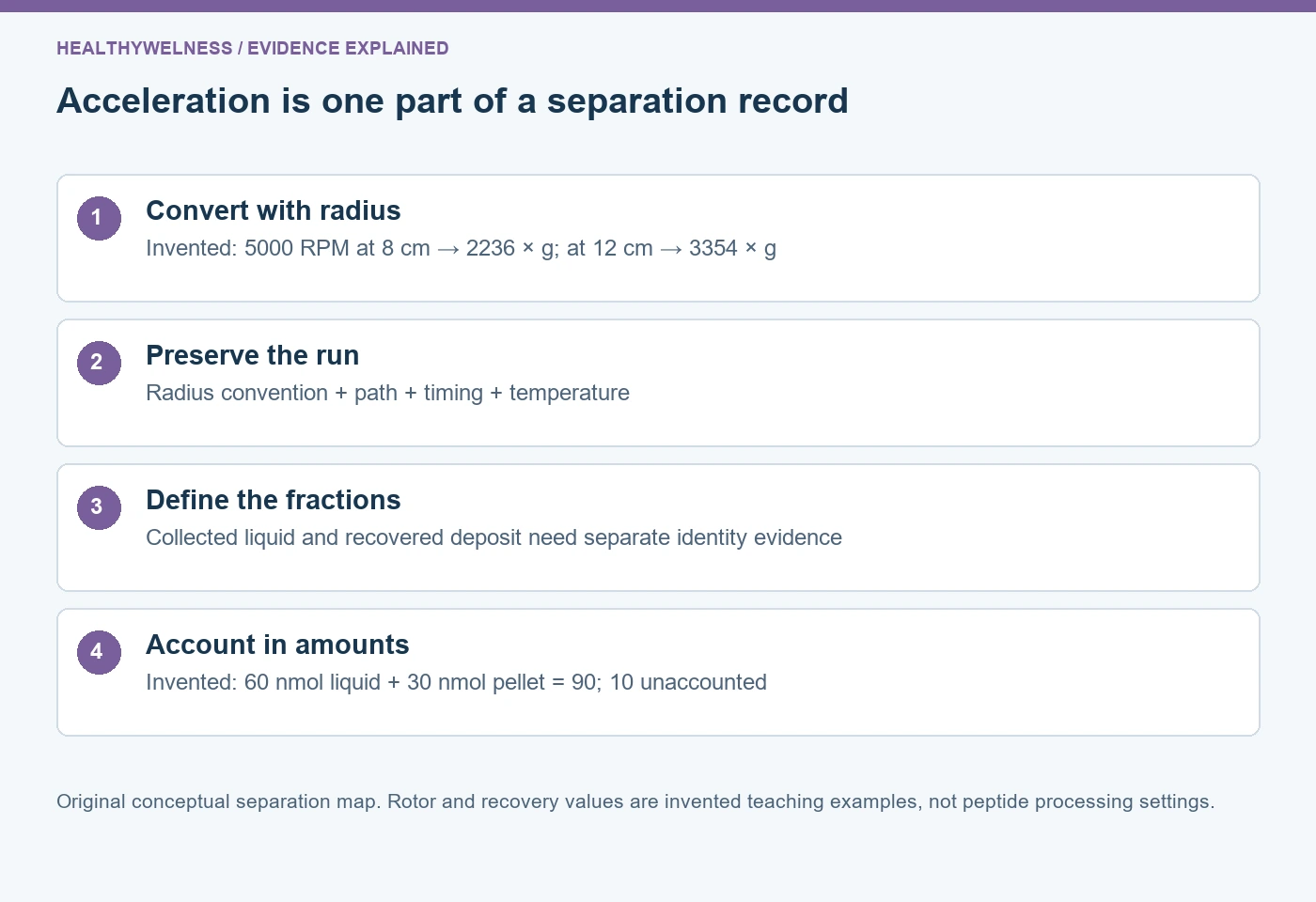
For A, RCF = 1.118 × 10−5 × 8 × 5,0002 = 2,236 × g. For B, the same arithmetic gives 3,354 × g. The larger radius produces 1.5 times the acceleration at the same speed. If the aim is to match A’s specified acceleration using B’s stated radius, B’s calculated speed is 5,000 × √(8/12), approximately 4,082 RPM.
The speed conversion addresses one mechanical quantity. It does not demonstrate equal separation efficiency, equal temperature history or equal sample recovery. Treating that calculated RPM as a complete transfer of a separation method would enlarge an arithmetic result into an unsupported experimental claim.
Eppendorf’s educational centrifugation guidance separately illustrates how equal RPM gives different accelerations in different rotors. It also discusses rotor type, run time, temperature and the k-factor. Those distinctions explain why recording only the converted speed loses information needed by another laboratory. [2]
The sample occupies a radial interval rather than a single point
Liquid in a tube extends over a range of distances from the axis. Maximum RCF usually refers to a specified outer position, while an average or minimum value refers elsewhere. Two reports can therefore print the same numerical RCF while referring to different locations. Preserve the radius convention instead of removing it as a minor technicality.
Tube geometry, adapter and fill volume help define the sedimentation path. A particle starting near the meniscus must travel before reaching a collecting surface. Matching acceleration at one point does not make those paths identical. This is why rotor transfer requires more reasoning than a speed conversion.
The k-factor summarizes aspects of rotor clearing behaviour for an appropriate sedimentation model. It can help compare time requirements when the assumptions apply. It is not a peptide identity measurement or a guarantee that every entity in a heterogeneous preparation reaches the pellet. A broad mixture may contain species with different sedimentation behaviour.
- Record rotor and adapter identity, not only instrument model.
- State RCF with its radius convention and retain RPM when available.
- Record tube format, sample volume and medium.
- Define timing, temperature and acceleration/deceleration history relevant to the comparison.
- Describe exactly which fraction was collected and measured.
Run time depends on when the clock starts
An elapsed time from starting the instrument and a duration counted after approaching the selected speed need not describe the same history. The difference can matter especially when acceleration occupies an appreciable part of a short run. A method that prints only minutes may leave this convention unresolved.
Eppendorf’s 5702 operating manual explicitly describes alternative start-of-timing settings: immediate timing or timing when 95% of the selected speed or force has been reached. It also explains that the displayed RCF in that instrument configuration is standardized to a specified rotor and tube arrangement, with other arrangements requiring their own radius information. These are device-specific examples of metadata that can change interpretation, rather than instructions for another instrument. [3]
Similarly, a selected chamber temperature is part of the record but should not silently become a complete measurement of sample temperature throughout the run. State what was controlled and what was measured. Instrument documentation can explain displayed quantities; it cannot fill missing sample evidence after the experiment.
A supernatant concentration defines a fraction before it defines a molecular state
After centrifugation, a laboratory often measures the liquid above deposited material and calls the result soluble peptide. That can be an operationally useful label if the separation and collection are stated. It does not independently show that every remaining molecule is monomeric, or that every removed entity was insoluble target.
Some assemblies may remain in the collected liquid under a particular run. Conversely, peptide can accompany other sedimenting material or remain associated with the tube. A visible deposit can contain medium components, contaminants or mixed material. Colour or appearance cannot assign its composition. Absence of a visible deposit also does not establish that no target left the sampled liquid.
For a peptide-state question, use measurements that address that state. Quantifying target after a preparation step that disrupts assemblies can establish target recovered from a fraction without reconstructing its earlier association state. The distinction matters when a report moves from liquid-phase amount to monomer concentration without showing the intermediate evidence.
The DLS guide and SEC aggregation guide explain complementary size-related measurements and their limits. No one fractionation or detection method establishes every aspect of a heterogeneous preparation.
Recovery arithmetic requires amounts and evaluated fraction measurements
Hypothetical fraction example: a preparation initially contains an assigned 100 nmol of intact target. After a defined centrifugation and collection procedure, suitable methods assign 60 nmol to collected supernatant and 30 nmol to a separately recovered pellet fraction. Assume both are on the same intact-target basis and that extraction recovery and matrix effects have been evaluated. These are invented values.
The accounted amount is 90 nmol, leaving 10 nmol unexplained. The supernatant fraction contains 60% of the initial amount. It would be incorrect to call the missing 40% degraded: 30% has been assigned to another measured fraction. It would also be incorrect to call all 40% pelleted when only 30% was measured there.
If the supernatant occupies 0.8 mL and the pellet extract occupies 0.2 mL, their concentrations are 75 and 150 nmol/mL, respectively. Adding these concentrations gives a meaningless recovery total. Multiply each concentration by its relevant volume before summing amounts. A concentrated pellet extract can have a larger concentration while containing less target than the supernatant.
The peptide concentration calculator can help check consistent mass–volume relationships; it cannot establish extraction recovery or separation completeness. A tidy sum is only as reliable as the measurements supplying it. An unvalidated pellet extraction can leave target unrecovered, while a matrix-dependent signal can bias the apparent amount.
Report the separation as an experimental definition
A useful conclusion states that a defined amount was recovered from the liquid or pellet-associated fraction under the reported separation conditions. A stronger conclusion about aggregation, precipitation or chemical change requires additional evidence. This language preserves what the experiment established while making clear what another laboratory would need to reproduce it.
For adjacent distinctions, see kinetic versus thermodynamic solubility and labware adsorption and recovery. Centrifugation defines the sampled fraction; it does not by itself identify the equilibrium state or locate every missing molecule.
Frequently asked questions
Can RPM be converted to RCF without the rotor radius?
No unique conversion is possible without the relevant radius. The radius unit and convention must also match the formula and the RCF being reported.
Does equal RCF guarantee equivalent separation?
No. Sedimentation path, time, medium, rotor geometry and sample properties also affect the fraction recovered. Matching RCF addresses acceleration at the stated radius.
Does a clear supernatant contain only monomer?
Clarity does not identify molecular state. Assemblies that remain in the collected liquid may require a suitable size- or state-sensitive measurement to characterize them.
Does a visible pellet prove peptide aggregation?
A deposit demonstrates material collected under the stated conditions. Its peptide content and association state need evidence; appearance alone cannot distinguish target assemblies from other material.
Why measure the pellet if the assay uses only supernatant?
A pellet measurement can help account for target missing from the liquid and test a physical-partitioning explanation. Its extraction and quantitative method still require evaluation, and unmeasured fractions remain unresolved.
References
- Eppendorf. Rotors, Tubes, Bottles and Caps for Ultracentrifuges: Operating Manual. Section 1.8, Calculation of separation characteristics.
- Eppendorf. Basics in Centrifugation: Calculating relative centrifugal force and selecting a centrifuge and rotors.
- Eppendorf. Centrifuge 5702/5702 R/5702 RH: Operating Manual. Sections 5.8.5–5.8.6.
Cover and evidence map: original conceptual editorial schematics, not measured results, exact molecular structures, or photographs of HealthyWelness facilities.
Sources
- Eppendorf. Rotors, Tubes, Bottles and Caps for Ultracentrifuges: Operating Manual. Section 1.8, Calculation of separation characteristics.
- Eppendorf. Basics in Centrifugation: Calculating relative centrifugal force and selecting a centrifuge and rotors.
- Eppendorf. Centrifuge 5702/5702 R/5702 RH: Operating Manual. Sections 5.8.5–5.8.6.