N-Acetyl Epitalon Amidate: Structure and What Is Published
N-acetyl Epitalon amidate is Ac-Ala-Glu-Asp-Gly-NH2. Its calculated formula and mass, how the two end caps change the molecule, and what PubMed covers.

Cover illustration: AI-generated editorial artwork. Conceptual only; not an exact molecular structure, actual laboratory result or evidence of clinical effects.
N-acetyl Epitalon amidate is Epitalon (Ala-Glu-Asp-Gly) with both ends capped: an acetyl group on the N-terminus and an amide at the C-terminus, written Ac-AEDG-NH2. Its calculated mass is about 431.4 g/mol. As of 2026-11-03 no PubMed record studies this capped form directly.
For laboratory research use only. The research materials supplied by HealthyWelness are not approved medicines, foods or cosmetics and are not for human or veterinary use. This article summarises published research and is not medical advice.
- Epitalon is the synthetic tetrapeptide Ala-Glu-Asp-Gly (AEDG), designed from the amino acid composition of the bovine pineal extract Epithalamin (Araj et al., 2025).
- N-acetyl Epitalon amidate has the calculated formula C16H25N5O9 and a mass of about 431.4 g/mol, roughly 41 Da more than uncapped Epitalon (390.35 g/mol).
- As of 2026-11-03, PubMed searches for “N-acetyl epitalon”, “epitalon amidate” and “Ac-AEDG-NH2” returned no records.
- A 2026 narrative review searched PubMed and Google Scholar through 22 September 2026 and concluded that Epitalon is biologically active but clinically unproven (Jain et al., 2026).
- Structure-activity data for 45 amidated peptide hormones showed the C-terminal amide was required for full activity of most of them (Merkler, 1994).
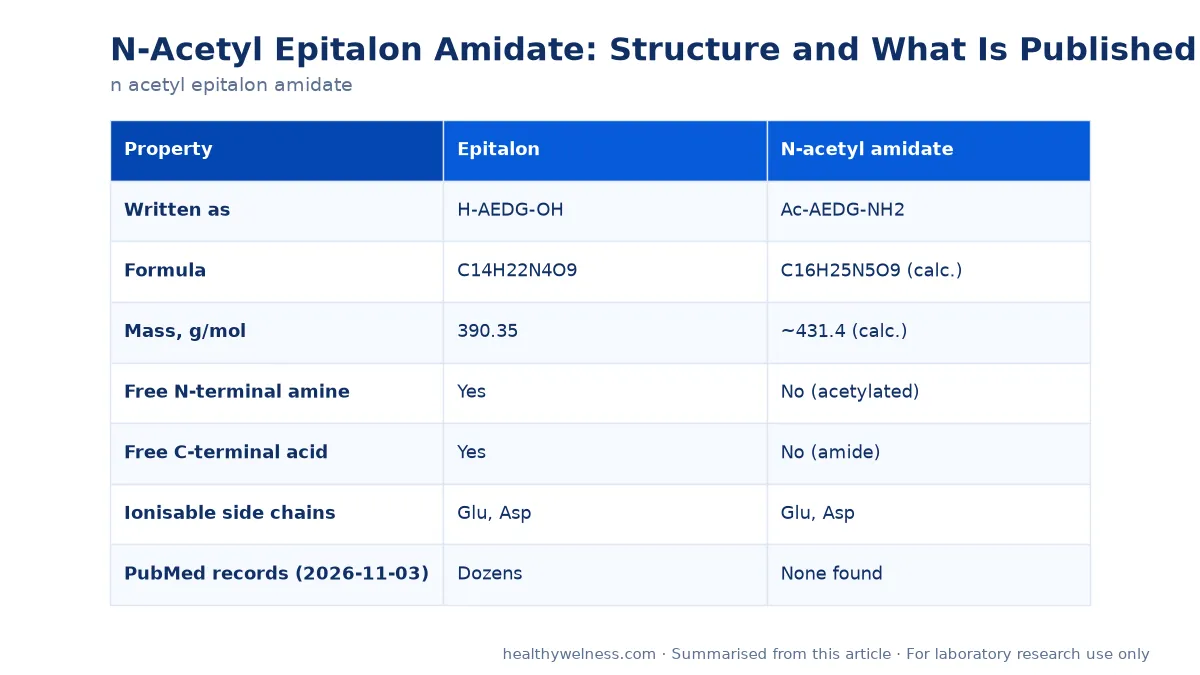
Quick facts: the parent and the capped form
| Property | Epitalon | N-acetyl amidate |
|---|---|---|
| Written as | H-AEDG-OH | Ac-AEDG-NH2 |
| Formula | C14H22N4O9 | C16H25N5O9 (calc.) |
| Mass, g/mol | 390.35 | ~431.4 (calc.) |
| Free N-terminal amine | Yes | No (acetylated) |
| Free C-terminal acid | Yes | No (amide) |
| Ionisable side chains | Glu, Asp | Glu, Asp |
| PubMed records (2026-11-03) | Dozens | None found |
The capped values are calculated, not measured. They follow from adding an acetyl group (C2H2O, +42.04) and replacing the terminal hydroxyl with an amino group (−0.98). Salt form and residual water change the weight of powder in a vial, so the certificate for a specific lot, not this table, is what a calculation of solution strength should start from. Our Epithalon research peptide listing describes the uncapped tetrapeptide.
Certificates are available for listed products — contact us for the latest report.
What each cap changes chemically
Epitalon at neutral pH is a highly charged small molecule. It carries a positive N-terminal amine, a negative C-terminal carboxylate, and two more negative side chains from glutamate and aspartate. Capping both ends removes two of those four charges. The net charge stays near −2 in both forms, but the capped molecule has lost the paired opposite charges at its ends, which changes how it interacts with water, surfaces and chromatography media. That sounds like a small edit. For a four-residue peptide, where the termini make up a large share of the surface, it is not.
| Modification | Chemical effect | Practical consequence |
|---|---|---|
| N-acetylation | Amine becomes neutral amide | Loses one positive charge |
| C-amidation | Carboxylate becomes amide | Loses one negative charge |
| Both together | Termini uncharged | Less zwitterionic, more retained on C18 |
| Both together | Ends no longer free | Exopeptidase recognition altered |
N-terminal acetylation
In cells, alpha-N-acetylation is one of the most common protein modifications. Acetyltransferase complexes add the acetyl group from acetyl-coenzyme A to nascent N-termini, and the modification has been linked to folding, stability, activity and localisation (Van Damme et al., 2011). That literature concerns proteins, not synthetic tetrapeptides. Its relevance here is narrower: it shows that the N-terminal acetyl group is a recognised biological signal, so adding one to a peptide is a structural change rather than a protective coating.
C-terminal amidation
Many natural peptide hormones end in an amide, made by the peptidylglycine alpha-amidating enzyme from a glycine-extended precursor. Merkler compiled structure-activity data on 45 such hormones and found that removing the amide reduced or abolished full activity for most of them (Merkler, 1994). Epitalon itself ends in glycine and is not naturally amidated, so the reverse question applies: adding an amide to a peptide that did not have one may change activity in either direction, and only testing can say which.
What the Epitalon literature actually covers
Everything published under the Epitalon name concerns the uncapped sequence. The main lines of work are summarised below, with the model named in each case.
| Study | Model | Reported finding |
|---|---|---|
| Khavinson et al., 2003 | Fetal fibroblast culture | Telomerase subunit expression, activity |
| Khavinson et al., 2020 | Gingival stem cells | Neurogenic markers up 1.6–1.8 fold |
| Araj et al., 2025 | Review | Few physico-chemical studies |
| Jain et al., 2026 | Narrative review | Active, clinically unproven |
The 2003 study added Epitalon to telomerase-negative human fetal fibroblasts and reported expression of the catalytic subunit, telomerase activity and telomere elongation (Khavinson et al., 2003). The 2020 study measured neurogenic differentiation markers in human gingival mesenchymal stem cells and used molecular modelling to propose binding to histone H1 sites (Khavinson et al., 2020). Both groups attribute these effects to the native tetrapeptide; neither tested capped analogues.
The 2025 overview is the most useful for a structural question. Its authors note that despite a large volume of biological work, physico-chemical and structural investigations of Epitalon remain limited (Araj et al., 2025). If the parent is under-characterised, the capped derivative is more so.
The 2026 review is the most critical. It separates synthetic Epitalon from the older Epithalamin extract, appraises studies by design and replication, and finds that human evidence is limited to small biomarker studies and one older controlled study, with pharmacokinetic and long-term safety data inadequate and regulatory questions unresolved after a 2026 FDA advisory review (Jain et al., 2026).
Why the capped form appears on the market
The logic offered for capping short peptides is protection from exopeptidases, the enzymes that trim amino acids from free ends. That reasoning is general and plausible, but for this specific molecule no stability or activity comparison was found. The same pattern is seen with other capped research peptides such as N-acetyl Semax amidate and N-acetyl Selank amidate, where the capped name circulates more widely than any data comparing it with the parent.
For a laboratory, the practical implication is that the capped and uncapped forms are two different test articles. A result obtained with one should be reported with its exact structure, and not cited as evidence for the other.
Handling in the lab
Uncapped Epitalon is acidic and dissolves readily in water. The capped form keeps both acidic side chains, so it is also expected to be water-soluble, though it carries less charge and may behave differently at high concentration. Neither form contains methionine, cysteine or tryptophan, so oxidation is not the main concern; hydrolysis and aspartate-related rearrangement in solution are the more likely slow changes, and cold, single-use aliquots limit both.
Concentration arithmetic is the same for either form: net peptide mass divided by diluent volume, which the peptide calculator handles. The two molecules are distinguished by mass spectrometry, with the capped form near 431 and the parent near 390. Background on the parent, including the Epithalamin history, is in the Epithalon overview, and the related thymus extract is compared in Epithalon versus Thymalin.
Telling the four possible forms apart by mass
A capped tetrapeptide can be incompletely capped. Synthesis can leave a fraction acetylated but not amidated, or the reverse, and an amide can slowly hydrolyse back to the acid in solution. The calculated monoisotopic masses below show which of these a mass spectrum can separate.
| Form | Formula (calc.) | Monoisotopic | [M+H]+ |
|---|---|---|---|
| H-AEDG-OH (Epitalon) | C14H22N4O9 | 390.139 | 391.146 |
| H-AEDG-NH2 | C14H23N5O8 | 389.155 | 390.162 |
| Ac-AEDG-OH | C16H24N4O10 | 432.149 | 433.156 |
| Ac-AEDG-NH2 | C16H25N5O9 | 431.165 | 432.172 |
The acetyl group is easy to see: it moves the mass by 42 Da. The amide is harder, because amide and acid differ by only 0.98 Da. On a low-resolution instrument the fully capped peptide and its hydrolysed, acetyl-only product sit one mass unit apart and can overlap with isotope peaks. A high-resolution measurement, or a chromatographic method that separates the two by charge, is needed to confirm the C-terminus. That distinction matters more for this derivative than for most peptides, since the amide is the feature that defines it.
Related research
Short bioregulator peptides from the same research school are surveyed in Russian bioregulator peptides. General guidance on reading the identity section of a certificate is in how to read a peptide COA.
Frequently asked questions
What is N-acetyl Epitalon amidate?
It is the tetrapeptide Epitalon (Ala-Glu-Asp-Gly) with an acetyl group on the N-terminal amine and an amide in place of the C-terminal carboxylic acid, written Ac-AEDG-NH2. The amino acid sequence is unchanged; only the two ends are capped.
What is the molecular weight of N-acetyl Epitalon amidate?
Calculated from the parent formula C14H22N4O9 (390.35 g/mol), acetylation adds C2H2O and amidation exchanges an OH for an NH2, giving C16H25N5O9 and about 431.4 g/mol. These are calculated values; the certificate for a given lot is the reference for the material in hand.
Is there published research on N-acetyl Epitalon amidate specifically?
As of 2026-11-03, PubMed searches for “N-acetyl epitalon”, “epitalon amidate” and “Ac-AEDG-NH2” returned no records. The published Epitalon literature concerns the uncapped tetrapeptide, and not finding a record does not prove that no study exists elsewhere.
Do Epitalon findings apply to the capped version?
Not automatically. Capping removes the two terminal charges and can change how a peptide is recognised by enzymes and binding partners. Merkler’s survey of 45 amidated peptide hormones found the C-terminal amide was required for full activity of most of them, which shows how much an end cap can matter (Merkler, 1994).
How can the two forms be told apart in the lab?
By mass. The capped form is about 41 Da heavier than Epitalon, a difference any routine mass spectrometry run resolves. Retention time on reversed-phase HPLC is also expected to shift, because the capped molecule carries less charge.
For laboratory research use only. The research materials supplied by HealthyWelness are not approved medicines, foods or cosmetics and are not for human or veterinary use. This article summarises published research and is not medical advice.
Sources
- Araj SK, et al. Overview of Epitalon-Highly Bioactive Pineal Tetrapeptide with Promising Properties. Int J Mol Sci. 2025. PMID: 40141333
- Jain A, et al. Epitalon and Epithalamin: A Narrative Review of Mechanistic, Preclinical, and Clinical Evidence. Int J Mol Sci. 2026. PMID: 42884164
- Khavinson VKh, et al. Epithalon peptide induces telomerase activity and telomere elongation in human somatic cells. Bull Exp Biol Med. 2003. PMID: 12937682
- Khavinson V, et al. AEDG Peptide (Epitalon) Stimulates Gene Expression and Protein Synthesis during Neurogenesis: Possible Epigenetic Mechanism. Molecules. 2020. PMID: 32019204
- Van Damme P, et al. Protein alpha-N-acetylation studied by N-terminomics. FEBS J. 2011. PMID: 21736701
- Merkler DJ. C-terminal amidated peptides: production by the in vitro enzymatic amidation of glycine-extended peptides and the importance of the amide to bioactivity. Enzyme Microb Technol. 1994. PMID: 7764886