Peptide Click Conjugation: Product Identity and Yield
Interpret peptide click-conjugation records through handle chemistry, triazole structure, product assignment, conversion, isolated recovery and purity.


A peptide click-conjugation reaction can join complementary handles efficiently, but reaction conversion does not establish the complete identity or purity of the isolated conjugate. Specify the azide and alkyne structures, attachment positions and final connection. Distinguish a copper-catalyzed terminal-alkyne reaction from strain-promoted chemistry, then assess product identity, side products and recovery with evidence suited to those structures.
For laboratory research use only. This article discusses chemical identity and analytical reasoning, not human or veterinary use. All reaction-accounting examples are invented and are not HealthyWelness process data.
- Click chemistry names a family of reactions, rather than one universal product structure.
- A terminal alkyne used with copper catalysis differs chemically from a strained cyclic alkyne used without that catalyst.
- Consumption of one reactant and formation of the intended conjugate are separate quantitative observations.
- Correct conjugate mass can leave attachment position, regioisomerism or molecular architecture unresolved.
Name the reaction and the retained molecular handles
A paper reports that a peptide was clicked to a fluorescent label. That sentence leaves several questions open. Which peptide atom carries the reactive handle? Is the handle attached directly or through a spacer? What label and alkyne structure were used? Does the final product contain one peptide per label or several? The reaction nickname cannot reconstruct those fields after they have been omitted.
For azide–alkyne conjugation, the reacting functional groups become part of a triazole-containing connection. The full retained handle and linker contribute to product composition and geometry. A small terminal alkyne and a bulky strained cyclic alkyne therefore cannot be treated as analytically interchangeable versions of a structure-free connector.
| Field | Question | Why it matters |
|---|---|---|
| Peptide handle | Which atom and linker? | Defines attachment position |
| Partner handle | Terminal or cyclic alkyne? | Defines retained structure |
| Reaction class | Catalyzed or strain-promoted? | Constrains product model |
| Architecture | One-to-one or crosslinked? | Defines possible species |
| Isolated fraction | What was actually recovered? | Separates reaction from material |
Keep final structure distinct from synthetic convenience. A handle installed to make conjugation possible remains a real modification unless a later transformation removes it. Describing the conjugate as the unmodified peptide can hide both the linker and the reporting group. Its usefulness in an experiment does not eliminate those differences.
The original reactions support specific chemical scope
Tornøe, Christensen and Meldal’s 2002 original study described copper(I)-catalyzed reactions of terminal alkynes with azides on solid supports, producing 1,4-substituted triazoles in peptide backbones or side chains. Its abstract establishes a defined reaction and product class; its successful examples do not establish the identity of an unrelated isolated conjugate. Tornøe et al., peptidotriazoles.
Agard, Prescher and Bertozzi’s 2004 original report introduced a strain-promoted cyclooctyne–azide reaction without the copper catalyst. That is a chemically different way to enable the cycloaddition. The abstract supports the catalyst-free reaction principle and its demonstrated model applications, not a blanket claim that every strained reagent gives identical products, kinetics or biological behavior. The PubMed record also lists an erratum, which should remain visible in source review. Agard et al., strain-promoted cycloaddition.
This guide uses those original abstracts for reaction context rather than prescribing a synthesis procedure. A current reagent’s technical record and actual product analysis must address its own structure. Broad historical observations about mildness or compatibility should not be promoted into material-specific guarantees.
Mass addition can confirm a composition without solving connectivity
In the idealized azide–alkyne cycloaddition, the two reactant structures contribute to the product without the loss of a small molecule. That atom-accounting statement concerns the specified cycloaddition itself. An activated ester used earlier to install a handle, a salt adduct or a later cleavage step requires separate bookkeeping.
Invented example: a neutral azide-bearing peptide has a monoisotopic mass of 1200.0000 Da, while its specified neutral alkyne partner has a mass of 300.0000 Da. Assume a one-to-one cycloaddition, no other reaction and the stated neutral forms. The predicted product mass is 1500.0000 Da. It is not 1481.9894 Da: subtracting water would incorrectly import condensation accounting into this stipulated cycloaddition.
| Object | Neutral mass | What the value represents |
|---|---|---|
| Azide peptide | 1200.0000 Da | Complete handle-bearing input |
| Alkyne partner | 300.0000 Da | Complete neutral input |
| One-to-one product | 1500.0000 Da | Sum under stated reaction model |
| Incorrect water subtraction | 1481.9894 Da | Wrong model for this example |
Now suppose two positional isomers of the azide peptide carry the same handle at different lysines. Either can yield a product with the same total mass. The mass sum does not identify which lysine was modified. Likewise, possible regioisomers can share elemental composition. A specified reaction’s expected selectivity is useful context, while assigning an isolated structure remains an analytical task.
The cyclization-connectivity guide explains the related problem of assigning a ring-closing bond. A click reaction can create a ring or connect separate molecules, depending on handle placement and architecture. The same reaction name cannot decide which of those outcomes occurred.
A conversion percentage needs its numerator
Consider a hypothetical reaction beginning with 100 nanomoles of handle-bearing peptide. A validated assay later finds 10 nanomoles of that starting peptide. Its disappearance is 90 nanomoles, or 90% starting-material conversion on that basis. That observation does not say what proportion became the desired conjugate.
Suppose a separate supported analysis assigns 75 nanomoles to the desired product and 15 nanomoles to other peptide-derived species. The peptide amount balance is then 10 + 75 + 15 = 100 nanomoles. Desired-product formation is 75% relative to input, while starting-material disappearance remains 90%. Calling both values 90% yield would erase the other products.
If purification recovers 60 nanomoles of the desired product, its isolated recovery relative to input is 60%. Its recovery relative to the 75 nanomoles present before purification is 80%. A final fraction could nevertheless be very pure under an appropriate analytical method. Conversion, product formation, isolated recovery and purity answer different questions with different denominators.
Every amount in this exercise is stipulated and assumes valid quantification of the named species. Real detector areas can differ per mole between starting material, label and conjugate. A 90% area decrease cannot automatically be substituted for a 90% mole decrease. Specify the calibration or response relationship that supports the quantity being reported.
Handle loss and product formation require complementary observations
Disappearance of an azide-related feature is compatible with its consumption, but does not uniquely establish the intended partner connection. A side reaction can also consume the handle. Conversely, detecting a product-compatible mass does not establish complete removal of free label or starting peptide from the isolated material. These observations are complementary rather than substitutes.
Torres and colleagues’ 2008 original peptide study investigated side-chain crosslinking using double cycloaddition and metal complexation. The original indexed text describes chemical comparisons used to assess ring closure alongside structural observations. This illustrates using more than a reaction label to interpret an assembly. This guide assessed retrieved original passages, not the complete supporting-information dataset. Torres et al., double-click peptide crosslinking.
For a new construct, choose observations that distinguish the actual alternatives. An intact-mass result addresses total composition. A suitable mapped fragment can address the handle location. A separation can address residual starting material within its resolving capability. A chemical handle comparison can narrow incomplete-reaction alternatives. None supplies every answer by itself.
Multi-handle reactants expand the possible architecture
A peptide with two azides and a partner with two alkynes can create more than one connection pattern. Intramolecular closure, intermolecular oligomers and incompletely connected species can enter the candidate set depending on the actual design. A one-to-one drawing should not silently replace that set simply because it was the intended outcome.
Even with one handle on each input, positional heterogeneity introduced during the earlier handle-installation step can survive the conjugation. Efficiently reacting a mixed starting population can efficiently produce a mixed product population. A high conversion figure cannot retrospectively make the input site-specific.
Write the full sequence and attachment map for each intended component. Define whether the desired endpoint is an isolated molecule, a multivalent assembly or a surface-bound construct. For a surface, bulk reagent depletion does not necessarily quantify the fraction of accessible surface groups modified. The measured phase and the desired occupancy must be connected by a supported model.
Keep the analytical construct distinct from its research interpretation
A fluorescently clicked peptide carries a reporter and a linker absent from the original chain. Its assay behavior belongs first to that construct. Establishing that the reporter does not alter the relevant property is a separate comparison. A clean conjugation spectrum cannot supply that functional evidence.
Read fluorescence-interference evidence for the later optical question and native-ligation junction evidence for another joining chemistry with a different final bond. Use the analytical-document lookup to locate available records. A record should be interpreted by its actual methods, rather than assuming click-conjugate characterization from a generic purity statement.
Questions about peptide click-product evidence
Does click chemistry identify one universal connector?
No. It names a family of reactions. Specify the actual handles, reaction class and final retained structure for the construct being discussed.
Does 90% starting-material disappearance mean 90% desired product?
No. Other reactions can consume starting material. Desired-product formation needs an appropriate assignment and quantitative basis.
Should water always be subtracted when calculating conjugate mass?
No. Use the atom balance of the actual transformation. The stipulated azide–alkyne cycloaddition combines its reactants without a water-loss step.
Does correct product mass prove the handle was at the intended residue?
No. Positional isomers can share composition. Attachment-site evidence must distinguish the relevant residue alternatives.
Does a pure conjugate establish unchanged peptide behavior?
No. Chemical characterization establishes properties of the modified construct. Comparing its research behavior with the unmodified peptide is another experimental question.
For laboratory research use only. The accounting examples are educational models, not process validation, product specifications or human or veterinary recommendations.
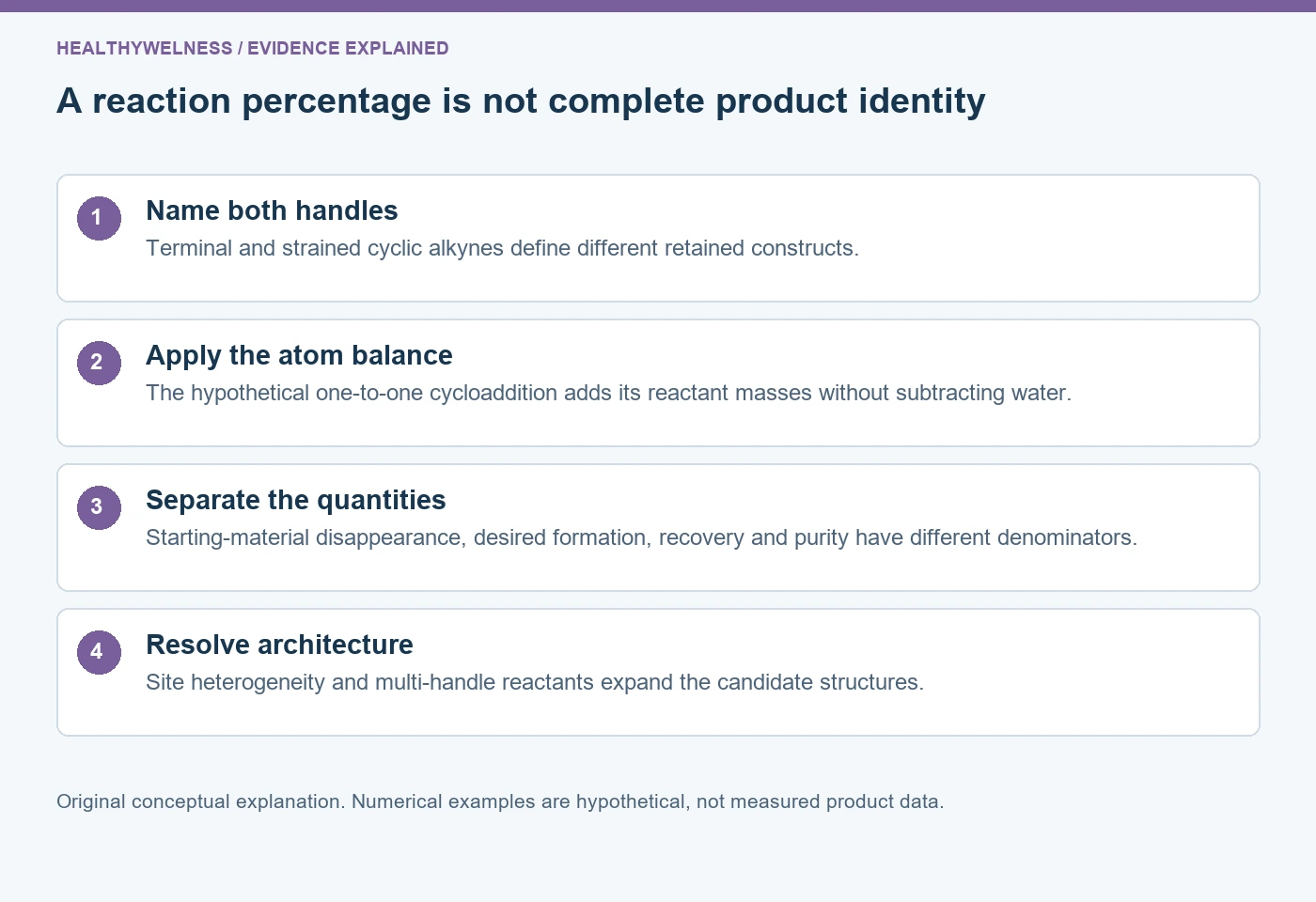
Cover and evidence map: original conceptual editorial schematics, not measured results, exact molecular structures, or photographs of HealthyWelness facilities.
Sources
- Tornøe CW, Christensen C, Meldal M. Peptidotriazoles on solid phase. J Org Chem. 2002;67:3057–3064. PMID11975567.
- Agard NJ, Prescher JA, Bertozzi CR. A strain-promoted [3+2] azide-alkyne cycloaddition for covalent modification of biomolecules in living systems. J Am Chem Soc. 2004;126:15046–15047. PMID15547999; erratum noted in PubMed.
- Torres O, et al. Peptide tertiary structure nucleation by side-chain crosslinking with metal complexation and double click cycloaddition. Chembiochem. 2008;9:1701–1705. PMID18600813.