NAC vs Glutathione: Precursor Amino Acid or Finished Tripeptide
NAC is an acetylated cysteine; glutathione is the tripeptide cells build from cysteine. How their chemistry, uptake and research questions differ.

Cover illustration: AI-generated editorial artwork. Conceptual only; not an exact molecular structure, actual laboratory result or evidence of clinical effects.
NAC is N-acetylcysteine, a modified single amino acid studied mainly as a cysteine supplier; glutathione is the tripeptide gamma-glutamyl-cysteinyl-glycine that cells build from cysteine. NAC feeds the synthesis step, glutathione is the end product, and the two are not interchangeable in an experiment.
For laboratory research use only. The research materials supplied by HealthyWelness are not approved medicines, foods or cosmetics and are not for human or veterinary use. This article summarises published research and is not medical advice.
- Glutathione (GSH) is the tripeptide gamma-L-glutamyl-L-cysteinyl-glycine; glutamate-cysteine ligase and the supply of cysteine are both rate-limiting for its synthesis (Lapenna, 2023).
- NAC’s antioxidant effect is attributed mainly to its role as a precursor of reduced glutathione, with direct scavenging only in conditions of cysteine and glutathione depletion (Aldini et al., 2018).
- Pedre and colleagues proposed that conversion of NAC to hydrogen sulphide and sulfane sulfur species explains many effects previously credited to NAC or NAC-derived glutathione (Pedre et al., 2021).
- After oral NAC, reduced NAC had a reported terminal half-life of 6.25 hours, and about 70% of total clearance was non-renal (Holdiness, 1991).
- A six-month randomised trial of oral glutathione in 54 adults reported rising glutathione in blood compartments that returned to baseline after a one-month washout (Richie et al., 2015).
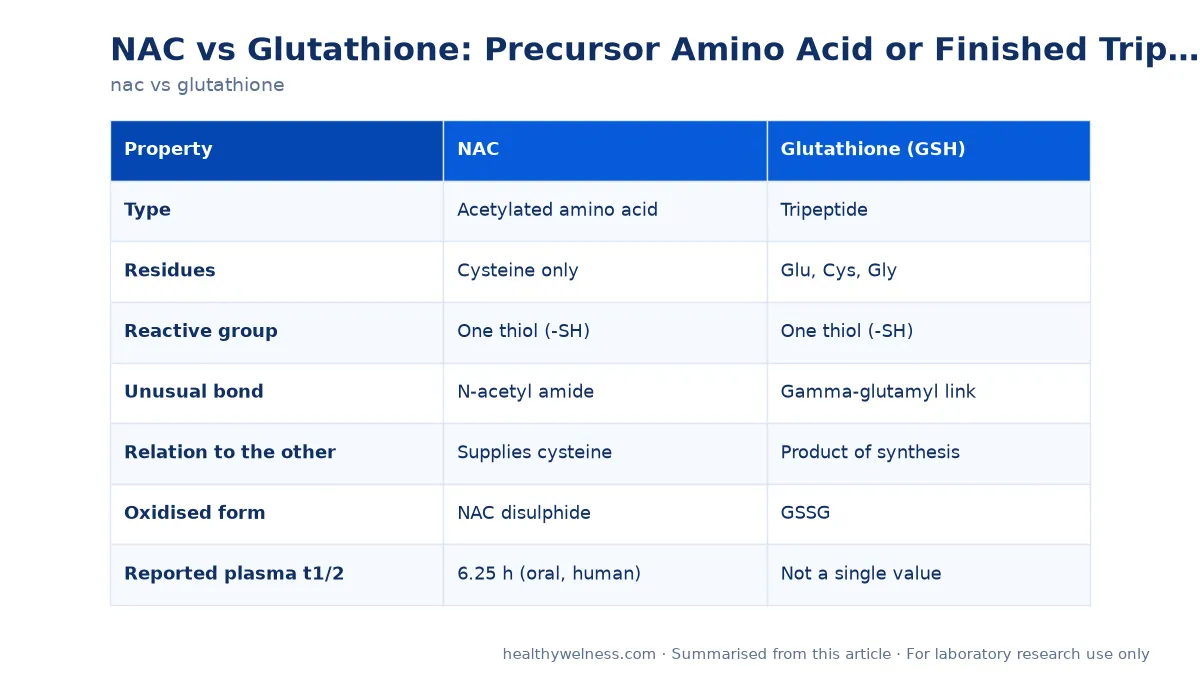
Side by side
| Property | NAC | Glutathione (GSH) |
|---|---|---|
| Type | Acetylated amino acid | Tripeptide |
| Residues | Cysteine only | Glu, Cys, Gly |
| Reactive group | One thiol (-SH) | One thiol (-SH) |
| Unusual bond | N-acetyl amide | Gamma-glutamyl link |
| Relation to the other | Supplies cysteine | Product of synthesis |
| Oxidised form | NAC disulphide | GSSG |
| Reported plasma t1/2 | 6.25 h (oral, human) | Not a single value |
The half-life row is not a like-for-like comparison. The NAC value comes from a pharmacokinetic review of oral administration (Holdiness, 1991). Glutathione is an endogenous molecule present at millimolar concentrations in tissue, synthesised, exported and degraded continuously, so its level reflects a balance rather than the clearance of a single administered amount. Our glutathione research material is reduced glutathione as a lyophilised solid.
Certificates are available for listed products — contact us for the latest report.
How one becomes part of the other
Glutathione synthesis happens in the cytosol in two ATP-dependent steps. Glutamate-cysteine ligase joins glutamate and cysteine through the glutamate side-chain carboxyl, forming gamma-glutamylcysteine, and glutathione synthase then adds glycine (Lapenna, 2023). The gamma linkage is unusual: most peptide bonds use the alpha carboxyl, and this one protects glutathione from ordinary peptidases while making it a substrate for gamma-glutamyl transferase outside the cell.
| Step | Enzyme | Where NAC enters |
|---|---|---|
| Deacetylation of NAC | Acylases | Releases free cysteine |
| Glu + Cys | Glutamate-cysteine ligase | Cysteine is a limiting input |
| gamma-Glu-Cys + Gly | Glutathione synthase | Indirect |
| GSSG back to GSH | Glutathione reductase | Not involved |
The older physiological literature emphasised that cells obtain glutathione substrates both by transporting amino acids and by salvaging circulating glutathione through gamma-glutamyl transpeptidase, and suggested that supplying substrate could bypass feedback inhibition of synthesis (Deneke and Fanburg, 1989). That is the rationale behind using NAC as a tool: it targets the input rather than the product.
Three mechanisms proposed for NAC, only one of which involves glutathione
Aldini and colleagues set out three ways NAC can act. First, as a precursor for reduced glutathione. Second, as a direct antioxidant toward specific oxidants such as nitrogen dioxide and hypohalous acids, mainly when cysteine and glutathione are depleted. Third, as a disulphide-breaking agent that frees thiols from thiolated proteins, which releases reduced proteins such as mercaptoalbumin and also explains NAC’s mucolytic action on cross-linked mucus glycoproteins (Aldini et al., 2018).
Pedre and colleagues take a more sceptical view. They note that NAC is arguably the most widely used “antioxidant” in cell and animal biology, but that in most cases its mechanism has remained untested. Their review proposes that NAC is converted to hydrogen sulphide and sulfane sulfur species, and that these per- and polysulfides could account for much of the protection previously credited to NAC or to glutathione made from it (Pedre et al., 2021).
For an experiment, the implication is direct. A result obtained with NAC is not, by itself, evidence that glutathione was responsible. Distinguishing the routes needs controls such as measuring glutathione directly, blocking its synthesis, or using a thiol that cannot feed it.
What the human studies measured
Two often-cited studies illustrate the different questions asked of each compound. They are summarised here by design and measured outcome only.
| Study | Design | Measured outcome |
|---|---|---|
| Richie et al., 2015 | 6-month RCT, n=54 | Glutathione in blood compartments |
| Kumar et al., 2021 | 36-week open-label, n=16 | RBC glutathione, oxidative markers |
| Holdiness, 1991 | Pharmacokinetic review | NAC absorption, clearance |
The Richie trial tested oral glutathione itself at two intake levels against placebo. Glutathione rose in blood, erythrocytes, plasma and lymphocytes over six months, the oxidised-to-reduced ratio in whole blood fell, and levels returned to baseline after a one-month washout (Richie et al., 2015). The result is notable because intact glutathione had long been assumed to be poorly available by mouth.
The Kumar study did not test NAC alone. It combined glycine with NAC (GlyNAC) in eight older adults, with eight younger adults studied only at baseline, and reported that 24 weeks corrected red-cell glutathione deficiency and oxidative stress markers, with the changes declining after 12 weeks of withdrawal (Kumar et al., 2021). Its small, open-label design and the combination of two precursors mean it says nothing about NAC versus glutathione directly.
Choosing between them in an experimental design
Because one compound is an input and the other an output, the right choice depends on the question being asked rather than on which is considered “stronger”. The table pairs common research questions with the compound that addresses them more directly, and the confound each choice brings.
| Research question | More direct tool | Main confound |
|---|---|---|
| Is synthesis capacity limiting? | NAC | H2S and disulphide effects |
| Does extracellular GSH matter? | Glutathione | Breakdown by GGT |
| Is a thiol reductant enough? | Both, compared | Different uptake |
| Does mucoprotein reduction matter? | NAC | Not a GSH question |
| Assay standard for GSH | Glutathione | Oxidation to GSSG |
Two design points follow from the literature above. First, an NAC arm benefits from a direct measurement of intracellular glutathione, so that any effect can be related to a change in the pool rather than assumed to come from it. Second, a glutathione arm in cell culture benefits from a stability check of the medium, because extracellular glutathione can be degraded or oxidised before it reaches the cells. Neither point is exotic; both are often skipped.
Analytical differences
The two molecules are easy to tell apart instrumentally and hard to tell apart with a simple thiol assay. Colorimetric thiol reagents react with any free sulfhydryl, so a sample containing both NAC and glutathione returns a combined value. Reversed-phase HPLC separates them, and mass spectrometry distinguishes them immediately: NAC has a molecular weight of about 163, glutathione about 307, and the glutathione disulphide GSSG about 613.
Mixed disulphides add a further complication. NAC’s disulphide-breaking activity, described by Aldini and colleagues, means that in a protein-containing sample some NAC ends up bound to protein thiols or to glutathione itself (Aldini et al., 2018). A total-thiol measurement after reduction will then differ from a free-thiol measurement before it, and the difference is informative rather than an error.
Handling in the lab
Both compounds are thiols, and the thiol is what oxidises. Reduced glutathione in solution slowly forms the disulphide GSSG, and NAC forms its own disulphide. Practical consequences for either: prepare solutions close to use, keep them cold, minimise headspace, and record the time from dissolution to assay. Metal ions accelerate thiol oxidation, so high-purity water matters.
Concentration is calculated from net mass and volume; the peptide calculator handles the arithmetic for glutathione. The detailed procedure for a common vial size is in reconstituting 600 mg glutathione, and the physical form of the dry material is covered in glutathione powder.
Related research
The parent overview is what is glutathione. The amino acid often confused with it is compared in glutamine versus glutathione, and its interaction with the NAD system in NAD+ and glutathione.
Frequently asked questions
What is the difference between NAC and glutathione?
N-acetylcysteine (NAC) is a single modified amino acid, cysteine with an acetyl group on its nitrogen. Glutathione is a tripeptide, gamma-glutamyl-cysteinyl-glycine, that cells synthesise from cysteine, glutamate and glycine. NAC is mainly studied as a source of cysteine for that synthesis; glutathione is the finished reductant.
Is L-glutathione the same comparison as glutathione versus NAC?
Yes. Natural glutathione is built from L-amino acids, so “L-glutathione” and “glutathione” name the same molecule. Searches for L-glutathione versus NAC and glutathione versus NAC ask the same question, and this article answers both.
Why is NAC so often used in cell experiments instead of glutathione?
Because intact glutathione crosses cell membranes poorly and is broken down outside cells, while NAC can supply cysteine, the amino acid that limits glutathione synthesis together with the enzyme glutamate-cysteine ligase (Lapenna, 2023). The convenience has a cost: NAC also has actions that do not run through glutathione.
Does NAC always work by raising glutathione?
No. Pedre and colleagues argue that the textbook mechanisms, disulphide reduction, direct scavenging and glutathione synthesis, cannot be generalised, and that conversion of NAC to hydrogen sulphide and sulfane sulfur species may explain many effects previously attributed to it (Pedre et al., 2021).
What has been measured when glutathione itself is taken orally?
In a six-month randomised placebo-controlled trial in 54 non-smoking adults, glutathione levels in blood, erythrocytes, plasma and lymphocytes rose over time, and returned to baseline after a one-month washout (Richie et al., 2015). The trial measured stores and markers, not clinical outcomes.
For laboratory research use only. The research materials supplied by HealthyWelness are not approved medicines, foods or cosmetics and are not for human or veterinary use. This article summarises published research and is not medical advice.
Sources
- Aldini G, et al. N-Acetylcysteine as an antioxidant and disulphide breaking agent: the reasons why. Free Radic Res. 2018. PMID: 29742938
- Pedre B, et al. The mechanism of action of N-acetylcysteine (NAC): The emerging role of H(2)S and sulfane sulfur species. Pharmacol Ther. 2021. PMID: 34171332
- Holdiness MR. Clinical pharmacokinetics of N-acetylcysteine. Clin Pharmacokinet. 1991. PMID: 2029805
- Richie JP Jr, et al. Randomized controlled trial of oral glutathione supplementation on body stores of glutathione. Eur J Nutr. 2015. PMID: 24791752
- Kumar P, et al. Glycine and N-acetylcysteine (GlyNAC) supplementation in older adults improves glutathione deficiency, oxidative stress, mitochondrial dysfunction, inflammation, insulin resistance, endothelial dysfunction, genotoxicity, muscle strength, and cognition: Results of a pilot clinical trial. Clin Transl Med. 2021. PMID: 33783984
- Deneke SM, et al. Regulation of cellular glutathione. Am J Physiol. 1989. PMID: 2572174
- Lapenna D. Glutathione and glutathione-dependent enzymes: From biochemistry to gerontology and successful aging. Ageing Res Rev. 2023. PMID: 37683986