Ionic Strength, Conductivity and Osmolality in Peptide Media
Compare ionic strength, conductivity and osmolality in peptide research media, with clear measurement limits and an ideal salt calculation.


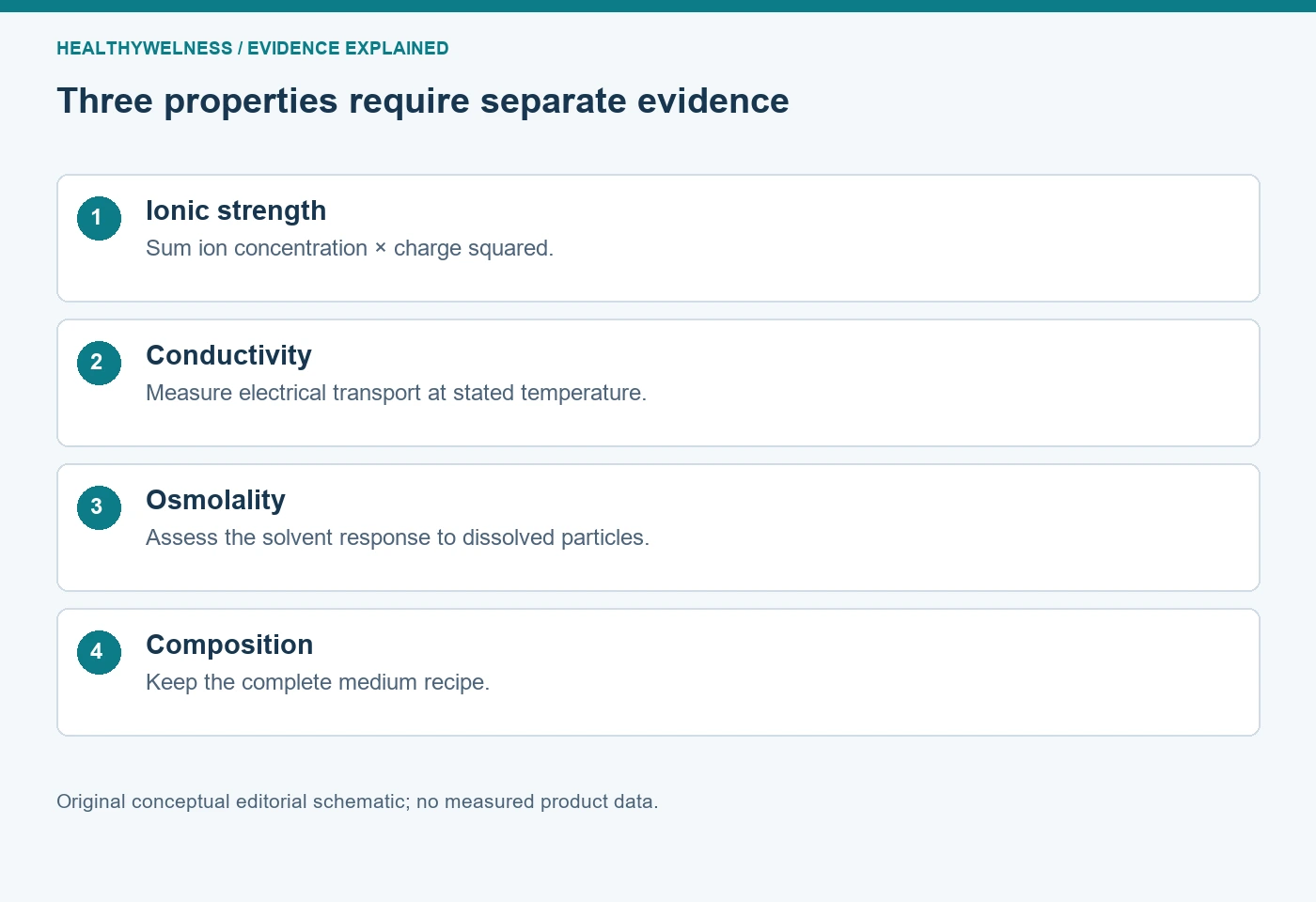
Ionic strength, conductivity and osmolality describe different properties of a peptide research medium and cannot generally replace one another. Ionic strength weights ion concentrations by squared charge, conductivity measures electrical transport, and osmolality concerns the solvent’s response to dissolved particles. A matching reading for one property does not establish a matching chemical environment.
For laboratory research use only. The compounds discussed are not approved for human or veterinary use and are not drugs, foods or cosmetics. This article summarises published research and is not medical advice.
- IUPAC defines concentration-based ionic strength as one-half the sum of ion concentrations multiplied by squared charge numbers.
- Conductivity depends on ion transport and temperature as well as composition; a conductivity meter does not identify every ion.
- Osmolality can include contributions from uncharged solutes that do not contribute directly to an ionic-strength sum.
- Equal osmolality does not establish equal ionic strength or equal suitability for a peptide assay.
Three measurements answer three different questions
A medium can be described as low salt, concentrated, conductive or osmotically matched without those descriptions meaning the same thing. The distinction matters when a peptide comparison changes a buffer, exchanges one salt for another, or adds a neutral cosolute. A single number can be useful for monitoring a known process while remaining insufficient to reconstruct its chemistry.
| Quantity | What it describes | Typical reporting basis |
|---|---|---|
| Ionic strength | Charge-weighted ion content | mol/L or mol/kg |
| Conductivity | Electrical transport | µS/cm or mS/cm |
| Osmolality | Osmotic solute effect | mOsm/kg solvent |
| pH | Hydrogen-ion activity | Value with temperature |
The last row is included because pH is frequently used as an informal substitute for the other three. Matching pH does not fix salt identity, dissolved-particle concentration or electrical transport. The existing buffer capacity versus pH guide addresses a separate question: resistance to added acid or base. Here the question is what can be inferred when someone reports a salt-related measurement.
Ionic strength counts ions with a charge-squared weight
The IUPAC definition is I = ½Σcᵢzᵢ² on a concentration basis. Each cᵢ is the concentration of an ionic species, and zᵢ is its charge number. The analogous molality expression uses amount per mass of solvent. The two bases should be named rather than mixed in the same calculation. [1]
The square is consequential. A divalent ion contributes four times its concentration inside the sum, whereas a monovalent ion contributes once its concentration. Electrical neutrality does not make ionic strength zero: positive and negative ions both contribute positively after the charges are squared. A neutral dissolved molecule has z = 0 and contributes zero to this particular sum.
The calculation requires species, not merely bottle names. For a fully dissociated simple salt, stoichiometry supplies an illustrative species list. For a mixture containing acid–base equilibria, ion pairing or complexes, the species present can require additional information. Counting total analytical metal as free divalent metal would silently assume a speciation model. A stated buffer concentration likewise does not identify all the counterions introduced during pH adjustment.
Ionic strength is therefore a useful descriptor with a defined scope. It does not retain every chemical identity after the sum has been taken. Two different ion mixtures can produce the same value while presenting different opportunities for specific binding or other interactions. A matching calculated ionic strength supports a charge-environment comparison under its assumptions; it does not establish chemical interchangeability.
A conductivity reading is an electrical transport result
Thermo Fisher’s technical explanation relates conductivity to charge-carrier number, movement and charge. It also describes calibration of the cell constant and temperature compensation. These are measurement properties, not a recipe for converting any unfamiliar mixture into a unique salt concentration. [2]
Suppose a known salt solution is repeatedly prepared by the same method. Conductivity can provide a useful consistency check against an established reference. That usefulness depends on the composition remaining sufficiently constrained. Once the salt identity, solvent environment or mixture changes, the old relationship is no longer automatically applicable.
The Dionex DX-120 manual gives the physical reason: hydration and solvent viscosity affect ionic mobility, and mobility is temperature dependent. Its discussion concerns conductivity detection in ion chromatography. The general transport principle is relevant here, while the manual’s instrument settings are not universal instructions for peptide media. [3]
Report the measured temperature and whether the value is raw or compensated to a reference temperature. A compensation algorithm changes how the reading is reported; it does not transform the sample into the reference-temperature chemical state. Also preserve the units. A number copied without µS/cm or mS/cm can introduce a thousandfold ambiguity before any chemistry is considered.
Osmolality also sees neutral dissolved species
A freezing-point osmometer assesses a colligative response of the solvent. KNAUER’s first-party explanation describes cooling, controlled freezing and the freezing plateau used to infer osmolality. This differs from passing electrical current through the sample. [4]
In a dilute ideal teaching model, a dissolved neutral molecule can count as one osmotically active particle while contributing nothing to the ionic-strength sum. A fully dissociated salt contributes its separate ions to the ideal particle count. Real solutions can depart from ideal particle-count arithmetic, so a calculated ideal value and a measured osmolality should retain different labels.
Keep osmolality and osmolarity distinct. The former is expressed per mass of solvent; the latter is expressed per volume of solution. Converting between them requires an appropriate relationship between those bases. A numerical comparison that silently changes kg to L can look tidy while representing different quantities.
An invented salt comparison exposes the mismatch
Hypothetical ideal example: consider water-based preparations containing only the stated solutes. Assume complete salt dissociation, no complexes, no background ions and ideal dilute behavior. Concentration is on a mol/L solution basis. The particle-count column is an ideal osmolarity calculation, deliberately not a measured osmolality.
| Invented preparation | Ion concentrations | Calculated I | Ideal particle total |
|---|---|---|---|
| 10 mM NaCl | 10 Na⁺; 10 Cl⁻ mM | 10 mM | 20 mOsm/L |
| 10 mM CaCl₂ | 10 Ca²⁺; 20 Cl⁻ mM | 30 mM | 30 mOsm/L |
| 30 mM glucose | No added ions | 0 mM | 30 mOsm/L |
| 10 mM NaCl + 10 mM glucose | 10 Na⁺; 10 Cl⁻ mM | 10 mM | 30 mOsm/L |
For the calcium-chloride row, I = ½[(10 × 4) + (20 × 1)] = 30 mM. For sodium chloride, I = ½(10 + 10) = 10 mM. Adding neutral glucose changes the ideal particle count without changing the stipulated ionic-strength sum. These are arithmetic consequences of invented inputs, not measurements of research materials.
The second, third and fourth rows share an ideal particle total but have very different calculated ionic strengths. The first and fourth share ionic strength but differ in ideal particle total. No conductivity values are supplied because ion concentrations alone, without an appropriate transport model and conditions, do not establish those values. Inventing a conductivity column would obscure the point of the comparison.
This example also illustrates a limit of matching. Replacing calcium chloride with glucose to preserve a particle count would remove calcium and chloride. Any assay involving specific ions would then have a chemically different medium even if an osmometer later returned similar numbers. The matched property must correspond to the causal question.
Choose the descriptor that matches the experimental uncertainty
If the uncertainty is whether a familiar buffer exchange reached a reproducible endpoint, conductivity may be a useful process observation. If the uncertainty concerns charge-weighted composition, calculate ionic strength from the relevant species model. If the uncertainty concerns total osmotic behavior, obtain an appropriate osmolality measurement. None of these measurements independently establishes peptide identity, recovery or molecular state.
- Preserve the complete final recipe, including stock contributions and pH-adjustment reagents.
- State whether a quantity was calculated, directly measured or inferred from a process-specific relationship.
- Retain temperature, units, calibration context and the stage at which the sample was measured.
- Assess peptide behavior separately when changing ion identity or adding a neutral cosolute.
A useful comparison can deliberately match one property and vary another. For example, a research design can compare media with similar measured osmolality while examining a specified ionic change. The interpretation should then acknowledge the intended chemical difference rather than describing the media as equivalent. If several ingredients change together, a signal difference cannot be uniquely attributed to ionic strength.
The sources here establish definitions and measurement principles. They do not provide a universal salt preference, an accepted conductivity range for all peptides or evidence of HealthyWelness product testing. Our commercial catalog does not change that evidential boundary. The value of these distinctions is a more explicit research record, not a new specification assigned to an untested material.
Questions about comparing peptide research media
Can conductivity be converted directly to ionic strength?
Only with an appropriate composition-dependent model or validated relationship. A single conductivity reading does not uniquely identify the ions and concentrations needed for the ionic-strength sum.
Does equal osmolality mean equal salt concentration?
No. Neutral solutes contribute to osmotic behavior, and salts differ in stoichiometry and nonideal behavior. Equal measured osmolality can describe chemically different media.
Does electrical neutrality mean zero ionic strength?
No. Oppositely charged ions balance net charge but their squared-charge contributions add positively in the ionic-strength definition.
Can a pH-matched buffer replace the original medium?
A matching pH alone does not establish matching ions, buffer capacity, conductivity or osmolality. Suitability requires evidence for the properties relevant to the actual research method.
Does a concentration calculator determine these properties?
A peptide mass–volume calculator checks nominal peptide concentration. It does not measure ion transport, solve complete solution speciation or determine osmolality.
Continue with composition and preparation evidence
Read buffer pH and temperature compensation and solvent contributions in peptide assays. The peptide concentration calculator supports nominal mass–volume arithmetic while the medium remains a separate part of the research record.
References
- IUPAC. Glossary of terms used in physical organic chemistry. Recommendations 1994. Ionic strength entry.
- Thermo Fisher Scientific. Conductivity Measurement and Testing. Conductivity and temperature-compensation sections.
- Dionex. DX-120 Ion Chromatograph Operator’s Manual. 1998. Appendix D.2.1–D.2.2.
- KNAUER. Freezing Point Osmometry. Measurement principle and instrument reporting basis.
For laboratory research use only. The compounds discussed are not approved for human or veterinary use and are not drugs, foods or cosmetics. This article summarises published research and is not medical advice.
Cover and evidence map: original conceptual editorial schematics, not measured results, exact molecular structures, or photographs of HealthyWelness facilities.
Sources
- IUPAC. Glossary of terms used in physical organic chemistry. Recommendations 1994. Ionic strength entry.
- Thermo Fisher Scientific. Conductivity Measurement and Testing. Conductivity and temperature-compensation sections.
- Dionex. DX-120 Ion Chromatograph Operator's Manual. 1998. Appendix D.2.1–D.2.2.
- KNAUER. Freezing Point Osmometry. Measurement principle and instrument reporting basis.