5-Amino-1MQ vs NAD+: Inhibitor or Cofactor
One blocks an enzyme that consumes nicotinamide; the other is the cofactor itself. Adjacent chemistry, opposite interventions, different controls.

Cover illustration: AI-generated editorial artwork. Conceptual only; not an exact molecular structure, actual laboratory result or evidence of clinical effects.
These two are compared because they sit adjacent in the same chemistry, and the comparison is useful once the relationship is stated correctly. NAD+ is the cofactor. 5-Amino-1MQ inhibits an enzyme that diverts a precursor away from making it. Supplying substrate and blocking an exit are opposite interventions, and they need opposite controls.
For laboratory research use only. The research materials supplied by HealthyWelness are not approved medicines, foods or cosmetics and are not for human or veterinary use. This article summarises published research and is not medical advice.
- 5-Amino-1MQ inhibits nicotinamide N-methyltransferase (NNMT), an enzyme that methylates nicotinamide.
- NAD+ is a dinucleotide coenzyme, not a peptide and not an enzyme inhibitor.
- Nicotinamide is a precursor in NAD+ salvage, which is why methylating it is relevant to NAD+ chemistry.
- 5-Amino-1MQ is a permanently charged quaternary ammonium cation supplied as a salt, commonly iodide.
- No human trials or published pharmacokinetics for 5-Amino-1MQ appear in the indexed literature that we can find.
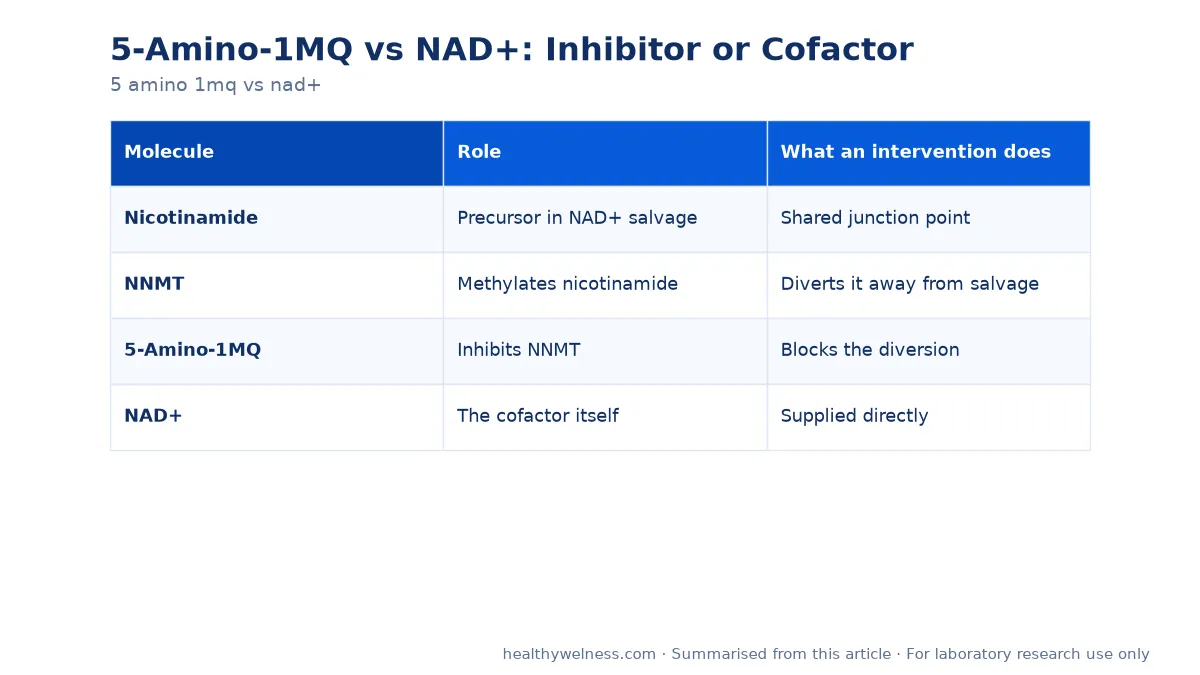
How are the two connected chemically?
Through nicotinamide, which both pathways run through from different directions.
| Molecule | Role | What an intervention does |
|---|---|---|
| Nicotinamide | Precursor in NAD+ salvage | Shared junction point |
| NNMT | Methylates nicotinamide | Diverts it away from salvage |
| 5-Amino-1MQ | Inhibits NNMT | Blocks the diversion |
| NAD+ | The cofactor itself | Supplied directly |
So one intervention works by removing an exit from the pathway and the other by adding material to it. The honest summary of the inhibitor’s logic is: if less nicotinamide is methylated, more remains available for salvage. Whether that produces a measurable change in a given system is an empirical question, not a deduction.
Why do they need different controls?
This is where the distinction stops being semantic.
- An enzyme inhibitor requires that the enzyme be present. In a system with little NNMT there is nothing to inhibit, and a null result carries no information about the compound. Confirming expression is the first control, not an afterthought.
- The proximal readout for an inhibitor is substrate and product. Measuring a downstream metabolic endpoint without confirming target engagement leaves the mechanism unaddressed.
- Selectivity needs checking against related methyltransferases, which share cofactor chemistry and are therefore plausible off-targets.
- A cofactor added directly faces a transport problem instead. NAD+ carries two negatively charged phosphate groups and crosses membranes poorly, which is why precursor approaches exist at all — the subject of the 2016 study by Trammell and colleagues on nicotinamide riboside.
The precursor route is covered in NAD+ compared with nicotinamide riboside, and why NAD+ is not a peptide in is NAD+ a peptide or a coenzyme.
What does each one’s evidence base contain?
They are not comparable in size, and pretending otherwise would misrepresent both.
NAD+ biology is a mature field with measurement work at a level of resolution most research compounds never reach. The 2018 study by Goodman and colleagues examined spatiotemporal compartmentalisation of hepatic NADH and NADPH metabolism; the 2015 review by Bilan and colleagues places NAD+/NADH among the main cellular redox couples. The central methodological point from that literature is that the ratio of oxidised to reduced forms is the quantity of interest, not either concentration — developed in NAD+ to NADH: reduction or oxidation.
5-Amino-1MQ’s compound-level literature is thinner. The 2018 study by Neelakantan and colleagues describes selective, membrane-permeable NNMT inhibitors in a mouse model. The 2025 Nature paper by Heide and colleagues concerns NNMT inhibition in cancer-associated fibroblasts — strong work about the target, in a different context, and frequently cited around this compound in a way that blurs that distinction.
| Question | 5-Amino-1MQ | NAD+ |
|---|---|---|
| Named molecular target | Yes — NNMT | Not applicable; it is the cofactor |
| Proximal assay available | Enzyme activity | Ratio measurement |
| Human trials | None found | Not the right framing |
| Published pharmacokinetics | None found | Precursor work exists |
| Membrane permeability | Designed for it | Poor — two phosphates |
The gaps in the inhibitor’s record are set out in what the 5-Amino-1MQ evidence actually contains.
Can they be compared in one experiment?
Yes, and it is a more interesting experiment than most pairings in this category, because the two act on the same pathway from opposite directions.
Three design points make it interpretable:
- Measure the pathway, not only an endpoint. If the hypothesis is that both raise NAD+ availability, measure the NAD+/NADH ratio rather than a downstream functional readout alone.
- Confirm NNMT expression before interpreting the inhibitor arm, and confirm that added NAD+ reaches the compartment of interest before interpreting the cofactor arm. Both arms have an access problem, and they are different problems.
- Run them together as a third arm. Blocking an exit and supplying substrate could be additive, or could reach a ceiling. Either outcome is informative, and no published co-administration work for this pair exists that we can find.
How does handling differ?
Neither is a peptide, and they fail in different ways.
- 5-Amino-1MQ is a permanently charged cation supplied as a salt, often iodide. Iodide is heavy, so the molecular weight of the exact salt matters for concentration, and iodide salts darken on light exposure as iodide oxidises — a visible quality signal and a reason to discard a discoloured lot. Detail in handling 5-Amino-1MQ.
- NAD+ is hygroscopic and degrades in solution, with the oxidised and reduced forms labile in opposite pH directions, so no single buffer suits both. Prepare solutions close to use. Detail in does NAD+ need refrigeration.
- Both need the molecular weight of the exact form supplied, which our reconstitution calculator takes as an explicit input rather than inferring from a sequence.
Our 5-Amino-1MQ research material is supplied for laboratory research use. Certificates are available for listed products — contact us for the latest report.
Why “adjacent chemistry” is a trap worth naming
Compounds that sit near each other on a metabolic map get discussed as though they were interchangeable levers on one dial. They rarely are, and this pair shows why.
Supplying a cofactor and inhibiting an enzyme differ in three ways that matter before any biology is considered:
- Where the intervention acts. Added cofactor has to reach the compartment where it is used; an inhibitor has to reach the enzyme. Those are different access problems, and a compound can solve one while failing the other entirely.
- What the concentration response means. For an inhibitor the curve saturates once the enzyme is fully blocked, and more compound adds nothing except off-target risk. For a supplied cofactor there is no equivalent ceiling, so a flat high end means something different in each case.
- What a null result tells you. No effect from an inhibitor in a low-enzyme system is uninformative. No effect from an added cofactor in a system that cannot take it up is equally uninformative, for an unrelated reason.
The practical consequence is that a side-by-side experiment needs two sets of controls rather than one shared set. That is the real cost of comparing compounds that look adjacent, and it is cheaper to pay at the design stage than to discover from an uninterpretable result.
Scope note
This material is supplied for laboratory research use only. It is not a medicine, not a supplement, and not for human or veterinary use. The published work described above is in cells and animal models.
Open questions
- Does NNMT inhibition measurably change the NAD+/NADH ratio in any published system?
- How selective is 5-Amino-1MQ against related methyltransferases?
- Would blocking the exit and supplying substrate together be additive, or reach a ceiling?
Related research
Frequently asked questions
What is the difference between 5-Amino-1MQ and NAD+?
One is an enzyme inhibitor and the other is a cofactor. 5-Amino-1MQ inhibits nicotinamide N-methyltransferase, an enzyme that methylates nicotinamide. NAD+ is the dinucleotide cofactor that nicotinamide is a precursor to. They sit adjacent in the same chemistry but are opposite kinds of intervention.
Are they alternatives to each other?
No. Adding a cofactor supplies substrate to a pathway. Inhibiting an enzyme removes a route out of it. Those are different experiments with different controls, and neither substitutes for the other.
Is 5-Amino-1MQ a peptide?
No, and neither is NAD+. 5-Amino-1MQ is a quaternary ammonium cation supplied as a salt. NAD+ is a dinucleotide coenzyme. Both appear in peptide catalogues because of the research area, not because of their chemistry.
What does NNMT do?
It transfers a methyl group to nicotinamide. Because nicotinamide is a precursor in NAD+ salvage, methylating it diverts that molecule away from the salvage route, which is the mechanistic reason an NNMT inhibitor is discussed alongside NAD+.
Which has more published evidence?
NAD+ biology by a wide margin, including compartment-resolved measurement work. 5-Amino-1MQ’s compound-level literature is a 2018 mouse study plus the wider NNMT target literature, with no human trials or published pharmacokinetics that we can find.
References
- Neelakantan H, et al. Selective and membrane-permeable small molecule inhibitors of nicotinamide N-methyltransferase reverse high fat diet-induced obesity in mice. Biochem Pharmacol. 2018. PMID: 29155147 https://pubmed.ncbi.nlm.nih.gov/29155147/
- Heide J, et al. NNMT inhibition in cancer-associated fibroblasts restores antitumour immunity. Nature. 2025. PMID: 40702186 https://pubmed.ncbi.nlm.nih.gov/40702186/
- Goodman RP, et al. Spatiotemporal compartmentalization of hepatic NADH and NADPH metabolism. J Biol Chem. 2018. PMID: 29514978 https://pubmed.ncbi.nlm.nih.gov/29514978/
- Bilan DS, et al. Main Cellular Redox Couples. Bioorg Khim. 2015. PMID: 26615634 https://pubmed.ncbi.nlm.nih.gov/26615634/
- Trammell SA, et al. Nicotinamide riboside is uniquely and orally bioavailable in mice and humans. Nat Commun. 2016. PMID: 27721479 https://pubmed.ncbi.nlm.nih.gov/27721479/
For laboratory research use only. The research materials supplied by HealthyWelness are not approved medicines, foods or cosmetics and are not for human or veterinary use. This article summarises published research and is not medical advice.
Sources
- Neelakantan H, et al. Selective and membrane-permeable small molecule inhibitors of nicotinamide N-methyltransferase reverse high fat diet-induced obesity in mice. Biochem Pharmacol. 2018. PMID: 29155147
- Heide J, et al. NNMT inhibition in cancer-associated fibroblasts restores antitumour immunity. Nature. 2025. PMID: 40702186
- Goodman RP, et al. Spatiotemporal compartmentalization of hepatic NADH and NADPH metabolism. J Biol Chem. 2018. PMID: 29514978
- Bilan DS, et al. Main Cellular Redox Couples. Bioorg Khim. 2015. PMID: 26615634
- Trammell SA, et al. Nicotinamide riboside is uniquely and orally bioavailable in mice and humans. Nat Commun. 2016. PMID: 27721479