Liraglutide vs Tirzepatide: One Receptor or Two
Liraglutide engages GLP-1 alone; tirzepatide engages GIP and GLP-1 with reported bias. Different half-life engineering, different evidence base.


Cover illustration: AI-generated editorial artwork. Conceptual only; not an exact molecular structure, actual laboratory result or evidence of clinical effects.
Liraglutide engages the GLP-1 receptor alone; tirzepatide engages the GIP and GLP-1 receptors with a reported imbalance between them. They also use different half-life chemistry, which is why reported durations differ by roughly an order of magnitude.
For laboratory research use only. The research materials supplied by HealthyWelness are not approved medicines, foods or cosmetics and are not for human or veterinary use. This article summarises published research and is not medical advice.
- Liraglutide is 97% homologous to native human GLP-1, with a 16-carbon fatty acid chain added for albumin binding (Sisson, 2011).
- Liraglutide’s reported elimination half-life is about 13 hours (Sisson, 2011); tirzepatide’s reported half-life is about 5 days (Schneck et al., 2024).
- Tirzepatide has been characterised as an imbalanced and biased dual agonist, with GIP receptor activity closer to the native hormone than its GLP-1 receptor activity is (Willard et al., 2020).
- Receptor trafficking and recycling after stimulation differ between mono- and dual-agonists at these receptors (Novikoff et al., 2021).
- Lymphatic uptake was similar for the lipidated agonist liraglutide and the non-lipidated exenatide in rats, indicating the lipid’s contribution is not primarily a lymphatic routing effect (Reddiar et al., 2024).
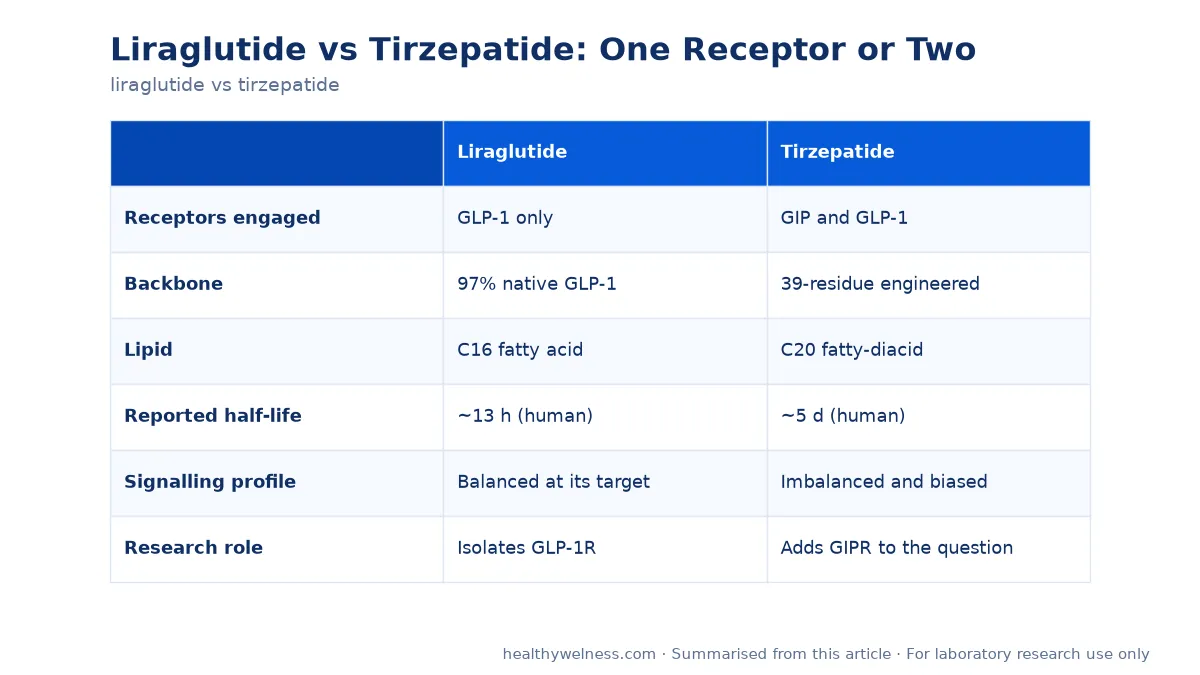
Side by side
| Liraglutide | Tirzepatide | |
|---|---|---|
| Receptors engaged | GLP-1 only | GIP and GLP-1 |
| Backbone | 97% native GLP-1 | 39-residue engineered |
| Lipid | C16 fatty acid | C20 fatty-diacid |
| Reported half-life | ~13 h (human) | ~5 d (human) |
| Signalling profile | Balanced at its target | Imbalanced and biased |
| Research role | Isolates GLP-1R | Adds GIPR to the question |
What “dual agonist” does and does not mean
The phrase invites a simple picture: two receptors, twice the effect. The receptor pharmacology published on tirzepatide points somewhere more specific.
Willard and colleagues characterised it as imbalanced and biased. Imbalanced refers to the relationship between its two activities: the compound’s engagement of the GIP receptor is closer to what native GIP does than its engagement of the GLP-1 receptor is to native GLP-1. Biased refers to what happens after binding — not every downstream arm of a receptor is engaged in the proportions the native ligand produces (Willard et al., 2020).
For an experiment, that has a direct consequence. A result obtained with tirzepatide cannot be attributed to “GLP-1 plus GIP” without controls that separate them, because the compound is not delivering either signal in its native proportion.
Why receptor trafficking matters here
Binding is the start of the story. Once a receptor is engaged it may be internalised, degraded or recycled back to the surface, and how quickly that happens determines what a sustained exposure actually produces. Work comparing selected mono- and dual-agonists at the GLP-1 and GIP receptors found that spatiotemporal signalling and trafficking dynamics differ between them (Novikoff et al., 2021).
This is one of the reasons a potency number alone is a poor summary. Two compounds with similar binding affinity can leave a cell in different states an hour later.
Two approaches to the same engineering problem
Native GLP-1 is cleared within minutes. Both compounds solve that with a fatty-acid chain that binds albumin non-covalently, slowing absorption after subcutaneous administration in the cited work and shielding the molecule from dipeptidyl peptidase-4 (Sisson, 2011). The difference is in the chain.
| Strategy | Liraglutide | Tirzepatide |
|---|---|---|
| Lipid length | C16 | C20 |
| Terminal group | Fatty acid | Diacid |
| Albumin affinity | Lower | Higher |
| Resulting duration | Hours | Days |
Systematic work on albumin-binding moieties in GLP-1 analogues shows that the interaction chemistry, not merely the presence of a lipid, directs the systemic properties of the resulting molecule (Bech et al., 2017). A diacid terminus binds albumin more tightly than a simple fatty acid, and that difference accounts for much of the gap between a daily and a weekly profile.
One mechanism that might be assumed is not supported: lymphatic uptake was found to be similar for lipidated liraglutide and non-lipidated exenatide in rats (Reddiar et al., 2024). The lipid is not working primarily by redirecting the molecule into lymph.
Choosing between them in a design
The two compounds are not competing answers to one question; they are tools for two different questions, and the choice follows from which one is being asked.
| If the question is | Use | Because |
|---|---|---|
| What does GLP-1R engagement do? | Liraglutide | One receptor |
| What does adding GIPR change? | Both | Needs the contrast |
| Does bias matter here? | Tirzepatide | Bias is its property |
| Does duration drive the effect? | Both | Durations differ widely |
The fourth row is the one most often skipped. A compound circulating for days and a compound circulating for hours produce different exposure profiles even at matched concentrations, so any difference observed between them confounds receptor coverage with exposure time unless the design separates the two. Matching on exposure rather than on nominal concentration is what makes such a comparison interpretable.
What a potency number leaves out
Published potency values for these compounds are measured in defined cell systems with a chosen readout, usually a proximal second messenger. A receptor that internalises quickly and one that recycles back to the surface can give similar readings at that timescale and diverge later (Novikoff et al., 2021). Reading across from a potency table to a sustained-exposure experiment therefore carries an assumption that the trafficking behaviour is equivalent, which for these two compounds is exactly what the published work says is not the case.
Handling in the lab
- Both are supplied for laboratory preparation; the stated label weight is not the net peptide content, and the batch documentation carries the figure that matters.
- Albumin-binding compounds are engineered for behaviour in a circulating system. That engineering does nothing for a vial on the bench, where the usual peptide-solution limits apply.
- Half-life differences of this size change what a sampling schedule has to look like. The half-life calculator plots the decay curve for a stated half-life and species.
Our tirzepatide research material is supplied with the specification for its batch stated on its own documentation. Liraglutide is not in our catalogue; it appears here because the comparison is the question people are asking.
Related research
For the dual-agonist mechanism in more depth see how tirzepatide works and tirzepatide’s reported half-life. Comparisons against other engineered incretin agonists are covered in retatrutide versus tirzepatide and orforglipron versus tirzepatide.
It is also worth separating two claims that often travel together. That tirzepatide engages two receptors is a structural and pharmacological fact. That engaging two receptors is the reason for any particular observed difference is an inference, and it requires the single-receptor comparator to be run under matched conditions before it can be made.
Open questions
Whether the reported GIP/GLP-1 imbalance is necessary for tirzepatide’s observed profile, or merely a property it happens to have, is unresolved. Answering it needs compounds matched on everything except the balance between the two activities, and such a matched series is not available in the public literature. As of 2026-11-07, a PubMed search combining “GIP GLP-1 dual agonist” with “matched potency ratio” returned no study of that design; absence here reflects this search, not the state of unpublished work.
Frequently asked questions
What is the main structural difference between liraglutide and tirzepatide?
The number of receptors engaged and the lipid used to extend half-life. Liraglutide is 97% homologous to native GLP-1 with a 16-carbon fatty acid chain added (Sisson, 2011). Tirzepatide is a 39-residue peptide carrying a C20 fatty-diacid and engaging both the GIP and GLP-1 receptors.
Why do their reported half-lives differ so much?
Because the albumin-binding chemistry differs. Liraglutide’s reported elimination half-life is about 13 hours (Sisson, 2011); tirzepatide’s reported half-life is about 5 days (Schneck et al., 2024). A longer diacid binds albumin more tightly, and that binding is what sets the circulating duration.
Is tirzepatide simply a stronger version of liraglutide?
No, and treating it that way misreads the pharmacology. Tirzepatide has been characterised as an imbalanced and biased dual agonist, with activity at the GIP receptor closer to native GIP than its GLP-1 receptor activity is to native GLP-1 (Willard et al., 2020). It is a different signalling profile, not a scaled one.
Does engaging two receptors double the signal?
The published receptor work does not support that reading. Trafficking and recycling dynamics differ between mono- and dual-agonists at these receptors, which means the downstream consequence depends on receptor internalisation and re-presentation, not only on binding (Novikoff et al., 2021).
Which is the cleaner experimental tool?
They answer different questions. Liraglutide isolates GLP-1 receptor engagement. Tirzepatide is the tool for asking what adding GIP receptor activity changes, and its bias means a control for each receptor separately is part of a sound design.
For laboratory research use only. The research materials supplied by HealthyWelness are not approved medicines, foods or cosmetics and are not for human or veterinary use. This article summarises published research and is not medical advice.
Sources
- Willard FS, et al. Tirzepatide is an imbalanced and biased dual GIP and GLP-1 receptor agonist. JCI Insight. 2020. PMID: 32730231
- Sisson EM. Liraglutide: clinical pharmacology and considerations for therapy. Pharmacotherapy. 2011. PMID: 21923591
- Novikoff A, et al. Spatiotemporal GLP-1 and GIP receptor signaling and trafficking/recycling dynamics induced by selected receptor mono- and dual-agonists. Mol Metab. 2021. PMID: 33556643
- Bech EM, et al. Peptide Half-Life Extension: Divalent, Small-Molecule Albumin Interactions Direct the Systemic Properties of Glucagon-Like Peptide 1 (GLP-1) Analogues. J Med Chem. 2017. PMID: 28771355
- Reddiar SB, et al. Lymphatic uptake of the lipidated and non-lipidated GLP-1 agonists liraglutide and exenatide is similar in rats. Eur J Pharm Biopharm. 2024. PMID: 38789061
- Schneck K, et al. Population pharmacokinetics of the GIP/GLP receptor agonist tirzepatide. CPT Pharmacometrics Syst Pharmacol. 2024. PMID: 38356317