Peptide Policy and Research: Week to 23 November 2026
Kentucky policy scope, engineered peptide microcondensates and vibrational benchmarks, plus a synthesis record with explicit date and evidence limits.


This week’s peptide records show why regulatory permission, a cellular observation and a computational benchmark must remain separate kinds of evidence. The 16–22 November 2026 selection covers a Kentucky pharmacy-board action, engineered antibody–peptide microcondensates and a new vibrational benchmark. A fourth synthesis record is discussed with its publication-date uncertainty retained.
For laboratory research use only. This report concerns scientific evidence and the scope of public documents. It provides no human or veterinary use instructions, clinical recommendations or product-specific quality claims.
- The Kentucky Board of Pharmacy’s 19 November 2026 alert reports a board action taken on 18 November; document date and action date are different.
- Kawaguchi and colleagues’ microcondensate paper was published on 16 November 2026; it concerns engineered research constructs, not an interchangeable catalog peptide.
- Suárez-Dou and colleagues’ 18 November 2026 report introduces QVib with 293 molecules and 1,366 conformers; conformers are not independent chemical identities.
The week’s evidence, with the clocks kept visible
Coverage is selective rather than an exhaustive news feed. Three items below have an identified document or publisher date inside the reporting window. The synthesis item has a December issue citation; its first-online and database-entry dates were not used as established events without verification. A search engine’s crawl date is not substituted for either. Links point to the authority or original research record, rather than a reseller’s account of it.
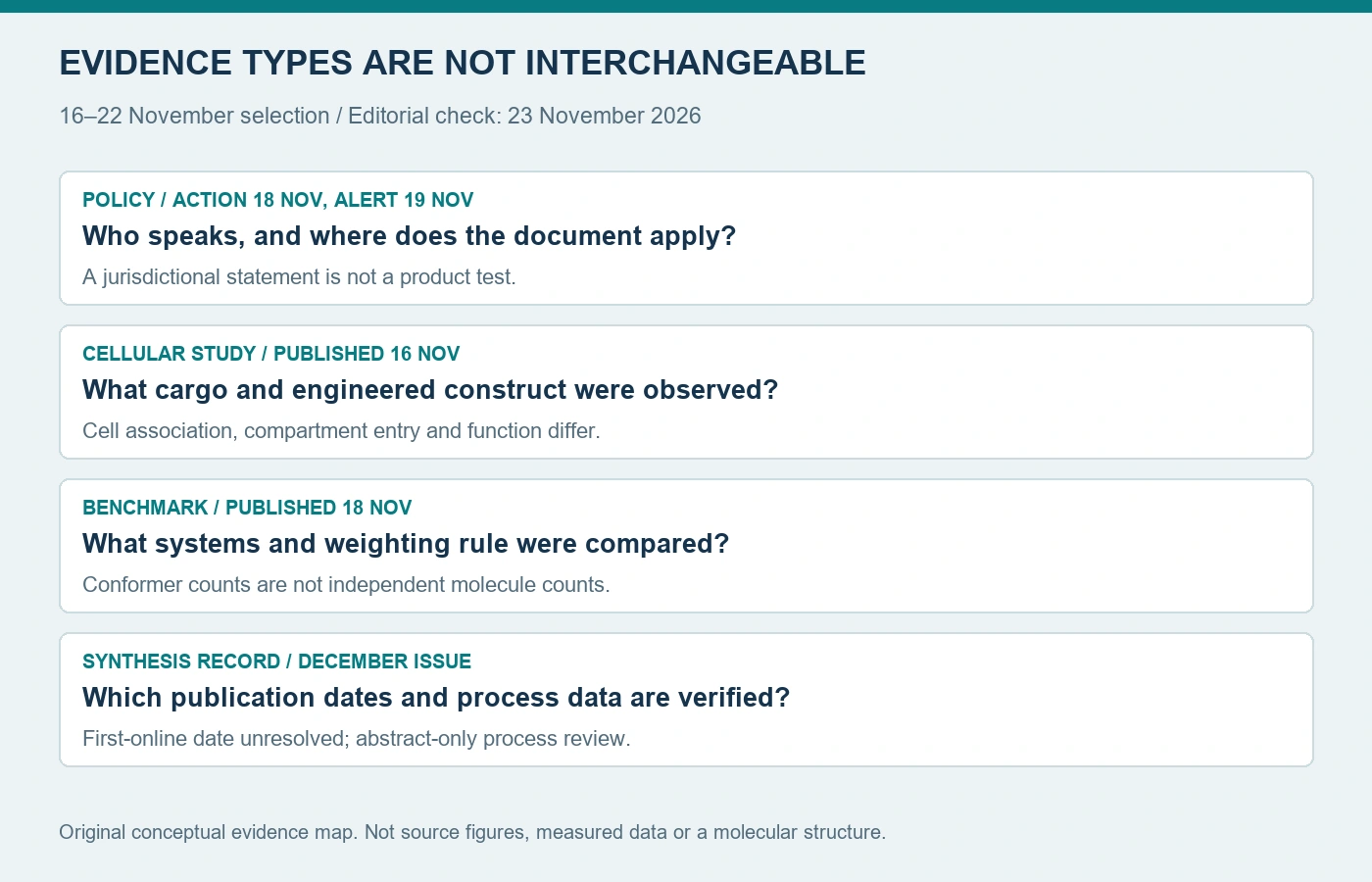
| Record | Date basis | Evidence type | Keep separate |
|---|---|---|---|
| Kentucky alert | 19 Nov; action 18 Nov | Board communication | State and federal scope |
| Microcondensates | Published 16 Nov | Cellular research | Entry and cargo function |
| QVib | Published 18 Nov | Simulation benchmark | Conformers and molecules |
| Cyclization record | Dec issue citation | Original abstract | Conversion and recovery |
Kentucky’s dated alert makes jurisdiction part of the record
What changed: the Kentucky Board of Pharmacy’s 19 November alert describes its 18 November decision to enforce 201 KAR 2:076 as written and decline the relevant waivers. The board states that federal enforcement discretion does not supersede Kentucky requirements or authorize the covered compounding in or into the state. Its audience includes resident and nonresident permit holders. The document discusses six substances and distinguishes enforcement priorities from approval. This is the board’s stated position in a dated communication, not our independent legal determination. Kentucky Board of Pharmacy, Compliance Alert, 19 November 2026.
Editorial implication: a useful policy summary needs more than the name of a molecule. Write down the issuer, audience, activity, territory and document status before summarizing a change. Those fields prevent a headline about one authority’s position from quietly becoming a worldwide claim. The practical question for this research publication is how accurately the source is described, rather than how a reader might obtain a clinical preparation.
A hypothetical document register illustrates the distinction. Record A has an announcement date, while Record B contains an implementation date. A timeline that sorts only by the newest web timestamp can reverse the order in which the underlying actions occurred. Keeping both fields makes the sequence auditable. The same discipline applies when an old document is reposted on a new page: visibility has changed, but that alone does not establish a new decision.
This item therefore updates the regulatory context of the series without presenting a new analytical finding. It supplies no measurement of identity, impurity composition or stability for any commercial material. Readers should consult the linked authority for the current document and its cited requirements. The report is not a destination-by-destination assessment of cross-border sales.
Engineered microcondensates put construct identity at the center of cellular delivery
What the original record reports: Kawaguchi and colleagues describe engineered IgGs with negatively charged tags combined with a trimeric membrane-permeabilizing peptide construct, FcB(L17E)3. The work examines cytosolic antibody entry under defined salt and serum conditions and uses live-cell imaging to investigate the process. The authors compare tag designs and distinguish complex formation from delivery behavior. The publication date is 16 November, rather than its earlier acceptance date. Our review used the accessible original abstract, introduction and indexed experimental passages; it was not a reanalysis of all supplementary movies or source data. Kawaguchi et al., Nature Communications, 2026, DOI 10.1038/s41467-026-78720-5.
Editorial interpretation: describe a multicomponent system as a multicomponent system. A cargo, tag, carrier architecture and measurement method are separate entities. Substituting a familiar peptide name for the full construct would erase the part of the experiment that actually distinguishes one preparation from another. A shared sequence fragment does not by itself make two assemblies equivalent.
For a deliberately invented reading exercise, imagine a preparation in which 60 of 100 observed cells have detectable cell-associated label, 25 have a validated cytosolic signal and 10 satisfy a separate cargo-function criterion. These are three stipulated observations with three definitions. Reporting 60% as functional delivery would collapse distinct endpoints. Conversely, the functional endpoint might be measured in a selected subset, which would introduce another denominator. None of these numbers comes from the paper.
The exercise shows what to preserve when comparing studies: the population counted, the compartment resolved and the rule for classifying a positive result. A clear figure can guide a question, but an image is not a substitute for knowing what was counted. The study is interesting precisely as an engineered research platform. This issue does not turn it into a general delivery claim about unrelated peptides, a validated human application or a purchasing recommendation.
QVib expands a benchmark, while keeping the test set in view
What was published: the 18 November paper by Suárez-Dou and colleagues evaluates machine-learned force fields using vibrational and conformational comparisons across molecular systems. Its QVib dataset includes 293 molecules and 1,366 conformers, alongside peptide and protein-related benchmarks. The original abstract reports improvements over the evaluated molecular-mechanics models and a favorable accuracy–cost balance for SO3LR among the models tested. This is a bounded comparison, not a statement about every model or material. We reviewed the original indexed abstract, introductory passage and publisher metadata; the complete trajectories and supplementary datasets were not independently rerun. Suárez-Dou et al., Nature Communications, 2026, DOI 10.1038/s41467-026-79241-x.
What a research reader can check: separate a dataset’s chemical coverage from the number of configurations it contains. An average across conformers need not give each molecule the same weight. The unit over which an error is averaged is therefore part of the result’s meaning, even before considering how well a model transfers beyond the benchmark.
Consider an invented two-molecule example. Molecule A contributes 90 conformers, each with an error of 1 arbitrary unit. Molecule B contributes 10 conformers, each with an error of 9. A conformer-weighted average is (90 × 1 + 10 × 9)/100 = 1.8. Giving the two molecule-level averages equal weight produces (1 + 9)/2 = 5. Both arithmetic operations are correct; they answer different questions. This example is not a calculation from QVib, an estimate of its performance or a criticism of its authors’ analysis.
A useful benchmark description should accordingly name the target being predicted, the comparison reference, aggregation rule and tested systems. Matching one type of observable also leaves other questions open. Computational agreement does not measure the identity or purity of a vial on a shelf. Related background is available in our Raman and infrared interpretation guide, which explains why the optical observable itself must be specified.
A synthesis abstract warrants attention without an invented release date
Record reviewed this issue: Patael and colleagues’ cagrilintide-precursor paper is listed as Journal of Peptide Science 32(12), e70143, December 2026, PMID 43046637. The original abstract describes on-resin disulfide cyclization and reports complete conversion for its stated substrate and conditions. Authors are affiliated with TAPI; this is an industry-affiliated original research report, not independent verification of HealthyWelness products. A December issue label is not proof that the paper first became public in December. Its first-online date remains unconfirmed here, so it is not counted as a fourth newly dated event in the 16–22 November window. Full methods, impurity data and supplementary information were not reviewed. Patael et al., Journal of Peptide Science, 2026, DOI 10.1002/psc.70143.
The analytical question is what follows a reaction endpoint. Starting-material disappearance, desired-product formation, isolated recovery and chemical identity are different measurements. A hypothetical synthesis beginning with 100 units could show no remaining starting material, yet distribute those units among several products. If 80 units are desired material and 60 are ultimately recovered, disappearance is complete while desired formation and isolated recovery have different values. A structural assignment still requires its own evidence. This is an invented mass-accounting example, not a reconstruction of the reported experiment.
That distinction matters when an abstract supplies a concise outcome without the complete process record. It is appropriate to report the stated observation and identify what was not inspected. It is inappropriate to fill missing isolation or impurity information with an assumption. Our reaction identity and yield guide develops the denominator problem using a different chemical reaction; it is background rather than evidence for this paper.
Open questions worth carrying into the next issue
- Does a subsequent authority communication change the scope or status of the Kentucky position? A later development should be linked and dated, rather than silently folded into this issue.
- Which cargo, construct and observation conditions can support a meaningful comparison with an engineered delivery system? Similar names alone cannot answer that question.
- How do benchmark conclusions change across chemical families, configuration weighting and genuinely external tests? A single aggregate score does not specify those comparisons.
- Can the synthesis paper’s first-online date and full process evidence be verified? The open questions concern access and interpretation, not an assumed defect in the research.
Questions about this week’s evidence
Does a federal enforcement statement establish the rules everywhere?
No. A policy account must retain its issuer, audience, territory, activity and current status. This issue reports a particular board communication and does not provide a universal legal conclusion.
Does cell-associated signal necessarily demonstrate functional cytosolic delivery?
No. Association, compartment-resolved entry and cargo function are distinct observations. A comparison needs the endpoint definitions and denominators used for each measurement.
Are conformers equivalent to independent molecules in a benchmark?
No. Different configurations of one chemical identity are not different chemical identities. The weighting unit can change an average and should be reported.
Does complete starting-material conversion establish isolated product purity?
No. Disappearance, product formation, recovery and identity require separate evidence. An abstract’s concise outcome should not be expanded into unreported measurements.
Has HealthyWelness independently validated these research systems?
No. This issue is an editorial review of public source material within the access limits stated. It reports no testing of our catalog materials and makes no clinical or manufacturing qualification claim.
Scope and related reading
The reporting window is 16–22 November 2026; the editorial check is dated 23 November. The three dated core developments are separated from the synthesis record whose first-online date is unresolved. The selected sources are not a complete survey of every peptide-related publication. Older context is not counted as a fresh federal action, and no company announcement has been substituted for independent participant results.
For continuing context, read the previous weekly issue, explore the peptide-science navigation, or use the material-document enquiry page for available records. A research article does not constitute a batch COA. All discussion remains within laboratory research and evidence interpretation; no human or veterinary use, administration or efficacy recommendation is provided.
Sources
- Kentucky Board of Pharmacy. Compliance alert dated 19 November 2026; board action 18 November.
- Kawaguchi Y, et al. Engineered antibody–peptide microcondensates. Nature Communications. Published 16 November 2026. DOI 10.1038/s41467-026-78720-5.
- Suárez-Dou S, et al. Vibrational and conformational benchmarking with machine-learned force fields. Nature Communications. Published 18 November 2026. DOI 10.1038/s41467-026-79241-x.
- Patael S, et al. On-resin cagrilintide-precursor disulfide cyclization. J Pept Sci. 2026 Dec;32(12):e70143. PMID 43046637; original abstract reviewed, first-online date unconfirmed.