Pramlintide Mechanism of Action: Amylin Analog vs Cagrilintide
How pramlintide acts as an amylin analog: proline substitutions, AMY receptors, area postrema signalling, and how the receptor profile of cagrilintide differs.


Cover illustration: AI-generated editorial artwork. Conceptual only; not an exact molecular structure, actual laboratory result or evidence of clinical effects.
Pramlintide is a synthetic analogue of the pancreatic hormone amylin that activates amylin receptors, slowing gastric emptying and suppressing post-meal glucagon through central pathways that include the area postrema. Three proline substitutions keep it from aggregating like human amylin. Cagrilintide, a later lipidated analogue, keeps the amylin-like binding mode but also activates the calcitonin receptor and has a far longer reported half-life.
For laboratory research use only. The research materials supplied by HealthyWelness are not approved medicines, foods or cosmetics and are not for human or veterinary use. This article summarises published research and is not medical advice.
- Pramlintide carries proline substitutions at positions 25, 28 and 29 of human amylin, which limit the self-aggregation of the native hormone (BioDrugs drug profile, 2003).
- Amylin receptors are heterodimers of the calcitonin receptor and one of three receptor activity-modifying proteins, forming AMY1R, AMY2R and AMY3R (Cao et al., 2022).
- In a 25-endpoint receptor pharmacology study, pramlintide was classed as amylin-receptor selective, while cagrilintide (AM833) acted as a nonselective amylin and calcitonin receptor agonist (Fletcher et al., 2021).
- The reported elimination half-life of pramlintide in patients was 30-50 minutes (McQueen, 2005); the reported half-life of cagrilintide in humans was 159-195 hours (Enebo et al., 2021).
- In 12 people with type 1 diabetes, pramlintide lowered postprandial glucagon excursions and meal glucose appearance without changing insulin sensitivity indices (Hinshaw et al., 2016).
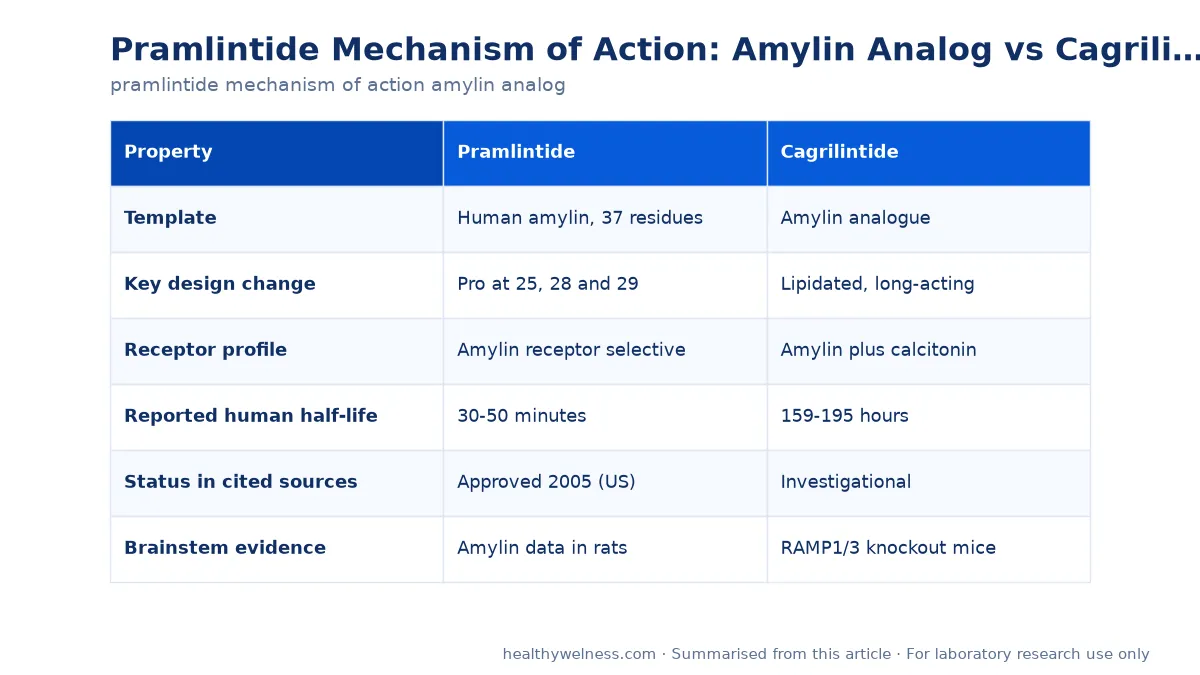
Pramlintide and cagrilintide at a glance
| Property | Pramlintide | Cagrilintide |
|---|---|---|
| Template | Human amylin, 37 residues | Amylin analogue |
| Key design change | Pro at 25, 28 and 29 | Lipidated, long-acting |
| Receptor profile | Amylin receptor selective | Amylin plus calcitonin |
| Reported human half-life | 30-50 minutes | 159-195 hours |
| Status in cited sources | Approved 2005 (US) | Investigational |
| Brainstem evidence | Amylin data in rats | RAMP1/3 knockout mice |
We do not supply pramlintide. The research material referenced here is the cagrilintide research peptide, which is discussed because it is a lipidated amylin analogue that binds the same calcitonin receptor and RAMP complexes as pramlintide and additionally activates the calcitonin receptor on its own. A full profile of the stocked compound is in what cagrilintide is.
Why amylin needed to be redesigned before it could be studied as a drug
Amylin is a 37-amino-acid pancreatic beta-cell hormone, and Hay and colleagues describe it primarily as a glucoregulatory hormone that also regulates energy metabolism. Its practical problem is physical rather than pharmacological. Human amylin readily forms amyloid fibrils, a property Kruse and colleagues describe as the hallmark that makes amylin a challenging starting point for drug design.
Rodents offered a clue. Rat amylin differs from the human sequence at six residues and does not form amyloid fibrils, and pramlintide borrows three of those differences: prolines at positions 25, 28 and 29. The 2026 review by Bailey and colleagues describes pramlintide as based on the structure of non-aggregating rat amylin. Chiu and colleagues note that the three prolines were already known to attenuate beta-sheet formation, the conformation that underlies fibrils.
They then tested how much each proline contributes, using molecular simulations with bias-exchange metadynamics on the full-length human amylin monomer. Human amylin sampled several beta-sheet conformations, some matching those reported experimentally. The proline substitutions perturbed long beta-sheets and reduced their stability, and the key result was that all three were required: only the triple substitution suppressed beta conformations and stabilised the alpha-helical form, while fewer substitutions had no significant inhibiting effect. That simulation result explains why the analogue carries three changes rather than one.
What receptors does an amylin analogue act on?
Amylin does not have a single dedicated receptor gene. Its receptors are formed when the calcitonin receptor, a class B G protein-coupled receptor, pairs with a receptor activity-modifying protein (RAMP). Three RAMPs give three amylin receptor subtypes, AMY1R, AMY2R and AMY3R. The calcitonin receptor without a RAMP is a separate target that responds to calcitonin.
Cao and colleagues solved cryo-electron microscopy structures of active amylin receptors bound to amylin and to calcitonin peptides. Amylin-bound complexes looked similar across all three subtypes, constrained by the RAMP and by an ordered mid-peptide segment the authors called the bypass motif. Calcitonin-bound amylin receptor complexes were distinct and overlapped calcitonin receptor complexes. Their conclusion was that amylin-based and calcitonin-based peptides activate the same receptors in different ways, which matters when comparing analogues built on different templates.
| Target | Composition | Pramlintide | Cagrilintide |
|---|---|---|---|
| AMY1R | CTR + RAMP1 | Agonist | Agonist |
| AMY2R | CTR + RAMP2 | Agonist | Agonist |
| AMY3R | CTR + RAMP3 | Agonist | Agonist |
| CTR alone | Calcitonin receptor | Not targeted (AMY-selective) | Agonist |
The selectivity labels in that table come from Fletcher and colleagues, who profiled cagrilintide (then coded AM833) across 25 endpoints of binding, activation and receptor regulation. They placed pramlintide among amylin-receptor selective agonists and salmon calcitonin and AM833 among nonselective agonists, and reported that AM833 had a unique pharmacological profile within that panel.
How does pramlintide slow gastric emptying and suppress glucagon?
The clinical pharmacology of pramlintide rests on two measurable actions after a meal. McQueen’s 2005 review summarises trials in which pramlintide suppressed post-meal glucagon secretion and slowed gastric emptying, and records approval in March 2005 as an adjunct to insulin in type 1 and type 2 diabetes.
Young’s review of the gastric emptying literature explains how that action was found. Early infusion studies showed blunted postprandial glucose with oral but not intravenous glucose, pointing to slower delivery of the meal rather than faster glucose disposal. Gastric emptying was then measured three ways: dye remaining in excised stomachs in animals, appearance of labelled tracers such as acetaminophen, and gamma-camera scintigraphy in people with type 1 diabetes and in volunteers without diabetes. In rats, amylin was 15-fold more potent than GLP-1 on a molar basis for inhibiting gastric emptying and was the most potent of 21 mammalian peptides tested, and the effect appears to be centrally mediated.
Hinshaw and colleagues separated these components in a randomised crossover study of 12 people with type 1 diabetes using a triple-tracer mixed meal. With pramlintide, 2-hour plasma glucose, insulin and glucagon excursions were lower, the meal rate of glucose appearance was lower, and endogenous glucose production was not different. Insulin sensitivity and liver insulin sensitivity were also unchanged. The authors attributed the smaller glucose excursions to glucagon inhibition and delayed gastric emptying slowing meal glucose appearance.
The area postrema is the best-mapped site of amylin action
Hay and colleagues note that amylin acts principally in the circumventricular organs, brain regions with a permeable blood-brain barrier where circulating hormones reach neurons directly. The area postrema in the brainstem is the most studied of these.
Potes and colleagues mapped which area postrema neurons respond. In rats, roughly half of the neurons activated by amylin, marked by c-Fos, were noradrenergic. When those neurons were lesioned with a saporin toxin targeted to dopamine-beta-hydroxylase, rats no longer reduced food intake in response to the lower amylin amount tested, and amylin-induced c-Fos in the area postrema and nucleus of the solitary tract was no longer significantly increased.
Carvas and colleagues extended the receptor question to cagrilintide. In mice lacking RAMP1 and RAMP3, fed a high-fat diet for 23 weeks before 3 weeks of treatment, area postrema c-Fos after cagrilintide was 57% lower than in wild-type littermates. Both cagrilintide and salmon calcitonin activated neurons of the dorsal vagal complex and lateral parabrachial nucleus in wild-type mice, and the authors concluded that cagrilintide depends on AMY1R and AMY3R for its body weight effect in this model.
What changed between pramlintide and cagrilintide?
Kruse and colleagues state the motivation directly: pramlintide’s short half-life was its practical limitation, and they report the structure-activity work that produced cagrilintide as a stable, lipidated, long-acting analogue selected for clinical development. In the phase 1b trial (NCT03600480) of 96 randomised adults with overweight or obesity, the reported half-life of cagrilintide was 159-195 hours across the doses tested, with exposure proportional to dose (Enebo et al., 2021). Development of the stocked peptide is followed in cagrilintide research, and its pairing with a GLP-1 analogue in cagrilintide and semaglutide.
The second change is receptor coverage. Pramlintide is amylin-receptor selective; cagrilintide also activates the calcitonin receptor alone. Fletcher and colleagues note that selective calcitonin receptor activation on its own is not efficacious, while amylin receptor agonists that also act at the calcitonin receptor may be more effective, which is the rationale for the dual profile. At the structural level, a 2025 cryo-EM study from the same Monash group (Cao et al.) found that cagrilintide adopts an amylin-like binding mode yet induces distinct conformational dynamics at calcitonin-family receptors.
Handling amylin analogues in the lab
The aggregation behaviour that shaped pramlintide is also the main handling consideration for any amylin analogue. Reconstituted solutions are best prepared at a defined concentration in mg/mL from the net peptide content on the certificate, mixed gently rather than vortexed, and inspected for turbidity before use. The peptide calculator converts vial mass and diluent volume into solution concentration, and stocked-material steps are in cagrilintide reconstitution. Certificates are available for listed products — contact us for the latest report.
Related research
Readers comparing the two analogues may also want the structural background in the cagrilintide profile linked above. For the broader class, the 2026 review by Bailey and colleagues traces the line from pramlintide to a second generation of non-aggregating, long-acting amylin analogues and dual amylin and calcitonin receptor agonists.
Frequently asked questions
What makes pramlintide different from human amylin?
Pramlintide is a synthetic analogue of the 37-residue hormone human amylin with proline substitutions at positions 25, 28 and 29, which limit the self-aggregation seen with native amylin (BioDrugs drug profile, 2003). Rat amylin, which does not form amyloid fibrils, carries prolines at the same three positions (Chiu et al., 2013).
Which receptors does pramlintide act on?
Amylin receptors, which are heterodimers of the calcitonin receptor with one of three receptor activity-modifying proteins, giving AMY1R, AMY2R and AMY3R (Cao et al., 2022). In a 25-endpoint pharmacology comparison, pramlintide was classed as amylin-receptor selective, whereas cagrilintide (AM833) was nonselective across amylin and calcitonin receptors (Fletcher et al., 2021).
How does pramlintide lower postprandial glucose in published studies?
Through suppressed glucagon and slower gastric emptying rather than altered insulin sensitivity. In a crossover study of 12 people with type 1 diabetes, pramlintide lowered 2-hour postprandial glucagon excursions and meal glucose appearance, while endogenous glucose production and insulin sensitivity indices were not different (Hinshaw et al., 2016).
Where in the brain does amylin act?
Mainly in circumventricular organs, with the area postrema the best-studied site (Hay et al., 2015). In rats, about half of the area postrema neurons activated by amylin were noradrenergic, and lesioning those neurons blunted amylin’s effect on food intake (Potes et al., 2010).
How does the half-life of pramlintide compare with cagrilintide?
Pramlintide’s reported elimination half-life in patients was 30-50 minutes (McQueen, 2005). Cagrilintide’s reported half-life in humans was 159-195 hours across the doses tested in a phase 1b trial (Enebo et al., 2021). The short half-life of pramlintide was the limitation that the lipidated cagrilintide design addressed (Kruse et al., 2021).
For laboratory research use only. The research materials supplied by HealthyWelness are not approved medicines, foods or cosmetics and are not for human or veterinary use. This article summarises published research and is not medical advice.
Sources
- Anonymous. Pramlintide: (AC 137, AC 0137, Symlin, Tripro-Amylin). BioDrugs. 2003. PMID: 12534323
- Chiu CC, et al. Effect of proline mutations on the monomer conformations of amylin. Biophys J. 2013. PMID: 24010666
- Hay DL, et al. Amylin: Pharmacology, Physiology, and Clinical Potential. Pharmacol Rev. 2015. PMID: 26071095
- McQueen J. Pramlintide acetate. Am J Health Syst Pharm. 2005. PMID: 16278328
- Hinshaw L, et al. Effect of Pramlintide on Postprandial Glucose Fluxes in Type 1 Diabetes. J Clin Endocrinol Metab. 2016. PMID: 26930181
- Young A. Inhibition of gastric emptying. Adv Pharmacol. 2005. PMID: 16492543
- Potes CS, et al. Noradrenergic neurons of the area postrema mediate amylin's hypophagic action. Am J Physiol Regul Integr Comp Physiol. 2010. PMID: 20554938
- Cao J, et al. A structural basis for amylin receptor phenotype. Science. 2022. PMID: 35324283
- Fletcher MM, et al. AM833 Is a Novel Agonist of Calcitonin Family G Protein-Coupled Receptors: Pharmacological Comparison with Six Selective and Nonselective Agonists. J Pharmacol Exp Ther. 2021. PMID: 33727283
- Kruse T, et al. Development of Cagrilintide, a Long-Acting Amylin Analogue. J Med Chem. 2021. PMID: 34288673
- Carvas AO, et al. Cagrilintide lowers bodyweight through brain amylin receptors 1 and 3. EBioMedicine. 2025. PMID: 40609154
- Enebo LB, et al. Safety, tolerability, pharmacokinetics, and pharmacodynamics of concomitant administration of multiple doses of cagrilintide with semaglutide 2·4 mg for weight management: a randomised, controlled, phase 1b trial. Lancet. 2021. PMID: 33894838
- Bailey CJ, et al. Long-acting amylin-related peptides as therapies for obesity and type 2 diabetes. Peptides. 2026. PMID: 41747885