Tirzepatide Structure: Sequence, Aib Residues and the C20 Chain
Tirzepatide is a 39-residue GIP-based peptide with two Aib residues, a C-terminal amide and a C20 fatty diacid on lysine 20. What each feature is for.


Cover illustration: AI-generated editorial artwork. Conceptual only; not an exact molecular structure, actual laboratory result or evidence of clinical effects.
Tirzepatide is a linear 39-amino-acid peptide based on the GIP sequence, carrying two aminoisobutyric acid (Aib) residues, an amidated C-terminus and a C20 fatty diacid attached to lysine 20. Its formula is C225H348N48O68 and its molecular weight 4813.53 Da. Each modification has a defined job: protease resistance, receptor tuning or albumin binding.
For laboratory research use only. The research materials supplied by HealthyWelness are not approved medicines, foods or cosmetics and are not for human or veterinary use. This article summarises published research and is not medical advice.
- Tirzepatide (LY3298176) is a fatty acid modified peptide with dual GIP and GLP-1 receptor agonist activity, designed for once-weekly administration (Coskun et al., 2018).
- Tirzepatide is a synthetic analogue of human GIP with a C20 fatty diacid that binds albumin, giving a half-life of about five days (Chavda et al., 2022).
- Tirzepatide’s molecular formula is C225H348N48O68 and its molecular weight 4813.53 Da.
- At the GLP-1 receptor, tirzepatide favours cAMP generation over beta-arrestin recruitment and drives less receptor internalisation than GLP-1 (Willard et al., 2020).
- Compared with native peptides and semaglutide, tirzepatide preserved maximal cAMP despite partial G-alpha-s recruitment (Novikoff et al., 2021).
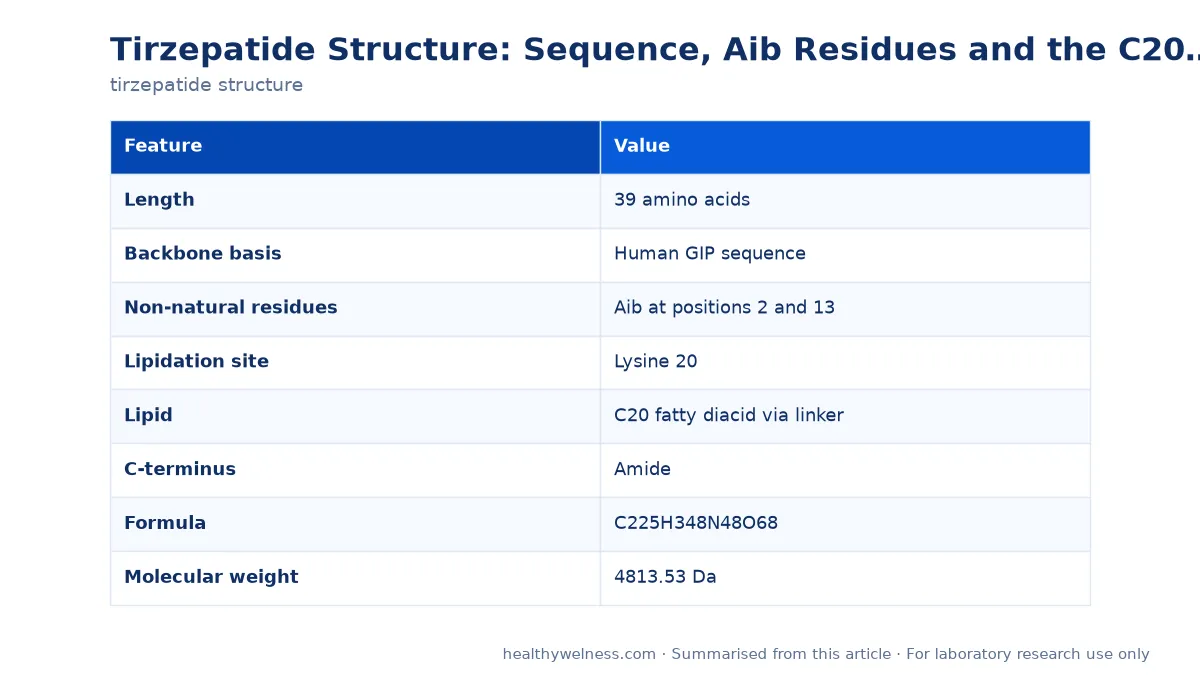
Quick facts
| Feature | Value |
|---|---|
| Length | 39 amino acids |
| Backbone basis | Human GIP sequence |
| Non-natural residues | Aib at positions 2 and 13 |
| Lipidation site | Lysine 20 |
| Lipid | C20 fatty diacid via linker |
| C-terminus | Amide |
| Formula | C225H348N48O68 |
| Molecular weight | 4813.53 Da |
The molecular weight refers to the free peptide. Material in a vial also contains counter-ions and residual water, so the net peptide figure on the certificate is the right starting point for any concentration calculation. Our tirzepatide research peptide is supplied as a lyophilised powder.
Certificates are available for listed products — contact us for the latest report.
The sequence, region by region
Written in one-letter code, with Aib shown as X and the lipidated lysine marked, the sequence is:
Y X E G T F T S D Y S I X L D K I A Q K* A F V Q W L I A G G P S S G A P P P S-NH2
| Region | Positions | Feature | Function |
|---|---|---|---|
| N-terminus | 1–2 | Tyr, then Aib | Receptor activation, DPP-4 block |
| Mid-helix | 3–19 | Aib at 13 | Helix and receptor tuning |
| Lipid anchor | 20 | Lys + C20 diacid | Albumin binding |
| C-terminal helix | 21–29 | Includes Trp25 | Receptor binding |
| Tail | 30–39 | Pro-rich, amidated | Stability, receptor contact |
The N-terminal region is where incretin peptides activate their receptors, and it is also where they are most vulnerable: native GIP and GLP-1 lose their first two residues to dipeptidyl peptidase-4 within minutes. Placing Aib, which has two methyl groups on its alpha carbon, at position 2 blocks that cleavage. The second Aib at position 13 sits within the helical region and influences both helix stability and how the peptide balances its two receptor activities.
Why a fatty acid chain changes everything
A 39-residue peptide without modification would be cleared by the kidneys and broken down by proteases within hours. The C20 fatty diacid on lysine 20 changes that. Chavda and colleagues describe how this acylation lets tirzepatide bind albumin, giving a half-life of about five days that suits once-weekly administration (Chavda et al., 2022). The discovery paper confirmed that the pharmacokinetic profile across a wide dose range in phase 1 supported weekly use (Coskun et al., 2018).
| Property | Unmodified peptide (expected) | Tirzepatide |
|---|---|---|
| Binding partner in plasma | None | Albumin |
| Renal filtration | Rapid | Limited while bound |
| Reported half-life | Short | About 5 days |
| Solution behaviour | Simple | Amphiphilic |
The lipid is a 20-carbon dicarboxylic acid, 1,20-eicosanedioic acid, attached through a hydrophilic linker rather than directly to the lysine side chain. The free carboxylic acid at the far end of the chain is what interacts with albumin’s fatty-acid binding sites, and the linker holds the lipid far enough from the peptide backbone that receptor binding is not obstructed. Changing either the chain length or the linker is one of the main levers medicinal chemists use to tune how long an acylated peptide circulates.
The lipid also makes the molecule amphiphilic: a water-soluble peptide with a long hydrophobic tail. That has consequences on the bench as well as in the circulation, covered under handling below.
How the structure produces dual, imbalanced activity
Tirzepatide began as a GIP analogue engineered to engage the GLP-1 receptor too. In vitro it activated both receptors, and in mice it acted through both to improve glucose tolerance (Coskun et al., 2018). Willard and colleagues then showed that the two activities are not equal. Using a method for calculating receptor occupancy at clinically effective exposures, they found greater engagement of the GIP receptor than the GLP-1 receptor. At the GIP receptor tirzepatide mimicked native GIP; at the GLP-1 receptor it favoured cAMP over beta-arrestin recruitment and was weaker at driving receptor internalisation than GLP-1 (Willard et al., 2020).
Novikoff and colleagues added a trafficking dimension. Relative to native and acylated GLP-1 agonists, both tirzepatide and another dual agonist preserved maximal cAMP production despite only partial G-alpha-s recruitment and showed reduced ligand-induced internalisation at both receptors. The authors concluded that the structure of GLP-1/GIP dual agonists confers a biased agonism that also modulates receptor trafficking (Novikoff et al., 2021). In structural terms, small differences in the peptide sequence translate into differences in how long receptors stay active at the cell surface.
From structure to clinical testing
The structure was carried into a phase 3 programme. In SURPASS-1 (NCT03954834), 478 adults with type 2 diabetes inadequately controlled by diet and exercise were randomised to tirzepatide or placebo for 40 weeks; all tirzepatide groups reduced HbA1c more than placebo, gastrointestinal events were the most frequent adverse events, and no clinically significant hypoglycaemia was reported (Rosenstock et al., 2021). Mechanistic detail is in how tirzepatide works.
Using the structure to check identity and integrity
Knowing the sequence lets a laboratory predict what a mass spectrum should show and which changes to look for. Electrospray ionisation of a peptide this size gives a series of multiply charged ions. The values below are calculated from the average molecular weight of 4813.53 Da by adding one proton mass (1.008) per charge.
| Ion | Calculated m/z |
|---|---|
| [M+3H]3+ | ~1605.5 |
| [M+4H]4+ | ~1204.4 |
| [M+5H]5+ | ~963.7 |
The sequence also points to the residues most likely to change during storage. These are general peptide chemistry liabilities, read off the sequence rather than measured for tirzepatide specifically.
| Residue | Position | Possible change | Mass shift |
|---|---|---|---|
| Trp | 25 | Oxidation | +16 or +32 Da |
| Gln | 19, 24 | Deamidation | +0.98 Da |
| Asp | 9, 15 | Isomerisation | None (needs HPLC) |
| Tyr | 1, 10 | Oxidation | +16 Da |
The last two columns show why mass spectrometry alone is not a complete integrity check. Deamidation changes the mass by less than one dalton, which on a 4.8 kDa molecule needs a high-resolution instrument to see, and aspartate isomerisation does not change the mass at all; reversed-phase HPLC, which separates such variants by retention time, complements the mass measurement. The general logic of these checks is explained in how to read a peptide COA.
Handling in the lab
The amphiphilic structure is the main handling consideration. Lipidated peptides can self-associate and adsorb to surfaces, so dissolution is done gently, without vigorous shaking, and solutions are kept cold. Identity is confirmed by mass spectrometry against the expected mass; because the molecule is large, the spectrum shows multiply charged ions that are deconvoluted to give the parent mass. Concentration is calculated from net peptide content with the peptide calculator, and the full procedure is in how to reconstitute tirzepatide.
Related research
The compound overview is what is tirzepatide, and the physical form of the dry material is covered in tirzepatide powder. Its reported pharmacokinetics are in tirzepatide half-life.
Frequently asked questions
What is the structure of tirzepatide?
Tirzepatide is a linear 39-amino-acid peptide built on the GIP sequence, with aminoisobutyric acid (Aib) at positions 2 and 13, an amidated C-terminus, and a C20 fatty diacid attached to lysine 20 through a linker. Its formula is C225H348N48O68 and its molecular weight 4813.53 Da.
Why does tirzepatide contain aminoisobutyric acid?
Aib is a non-natural amino acid with two methyl groups on its alpha carbon. At position 2 it blocks the cleavage by dipeptidyl peptidase-4 that rapidly inactivates native GIP and GLP-1; at position 13 it influences helical structure and receptor activity.
What does the fatty acid chain do?
The C20 fatty diacid binds serum albumin, which slows clearance and gives tirzepatide a half-life of about five days, appropriate for once-weekly administration in trials (Chavda et al., 2022).
How does the structure produce dual receptor activity?
The peptide is a GIP analogue engineered to also activate the GLP-1 receptor. Pharmacologically it mimics native GIP at the GIP receptor but is biased toward cAMP over beta-arrestin at the GLP-1 receptor, and it engages the GIP receptor more (Willard et al., 2020).
Does the structure change how receptors are internalised?
Yes, compared with native ligands. Tirzepatide preserved maximal cAMP production despite partial G-alpha-s recruitment and caused less receptor internalisation at both GIP and GLP-1 receptors than native peptides or semaglutide (Novikoff et al., 2021).
For laboratory research use only. The research materials supplied by HealthyWelness are not approved medicines, foods or cosmetics and are not for human or veterinary use. This article summarises published research and is not medical advice.
Sources
- Coskun T, et al. LY3298176, a novel dual GIP and GLP-1 receptor agonist for the treatment of type 2 diabetes mellitus: From discovery to clinical proof of concept. Mol Metab. 2018. PMID: 30473097
- Chavda VP, et al. Tirzepatide, a New Era of Dual-Targeted Treatment for Diabetes and Obesity: A Mini-Review. Molecules. 2022. PMID: 35807558
- Willard FS, et al. Tirzepatide is an imbalanced and biased dual GIP and GLP-1 receptor agonist. JCI Insight. 2020. PMID: 32730231
- Novikoff A, et al. Spatiotemporal GLP-1 and GIP receptor signaling and trafficking/recycling dynamics induced by selected receptor mono- and dual-agonists. Mol Metab. 2021. PMID: 33556643
- Rosenstock J, et al. Efficacy and safety of a novel dual GIP and GLP-1 receptor agonist tirzepatide in patients with type 2 diabetes (SURPASS-1): a double-blind, randomised, phase 3 trial. Lancet. 2021. PMID: 34186022