Semaglutide vs Tirzepatide: What Is the Difference?
Semaglutide (often misspelled semiglutide) is a GLP-1 analogue; tirzepatide adds GIP agonism. Structure, receptor bias and the SURMOUNT-5 trial explained.


Cover illustration: AI-generated editorial artwork. Conceptual only; not an exact molecular structure, actual laboratory result or evidence of clinical effects.
Semaglutide is a single-receptor GLP-1 analogue; tirzepatide is a dual agonist that activates the GIP receptor as well as the GLP-1 receptor. Both are acylated peptides built for once-weekly administration, and two open-label phase 3 trials have compared them directly. “Semiglutide” is a misspelling of semaglutide.
For laboratory research use only. The research materials supplied by HealthyWelness are not approved medicines, foods or cosmetics and are not for human or veterinary use. This article summarises published research and is not medical advice.
- Semaglutide differs from human GLP-1 by two amino acid substitutions (Aib8, Arg34) and is derivatized at lysine 26 with a fatty acid moiety that increases albumin binding (Lau et al., 2015).
- Receptor-occupancy modelling found tirzepatide engages the GIP receptor more than the GLP-1 receptor, an imbalanced profile (Willard et al., 2020).
- In SURMOUNT-5, 751 adults with obesity without type 2 diabetes were randomized to tirzepatide or semaglutide for 72 weeks; mean weight change was −20.2% and −13.7% respectively (Aronne et al., 2025).
- In SURPASS-2, 1879 adults with type 2 diabetes were randomized for 40 weeks, and all three tirzepatide arms were noninferior and superior to semaglutide for HbA1c change (Frías et al., 2021).
First, the spelling
The query that brings many readers here spells the first drug “semiglutide”. The international non-proprietary name is semaglutide, with an “a”. The misspelling matters for anyone searching the literature: PubMed and ClinicalTrials.gov index the correct name, and a search on the misspelled form returns little. Throughout this article the correct spelling is used.
How the two molecules are built
Both drugs are peptides that start from a natural hormone sequence and add chemistry to survive in circulation for about a week. They start from different hormones, though, and that is the root of every other difference.
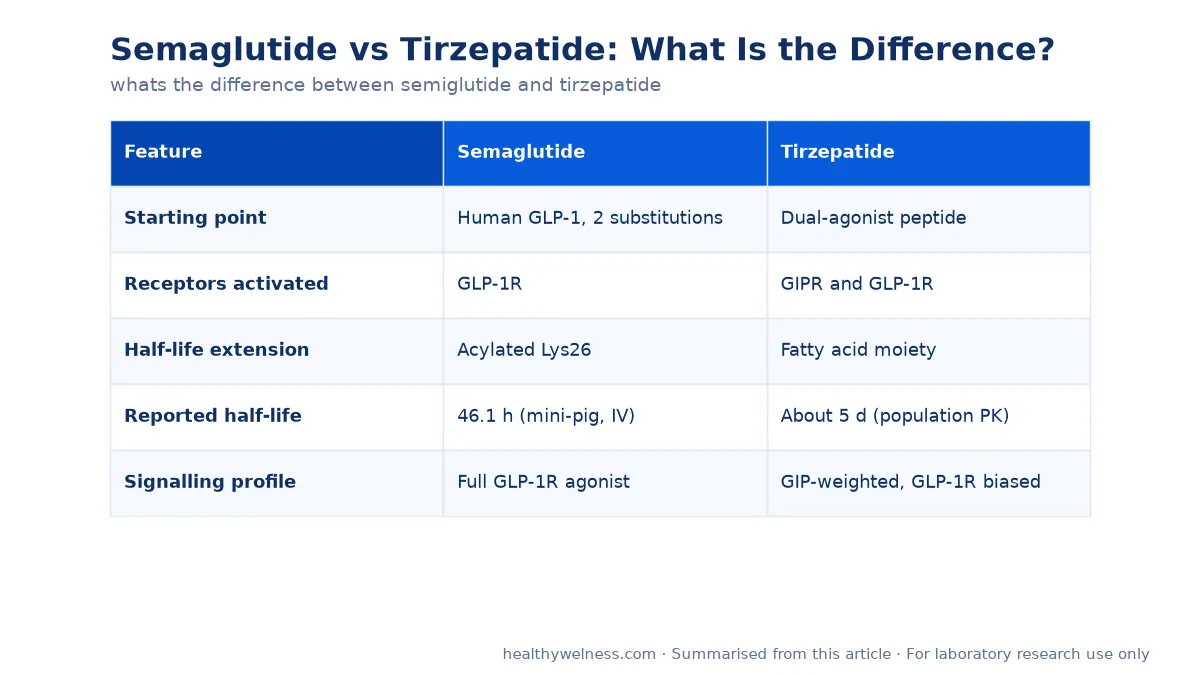
| Feature | Semaglutide | Tirzepatide |
|---|---|---|
| Starting point | Human GLP-1, 2 substitutions | Dual-agonist peptide |
| Receptors activated | GLP-1R | GIPR and GLP-1R |
| Half-life extension | Acylated Lys26 | Fatty acid moiety |
| Reported half-life | 46.1 h (mini-pig, IV) | About 5 d (population PK) |
| Signalling profile | Full GLP-1R agonist | GIP-weighted, GLP-1R biased |
Lau and colleagues described semaglutide as the outcome of a programme to improve on liraglutide, an earlier once-daily GLP-1 analogue. The fatty acid moiety and the linker chemistry were tuned to raise albumin affinity while keeping GLP-1 receptor potency. The result had a GLP-1 receptor affinity of 0.38 nM, three-fold lower than liraglutide, but much higher albumin affinity, a plasma half-life of 46.1 hours in mini-pigs and full stability against metabolic degradation (Lau et al., 2015).
Tirzepatide (LY3298176) was designed from the outset as a single peptide with agonist activity at two receptors, GIP and GLP-1, rather than as an improved version of a single hormone. Its population pharmacokinetics in people, pooled from 19 studies, were described by a two-compartment model with a half-life of about 5 days (Schneck et al., 2024). Structural detail is in tirzepatide structure.
Two receptors, unequally
The phrase “dual agonist” can suggest a molecule that hits two receptors equally hard. Willard and colleagues showed that tirzepatide does not. Calculating receptor occupancy at clinically relevant exposures, they found greater engagement of the GIP receptor than the GLP-1 receptor. At the GIP receptor, tirzepatide signalled much like native GIP. At the GLP-1 receptor, it was biased: it favoured cAMP generation over beta-arrestin recruitment and drove weaker receptor internalisation than GLP-1 itself (Willard et al., 2020).
Semaglutide has no GIP receptor activity. So the comparison is not “one receptor versus two of the same strength” but “a full GLP-1 analogue versus a GIP-weighted molecule with a partial, biased GLP-1 component”. How much of tirzepatide’s effect comes from each receptor remains debated; the mechanism is covered in how tirzepatide works.
What the head-to-head trials found
Unlike many comparisons on this site, this one has direct randomized data. Two trials matter.
| Feature | SURPASS-2 | SURMOUNT-5 |
|---|---|---|
| Population | Type 2 diabetes | Obesity, no diabetes |
| Participants | 1879 | 751 |
| Duration | 40 weeks | 72 weeks |
| Design | Open-label, phase 3 | Open-label, phase 3b |
| Primary end point | HbA1c change | Percent weight change |
| Result | Tirzepatide superior | −20.2% vs −13.7% |
SURPASS-2 randomized adults with type 2 diabetes, mean baseline HbA1c 8.28%, to three tirzepatide arms or one semaglutide arm. HbA1c fell by 2.01 to 2.30 percentage points with tirzepatide and 1.86 with semaglutide; every tirzepatide arm was noninferior and superior. Nausea occurred in 17 to 22% of tirzepatide participants and 18% with semaglutide, and serious adverse events in 5 to 7% and 3% respectively (Frías et al., 2021).
SURMOUNT-5 randomized adults with obesity but without type 2 diabetes to the maximum tolerated level of each drug for 72 weeks. The least-squares mean weight change was −20.2% with tirzepatide and −13.7% with semaglutide, and waist circumference fell by 18.4 cm and 13.0 cm. The most common adverse events in both groups were gastrointestinal and mostly mild to moderate (Aronne et al., 2025). Both trials were open-label, so participants and investigators knew the assignment, which can influence reporting of subjective adverse events.
Why the half-lives look alike despite different designs
Both molecules reach a once-weekly profile by the same broad strategy, fatty-acid-driven albumin binding, even though their peptide backbones differ. Albumin-bound peptide is protected from renal filtration and from proteases, so clearance slows. The figures above come from different species and methods (an intravenous mini-pig study for semaglutide, a human population model for tirzepatide), so they should not be subtracted from each other. The tirzepatide value is discussed in tirzepatide half-life.
Handling in the lab
For bench work the two are separate reagents. Both are lipidated peptides that can adsorb to plastic and glass at low concentration, so low-binding tubes and prompt use of dilute solutions reduce losses. Identity is confirmed by mass spectrometry, as the two differ substantially in mass. Concentrations should be calculated from net peptide content with the peptide calculator, and reconstitution is covered in how to reconstitute tirzepatide.
Material from the tirzepatide research peptide listing is supplied lyophilised for laboratory research only. Semaglutide is not part of this catalogue. Certificates are available for listed products — contact us for the latest report.
Open questions
The trials establish that tirzepatide produced larger changes than semaglutide in both populations studied, but they do not explain why. Whether the difference comes from GIP receptor agonism, from the biased GLP-1 signalling, from exposure differences, or from some combination, cannot be separated in a clinical trial, and preclinical work has not settled it either.
A second gap concerns populations. SURPASS-2 enrolled adults with type 2 diabetes on metformin and SURMOUNT-5 enrolled adults with obesity without diabetes; neither tells us how the two compare in other groups, over longer periods, or on hard outcomes such as cardiovascular events. Both trials were also open-label, which is common for injectable comparisons with different devices but is still a limitation worth recording when the results are cited. Readers comparing tirzepatide with other incretin compounds may also find GLP-1 vs tirzepatide useful.
Frequently asked questions
Is semiglutide the same thing as semaglutide?
Yes. Semiglutide is a common misspelling; the international non-proprietary name is semaglutide. It is a GLP-1 analogue with two amino acid substitutions and an acylated lysine at position 26 (Lau et al., 2015).
What is the main difference between semaglutide and tirzepatide?
Semaglutide activates only the GLP-1 receptor. Tirzepatide activates both the GIP and GLP-1 receptors, and receptor-occupancy modelling suggests it engages the GIP receptor more than the GLP-1 receptor (Willard et al., 2020).
Have the two been compared directly in a trial?
Yes. SURPASS-2 compared them in type 2 diabetes over 40 weeks (Frías et al., 2021), and SURMOUNT-5 compared them in adults with obesity without diabetes over 72 weeks (Aronne et al., 2025). Both were open-label phase 3 trials.
Do they have similar half-lives?
Both were designed for once-weekly administration through albumin binding. Semaglutide had a plasma half-life of 46.1 hours in mini-pigs after intravenous administration (Lau et al., 2015), and tirzepatide’s population half-life in people was about 5 days (Schneck et al., 2024).
Why is the misspelling worth correcting in a lab record?
Inventory systems, literature searches and certificates all key on the exact name. A record that says semiglutide will not match PubMed, ClinicalTrials.gov or a supplier certificate for semaglutide, which makes later audits harder.
What does biased agonism mean for tirzepatide?
At the GLP-1 receptor, tirzepatide favoured cAMP generation over beta-arrestin recruitment and drove less receptor internalisation than native GLP-1, while at the GIP receptor it behaved like native GIP (Willard et al., 2020).
For laboratory research use only. The research materials supplied by HealthyWelness are not approved medicines, foods or cosmetics and are not for human or veterinary use. This article summarises published research and is not medical advice.
Sources
- Lau J, et al. Discovery of the Once-Weekly Glucagon-Like Peptide-1 (GLP-1) Analogue Semaglutide. J Med Chem. 2015. PMID: 26308095
- Willard FS, et al. Tirzepatide is an imbalanced and biased dual GIP and GLP-1 receptor agonist. JCI Insight. 2020. PMID: 32730231
- Aronne LJ, et al. Tirzepatide as Compared with Semaglutide for the Treatment of Obesity. N Engl J Med. 2025. PMID: 40353578
- Frías JP, et al. Tirzepatide versus Semaglutide Once Weekly in Patients with Type 2 Diabetes. N Engl J Med. 2021. PMID: 34170647
- Schneck K, et al. Population pharmacokinetics of the GIP/GLP receptor agonist tirzepatide. CPT Pharmacometrics Syst Pharmacol. 2024. PMID: 38356317