GLP-1 vs Tirzepatide: A Hormone, a Drug Class and a Dual Agonist
GLP-1 is a gut hormone and the name of a receptor-agonist class; tirzepatide adds GIP receptor activity. Where it fits, and how it differs from both.

Cover illustration: AI-generated editorial artwork. Conceptual only; not an exact molecular structure, actual laboratory result or evidence of clinical effects.
GLP-1 is a gut hormone and the name of a class of drugs that activate its receptor; tirzepatide is a dual agonist that activates the GLP-1 receptor and the GIP receptor. It overlaps with the GLP-1 class at one receptor and differs from it at the other.
For laboratory research use only. The research materials supplied by HealthyWelness are not approved medicines, foods or cosmetics and are not for human or veterinary use. This article summarises published research and is not medical advice.
- GLP-1 (glucagon-like peptide-1) is an incretin hormone secreted from the gut after nutrient intake that augments insulin secretion (Nauck et al., 2021).
- Native human GLP-1 has a half-life of about two minutes, which GLP-1 receptor agonists extend through sequence substitutions, fatty-acid conjugation or fusion to albumin or an Fc fragment (Min et al., 2025).
- Tirzepatide (LY3298176) is a dual GIP and GLP-1 receptor agonist that engages the GIP receptor more than the GLP-1 receptor (Willard et al., 2020).
- GLP-1 suppresses and GIP increases glucagon secretion, both in a glucose-dependent manner, and their insulinotropic effects are additive (Nauck et al., 2021).
- GLP-1 receptor agonists have been classified as short-acting (exenatide twice daily, lixisenatide) or long-acting (liraglutide, extended-release exenatide, dulaglutide, albiglutide, semaglutide) (Sfairopoulos et al., 2018).
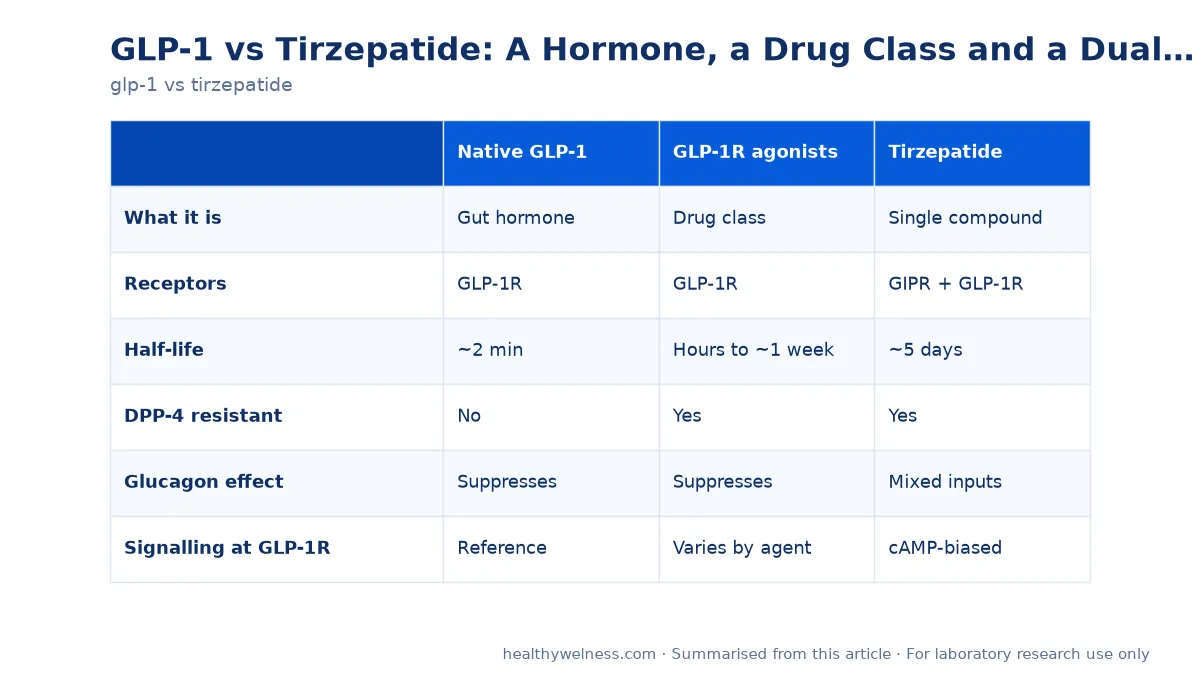
Three things called “GLP-1”
| Native GLP-1 | GLP-1R agonists | Tirzepatide | |
|---|---|---|---|
| What it is | Gut hormone | Drug class | Single compound |
| Receptors | GLP-1R | GLP-1R | GIPR + GLP-1R |
| Half-life | ~2 min | Hours to ~1 week | ~5 days |
| DPP-4 resistant | No | Yes | Yes |
| Glucagon effect | Suppresses | Suppresses | Mixed inputs |
| Signalling at GLP-1R | Reference | Varies by agent | cAMP-biased |
Much of the confusion in this search comes from the first two columns sharing a name. “GLP-1” in everyday use usually means the drug class, and the class is defined by its receptor, not by a shared structure. Tirzepatide belongs to the class only partially. Our tirzepatide research material is listed for laboratory work.
The native hormone and its problem
GLP-1 is one of two incretin hormones, the other being GIP. Together they explain the incretin effect, the larger insulin response to oral glucose than to the same glucose given intravenously. Gupta’s overview puts GLP-1 and GIP together at over 90% of incretin function (Gupta, 2013), and Nauck and colleagues describe their insulinotropic actions as additive (Nauck et al., 2021).
The hormone is a poor experimental tool for anything longer than an acute study. Its circulating half-life is about two minutes (Min et al., 2025), because dipeptidyl peptidase-4 cleaves it rapidly. GLP-1 receptor agonists are injectable peptides that resemble GLP-1 in structure and function but are not deactivated by DPP-4 (Sfairopoulos et al., 2018).
How the GLP-1 class was built
| Strategy | Example | Source |
|---|---|---|
| Exendin backbone | Exenatide | Gupta 2013 |
| DPP-4-resistant analogue | Lixisenatide, albiglutide | Gupta 2013 |
| Human GLP-1 analogue | Liraglutide | Gupta 2013 |
| Fatty-acid conjugation | Liraglutide, semaglutide | Min 2025 |
| Albumin or Fc fusion | Albiglutide, dulaglutide | Min 2025 |
Gupta’s 2013 review classified GLP-1 analogues into exendin-based therapies, DPP-4-resistant analogues and analogues of human GLP-1 (Gupta, 2013). The later review by Min and colleagues describes the modifications in chemical terms: amino acid substitutions, fatty acid conjugation through a linker, and fusion with albumin or the IgG Fc region, producing compounds with minimal metabolism and renal excretion (Min et al., 2025). Every member of the class shares one feature that tirzepatide does not: no deliberate GIP receptor activity.
What adding GIP changes
GIP is the more important incretin physiologically, but its effects differ from GLP-1’s in ways that made combining them non-obvious. Nauck and colleagues summarise the key points: GLP-1 suppresses glucagon while GIP increases it; GIP has lost much of its acute insulinotropic activity in type 2 diabetes for largely unknown reasons, while GLP-1’s effect is only slightly impaired; and GLP-1 at pharmacological concentrations reduces appetite (Nauck et al., 2021).
Samms and colleagues addressed the question directly. Dose-related gastrointestinal effects limit how far GLP-1 receptor agonism can be pushed, and one approach to widening the window is to engineer GLP-1 activity into the GIP sequence. They review GIP’s complex role in adipose tissue and argue that its effects on lipid and glucose metabolism are most evident when paired with GLP-1’s anorexigenic mechanism (Samms et al., 2020). Liu adds that GIP directly stimulates lipogenesis while GLP-1 indirectly promotes lipolysis, a combination described as maintaining healthy adipocyte function (Liu, 2024).
Tirzepatide is not a simple sum
Tirzepatide does not deliver native GIP plus native GLP-1. Willard and colleagues found it mimicked native GIP at the GIP receptor but was biased at the GLP-1 receptor, favouring cAMP generation over beta-arrestin recruitment and driving less receptor internalisation than GLP-1. In primary islets, beta-arrestin-1 limited the insulin response to GLP-1 but not to GIP or tirzepatide (Willard et al., 2020). The GLP-1 receptor half of tirzepatide is therefore not equivalent to a selective GLP-1 agonist.
Where the receptors are
The difference between the GLP-1 class and tirzepatide is also a difference in which tissues respond. Liu’s review places both incretin receptors on pancreatic beta cells and in brain satiety centres, with divergent effects on alpha cells and adipocytes (Liu, 2024).
| Tissue | GLP-1 receptor action | GIP receptor action |
|---|---|---|
| Beta cell | Insulin secretion | Insulin secretion |
| Alpha cell | Glucagon down when glucose high | Glucagon up when glucose low |
| Adipocyte | Indirect lipolysis | Direct lipogenesis |
| Brain satiety centres | Reduced intake | Involved in intake |
A selective GLP-1 agonist acts on the left column only. Tirzepatide acts on both, which means a tissue that expresses the GIP receptor but little GLP-1 receptor can respond to tirzepatide and not to the GLP-1 class at all. For in vitro work, checking receptor expression in the chosen cell line is the first step; a cell that lacks the GIP receptor will make tirzepatide look like a GLP-1 agonist with unusual signalling.
The alpha-cell row is the clearest point of opposition. Nauck and colleagues describe GLP-1 as suppressing and GIP as increasing glucagon, both glucose-dependently (Nauck et al., 2021). An experiment run at one glucose concentration will therefore see only one side of that relationship.
Using the comparison in an experiment
- Native GLP-1 answers acute questions about the receptor’s physiological ligand, but only over minutes.
- A selective GLP-1 receptor agonist isolates GLP-1 receptor engagement over hours to days.
- Tirzepatide asks what GIP receptor engagement plus a biased GLP-1 signal changes.
- A GIP receptor control is needed to separate the two receptor contributions.
Without the last item, a difference between tirzepatide and a GLP-1 agonist cannot be attributed to GIP, because the GLP-1 receptor signal also differs. The half-life calculator helps align sampling across compounds with very different durations.
Handling in the lab
Native GLP-1 needs DPP-4 inhibition in any biological sample if its concentration is to be measured meaningfully. Tirzepatide’s lipid chain makes it adsorb to plastic in dilute solution, and low-binding consumables help. Preparation is covered in tirzepatide reconstitution.
Related research
Whether GLP-1 counts as a peptide is answered in is GLP-1 a peptide. Tirzepatide is compared with individual class members in semaglutide versus tirzepatide and liraglutide versus tirzepatide, and its mechanism in how tirzepatide works.
Frequently asked questions
Is tirzepatide a GLP-1?
Not in the strict sense. Tirzepatide (LY3298176) is a dual agonist at the GIP and GLP-1 receptors, with greater engagement of the GIP receptor (Willard et al., 2020). It has GLP-1 receptor activity, so it is often grouped with GLP-1 receptor agonists, but it is not a GLP-1 analogue and not a selective agonist.
Is tirzepatide a GLP-1 or a GLP-2 agonist?
Neither GLP-2 nor GLP-1 alone. The two receptors it acts on are those for GIP (glucose-dependent insulinotropic polypeptide) and GLP-1 (Willard et al., 2020). GLP-2 is a different proglucagon-derived peptide with its own receptor.
What does native GLP-1 do?
GLP-1 is an incretin hormone released from the gut after nutrient intake that augments insulin secretion. It suppresses glucagon in a glucose-dependent manner, and at pharmacological concentrations reduces appetite and food intake (Nauck et al., 2021).
Why can't native GLP-1 be used as a research tool for long exposures?
Its half-life is about two minutes (Min et al., 2025). Dipeptidyl peptidase-4 inactivates it rapidly, which is why GLP-1 receptor agonists were engineered to resist DPP-4 and to circulate far longer (Sfairopoulos et al., 2018).
How do GIP and GLP-1 differ in their effects?
Both stimulate insulin secretion, and their effects on it are additive. They differ on glucagon: GLP-1 suppresses and GIP increases glucagon secretion, both glucose-dependently (Nauck et al., 2021). GIP also directly stimulates lipogenesis in adipocytes (Liu, 2024).
For laboratory research use only. The research materials supplied by HealthyWelness are not approved medicines, foods or cosmetics and are not for human or veterinary use. This article summarises published research and is not medical advice.
Sources
- Willard FS, et al. Tirzepatide is an imbalanced and biased dual GIP and GLP-1 receptor agonist. JCI Insight. 2020. PMID: 32730231
- Nauck MA, et al. The evolving story of incretins (GIP and GLP-1) in metabolic and cardiovascular disease: A pathophysiological update. Diabetes Obes Metab. 2021. PMID: 34310013
- Sfairopoulos D, et al. Clinical pharmacology of glucagon-like peptide-1 receptor agonists. Hormones (Athens). 2018. PMID: 29949126
- Min JS, et al. A Comprehensive Review on the Pharmacokinetics and Drug-Drug Interactions of Approved GLP-1 Receptor Agonists and a Dual GLP-1/GIP Receptor Agonist. Drug Des Devel Ther. 2025. PMID: 40330819
- Samms RJ, et al. How May GIP Enhance the Therapeutic Efficacy of GLP-1? Trends Endocrinol Metab. 2020. PMID: 32396843
- Liu QK. Mechanisms of action and therapeutic applications of GLP-1 and dual GIP/GLP-1 receptor agonists. Front Endocrinol (Lausanne). 2024. PMID: 39114288
- Gupta V. Glucagon-like peptide-1 analogues: An overview. Indian J Endocrinol Metab. 2013. PMID: 23869296