Semaglutide vs Tirzepatide: Receptors, Kinetics, SURPASS-2
Semaglutide engages GLP-1 alone; tirzepatide engages GIP and GLP-1. Structure, reported half-lives and the SURPASS-2 head-to-head trial, compared.


Cover illustration: AI-generated editorial artwork. Conceptual only; not an exact molecular structure, actual laboratory result or evidence of clinical effects.
Semaglutide is a selective GLP-1 receptor agonist; tirzepatide is a dual GIP and GLP-1 receptor agonist. Both use albumin binding for a multi-day half-life, and they have been compared head to head in the SURPASS-2 trial (NCT03987919), where tirzepatide was superior on the glycated haemoglobin endpoint.
For laboratory research use only. The research materials supplied by HealthyWelness are not approved medicines, foods or cosmetics and are not for human or veterinary use. This article summarises published research and is not medical advice.
- Semaglutide is a selective GLP-1 receptor agonist with a reported half-life of about 7 days, reaching steady state in 4–5 weeks (Hall et al., 2018).
- Tirzepatide’s half-life was about 5 days in a two-compartment population model built from 19 pooled studies (Schneck and Urva, 2024).
- Tirzepatide engages the GIP receptor more than the GLP-1 receptor and favours cAMP generation over beta-arrestin recruitment at the GLP-1 receptor (Willard et al., 2020).
- In SURPASS-2, 1,879 adults with type 2 diabetes were randomised for 40 weeks, and every tirzepatide arm was noninferior and superior to semaglutide on change in glycated haemoglobin (Frias et al., 2021).
- Native human GLP-1 has a half-life of about 2 minutes, which is the problem both molecules were engineered to solve (Min et al., 2025).
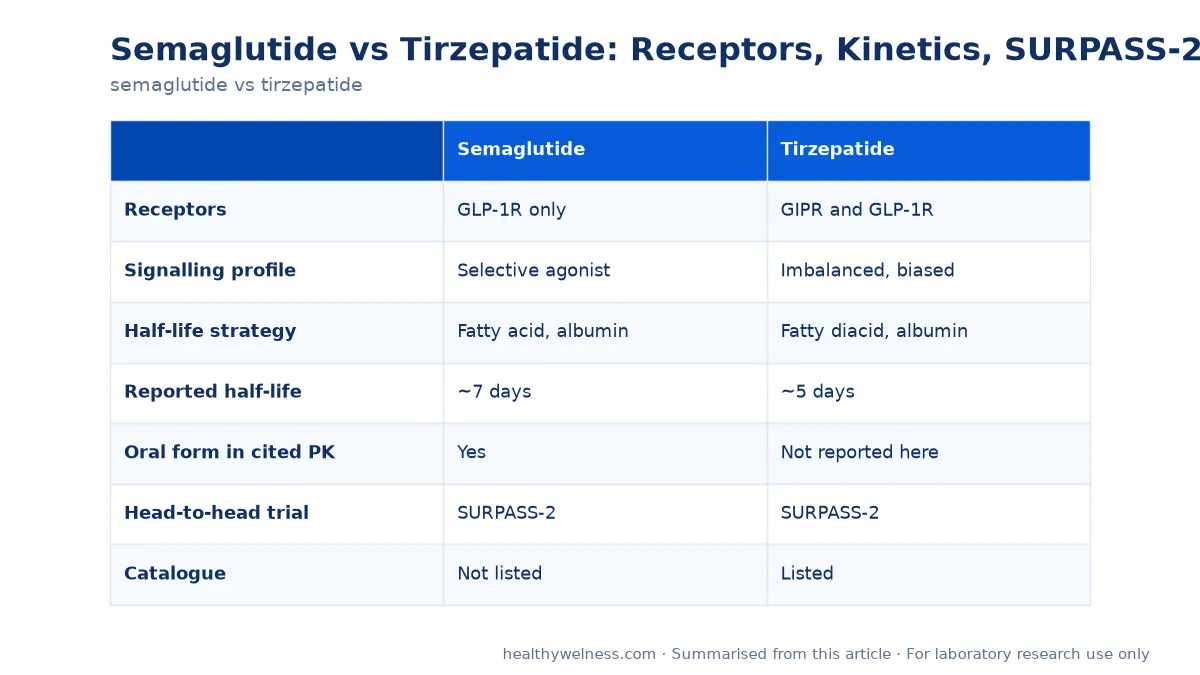
Side by side
| Semaglutide | Tirzepatide | |
|---|---|---|
| Receptors | GLP-1R only | GIPR and GLP-1R |
| Signalling profile | Selective agonist | Imbalanced, biased |
| Half-life strategy | Fatty acid, albumin | Fatty diacid, albumin |
| Reported half-life | ~7 days | ~5 days |
| Oral form in cited PK | Yes | Not reported here |
| Head-to-head trial | SURPASS-2 | SURPASS-2 |
| Catalogue | Not listed | Listed |
Semaglutide is not in our catalogue; it appears here because the comparison is the most-searched question in this class. Our tirzepatide research material is listed for laboratory use.
What separates them at the receptor
The simplest description is one receptor versus two, but the published pharmacology is more specific. Willard and colleagues developed a method for estimating occupancy of each receptor at clinically studied exposures and found tirzepatide engaged the GIP receptor more than the GLP-1 receptor. At the GIP receptor it behaved like native GIP. At the GLP-1 receptor it was biased, favouring cAMP over beta-arrestin and driving less receptor internalisation than GLP-1 itself (Willard et al., 2020).
Semaglutide has no GIP activity, so it is the cleaner tool for asking what GLP-1 receptor engagement alone does. The two together are the natural pair for asking what adding GIP receptor activity changes, with the important caveat that tirzepatide’s GLP-1 receptor activity is not equivalent to semaglutide’s. A difference between them can reflect GIP engagement, GLP-1 receptor bias, or both. The mechanism is set out further in how tirzepatide works.
Kinetics: closer than the receptor story
| Parameter | Semaglutide | Tirzepatide | Source |
|---|---|---|---|
| Half-life | ~7 days | ~5 days | Hall 2018; Schneck 2024 |
| Steady state | 4–5 weeks | Not cited here | Hall 2018 |
| PK model | Predictable, dose-linear | Two-compartment | Yang 2024; Schneck 2024 |
| Covariate effects | Body weight possible | No adjustment needed | Yang 2024; Schneck 2024 |
Both molecules solve the same problem, the roughly two-minute half-life of native GLP-1, by adding a lipid that binds albumin, among other structural changes such as amino acid substitutions (Min et al., 2025). A systematic review of semaglutide pharmacokinetics found a predictable profile with exposure rising with dose, limited drug-drug interactions, and possible influence of body weight on exposure (Yang and Yang, 2024). The tirzepatide model found no demographic covariate requiring adjustment (Schneck and Urva, 2024).
For an experimental design, the similar half-lives are useful: sampling schedules built for one are broadly appropriate for the other, which is not true of most pairs in this class. A comparison with a shorter-acting agonist is in liraglutide versus tirzepatide. The half-life calculator will plot both curves.
SURPASS-2 in detail
SURPASS-2 is the reference comparison. It was an open-label, 40-week, phase 3 trial that randomised 1,879 adults with type 2 diabetes in a 1:1:1:1 ratio to three tirzepatide arms or one semaglutide arm. At baseline, mean glycated haemoglobin was 8.28%, mean age 56.6 years and mean body weight 93.7 kg. The primary endpoint was change in glycated haemoglobin at 40 weeks (Frias et al., 2021).
| Endpoint | Tirzepatide arms | Semaglutide arm |
|---|---|---|
| HbA1c change | −2.01 to −2.30 points | −1.86 points |
| Difference vs comparator | −0.15 to −0.45 points | Reference |
| Body weight difference | −1.9 to −5.5 kg | Reference |
| Nausea | 17–22% | 18% |
| Serious adverse events | 5–7% | 3% |
All three tirzepatide arms were noninferior and superior on the primary endpoint. Hypoglycaemia below 54 mg/dL was reported in 0.2–1.7% of tirzepatide recipients and 0.4% of semaglutide recipients (Frias et al., 2021). The trial was open-label and funded by the manufacturer of tirzepatide, both of which belong in any reading of it.
The islet-function analysis
A post hoc analysis of the same trial examined markers of beta-cell function and insulin sensitivity. At week 40, HOMA2-B rose by 96.9–120.4% across tirzepatide arms against 84.0% with semaglutide, and HOMA2-IR fell by 15.5–24.0% against 5.1%. The two higher tirzepatide arms reduced fasting C-peptide and fasting glucagon (Frias et al., 2024). Being post hoc, these findings generate hypotheses about mechanism rather than test them.
Why the two half-lives are similar
Given the difference in receptor pharmacology, the similarity in duration can look surprising. It follows from the shared engineering approach. Native GLP-1’s two-minute half-life is set by DPP-4 cleavage and renal clearance; both molecules defeat the first with sequence changes at the cleavage site and the second by binding albumin through a lipid chain, which keeps the complex too large for glomerular filtration (Min et al., 2025). Once albumin binding dominates, the half-life reflects how tightly and how reversibly the lipid binds, and both molecules were optimised toward weekly profiles.
This matters when interpreting differences between them. Because exposure duration is broadly matched, it is less likely than in other comparisons to be the explanation for an observed difference, which pushes attention back to receptor coverage and bias. That is one of the features that makes this pair, rather than tirzepatide against a short-acting agonist, the more informative comparison.
What the trial does not settle
- Which receptor is responsible. SURPASS-2 compares two molecules, not two receptors; GIP engagement and GLP-1 receptor bias are confounded.
- Equivalence of exposure. The arms were chosen by clinical convention, not by matched receptor occupancy.
- Populations beyond the trial. Results apply to adults with type 2 diabetes at the baseline characteristics described.
- Mechanism in tissues. HOMA indices are model-derived estimates, not direct measurements of beta-cell mass or function.
Handling in the lab
Both are lipidated peptides, so the same cautions apply: adsorption to surfaces in dilute solution, the need to work from net peptide content rather than label weight, and avoidance of repeated freeze-thaw. Tirzepatide-specific preparation is covered in tirzepatide reconstitution, and its kinetics in tirzepatide half-life.
Related research
The broader class is compared in GLP-1 versus tirzepatide, and the triple agonist in retatrutide versus semaglutide. For tirzepatide itself, start with the tirzepatide overview.
Frequently asked questions
What is the main pharmacological difference between semaglutide and tirzepatide?
Receptor coverage. Semaglutide is a selective GLP-1 receptor agonist, while tirzepatide (LY3298176) is a dual GIP and GLP-1 receptor agonist with greater engagement of the GIP receptor and cAMP-biased signalling at the GLP-1 receptor (Willard et al., 2020).
How do their reported half-lives compare?
They are of the same order. Semaglutide’s reported half-life is about 7 days (Hall et al., 2018), and tirzepatide’s was about 5 days in a population model built on 19 pooled studies (Schneck and Urva, 2024). Both rely on fatty-acid-mediated albumin binding.
Has the comparison been tested in a randomised trial?
Yes. SURPASS-2 (NCT03987919) randomised 1,879 adults with type 2 diabetes to one of three tirzepatide arms or a semaglutide arm for 40 weeks. All tirzepatide arms were noninferior and superior to semaglutide on change in glycated haemoglobin (Frias et al., 2021).
What adverse events were reported in SURPASS-2?
Gastrointestinal events were most common and mostly mild to moderate in both groups: nausea in 17 to 22% with tirzepatide and 18% with semaglutide, diarrhoea in 13 to 16% and 12%, and vomiting in 6 to 10% and 8%. Serious adverse events occurred in 5 to 7% and 3% respectively (Frias et al., 2021).
Did SURPASS-2 look at beta-cell markers?
A post hoc analysis reported greater increases in HOMA2-B and greater reductions in HOMA2-IR across tirzepatide arms than with semaglutide at week 40, with reductions in fasting glucagon in the two higher tirzepatide arms (Frias et al., 2024).
For laboratory research use only. The research materials supplied by HealthyWelness are not approved medicines, foods or cosmetics and are not for human or veterinary use. This article summarises published research and is not medical advice.
Sources
- Frias JP, et al. Tirzepatide versus Semaglutide Once Weekly in Patients with Type 2 Diabetes. N Engl J Med. 2021. PMID: 34170647
- Frias JP, et al. Tirzepatide Improved Markers of Islet Cell Function and Insulin Sensitivity in People With T2D (SURPASS-2). J Clin Endocrinol Metab. 2024. PMID: 38252888
- Willard FS, et al. Tirzepatide is an imbalanced and biased dual GIP and GLP-1 receptor agonist. JCI Insight. 2020. PMID: 32730231
- Schneck K, Urva S. Population pharmacokinetics of the GIP/GLP receptor agonist tirzepatide. CPT Pharmacometrics Syst Pharmacol. 2024. PMID: 38356317
- Hall S, et al. Pharmacokinetics and Clinical Implications of Semaglutide: A New Glucagon-Like Peptide (GLP)-1 Receptor Agonist. Clin Pharmacokinet. 2018. PMID: 29915923
- Yang XD, Yang YY. Clinical Pharmacokinetics of Semaglutide: A Systematic Review. Drug Des Devel Ther. 2024. PMID: 38952487
- Min JS, et al. A Comprehensive Review on the Pharmacokinetics and Drug-Drug Interactions of Approved GLP-1 Receptor Agonists and a Dual GLP-1/GIP Receptor Agonist. Drug Des Devel Ther. 2025. PMID: 40330819