How Does Tirzepatide Work? Imbalanced Dual Agonism
Tirzepatide engages GIP and GLP-1 receptors unequally and with signalling bias. The 2020 paper that established this, and why it matters in the lab.


Cover illustration: AI-generated editorial artwork. Conceptual only; not an exact molecular structure, actual laboratory result or evidence of clinical effects.
Tirzepatide activates the GIP receptor and the GLP-1 receptor unequally, and at the GLP-1 receptor it favours some downstream signalling arms over others. A 2020 study in JCI Insight established this, describing it as an imbalanced and biased dual agonist. Neither word is decoration; both change what an experiment with it can conclude.
For laboratory research use only. The research materials supplied by HealthyWelness are not approved medicines, foods or cosmetics and are not for human or veterinary use. This article summarises published research and is not medical advice.
- Tirzepatide was characterised as an imbalanced and biased dual GIP and GLP-1 receptor agonist (Willard et al., JCI Insight 2020, PMID 32730231).
- Imbalanced means the two receptor activities are not matched in potency, so their ratio shifts with concentration.
- Biased means the compound favours some downstream arms of a receptor over others rather than activating all proportionally.
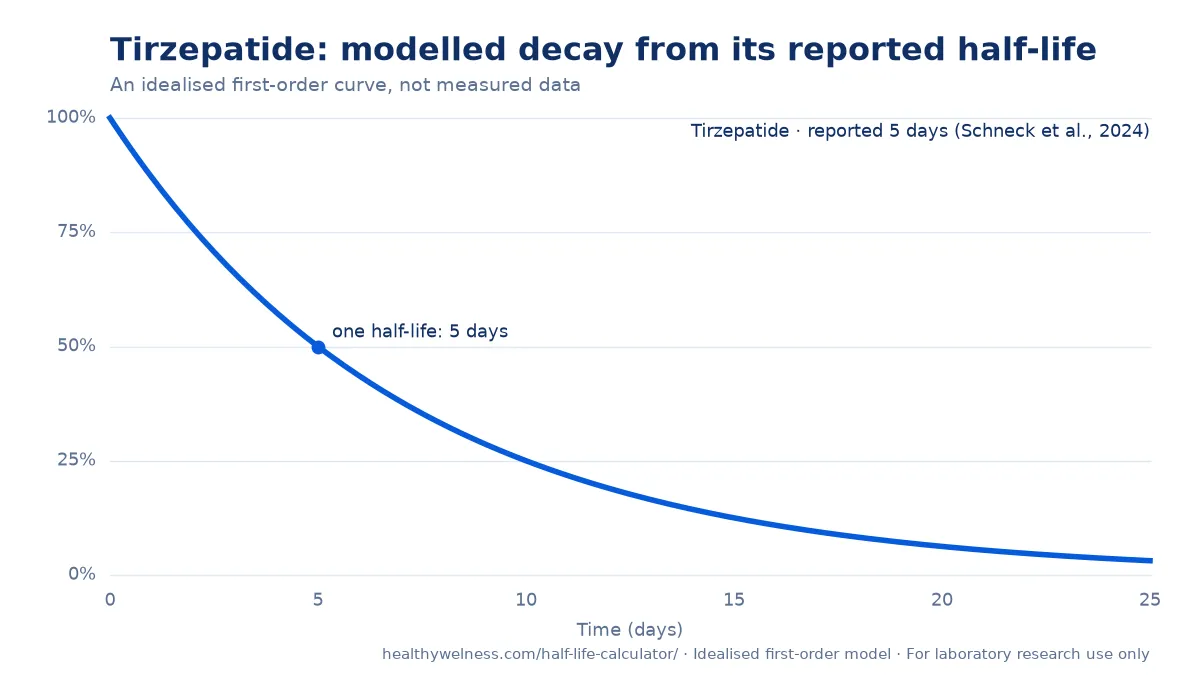
- Tirzepatide’s half-life was reported as approximately 5 days (Schneck et al., 2024, PMID 38356317).
- A 2025 molecular dynamics study examined how tirzepatide activates both receptors at the structural level (Zou et al., PMID 40692063).
What does “imbalanced” actually mean?
That the compound is not equally potent at its two receptors. The 2020 paper by Willard and colleagues reported tirzepatide as more potent at the GIP receptor than at the GLP-1 receptor.
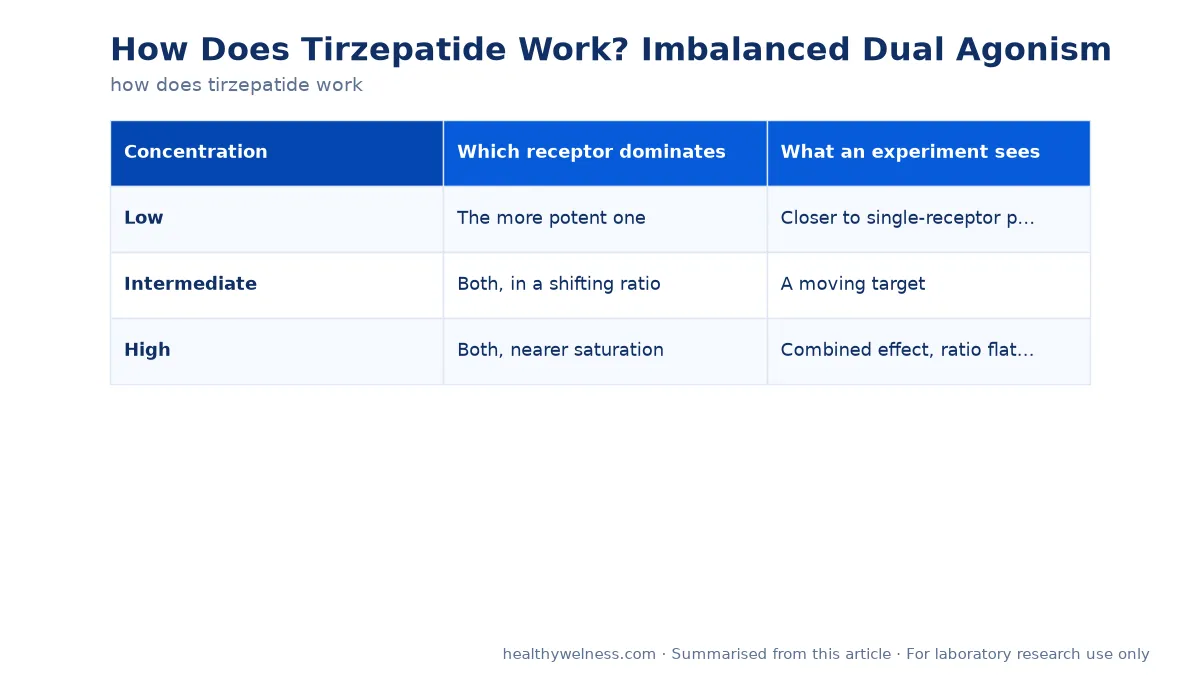
The consequence is easy to state and easy to forget: the ratio of GIP to GLP-1 activity is not a fixed property of the molecule. It depends on concentration. At a low concentration the more potent receptor dominates; as concentration rises the second receptor contributes more. A single compound therefore produces a sliding mixture of two pharmacologies rather than one fixed combination.
| Concentration | Which receptor dominates | What an experiment sees |
|---|---|---|
| Low | The more potent one | Closer to single-receptor pharmacology |
| Intermediate | Both, in a shifting ratio | A moving target |
| High | Both, nearer saturation | Combined effect, ratio flattening |
For a dose-response experiment this matters directly. A curve generated with an imbalanced agonist is not a curve for one pharmacology measured at several concentrations; it is several pharmacologies measured once each.
What does “biased” mean, and why is it separate?
Bias is about what happens after a receptor is engaged.
A G protein-coupled receptor can signal through more than one route — classically through G proteins and through beta-arrestin recruitment, which also governs receptor internalisation. An unbiased agonist activates those arms roughly in proportion. A biased agonist does not: it favours some and under-engages others.
So bias and imbalance are independent properties, and tirzepatide reportedly has both:
- Imbalance describes the relationship between the two receptors.
- Bias describes the relationship within one receptor’s downstream arms.
The practical implication is the one most often skipped: matching receptor occupancy with a different ligand does not guarantee matching downstream output. If a comparison between tirzepatide and another GLP-1 receptor agonist gives different results at equal occupancy, bias is a candidate explanation rather than an anomaly.
What did the structural work add?
The 2025 study by Zou and colleagues in the International Journal of Biological Macromolecules approached the same question from molecular dynamics and protein–peptide binding, asking how one peptide activates two related receptors.
Both the GLP-1 receptor and the GIP receptor are class B G protein-coupled receptors, which bind long peptide ligands in two parts: the extracellular domain grips the ligand’s C-terminal region while the N-terminal region reaches into the receptor core to activate it. A single peptide able to do that at two related receptors is a design achievement, and the imbalance is in part a consequence of how well it fits each one.
The contrast worth holding alongside this is the non-peptide route to the same receptor, described by Sloop and colleagues in 2024, where a small molecule activates the GLP-1 receptor without being able to occupy both sites — covered in orforglipron compared with tirzepatide.
How does the 5-day half-life shape an experiment?
The chart above plots first-order decay from the reported figure. It is an idealised model, not measured data.
- After five half-lives roughly 3 per cent remains — about 25 days for a 5-day half-life, which is the timescale on which an in vivo exposure effectively ends.
- Weekly dosing accumulates. The interval is shorter than the time to near-complete clearance, which is how a steady state is reached rather than a series of isolated peaks.
- None of this transfers to a dish. In vitro the limiting factors are proteolysis in the medium, adsorption to surfaces and aggregation, not renal clearance and albumin binding.
You can plot your own values in our half-life calculator. The measured figure and its source are discussed further in tirzepatide half-life.
What should an experiment do about imbalance and bias?
Three concrete design choices follow, and none of them is expensive.
- Run a selective comparator. A GLP-1-only agonist in the same system lets a difference be attributed rather than guessed at. A non-peptide agonist is particularly useful here because it is chemically unrelated, so peptide-handling artefacts do not travel between arms.
- Report the concentration, not just the compound. Because the receptor ratio shifts with concentration, a result at one concentration is not a result about tirzepatide in general.
- Choose readouts that distinguish signalling arms where bias is relevant. A single downstream measure cannot detect bias, by definition.
The wider class comparison, including the three-receptor case, is in mazdutide, survodutide and tirzepatide compared.
How is tirzepatide handled in the laboratory?
- Store sealed lyophilized material at −20 °C, dry and dark; warm the vial to room temperature before opening so moisture does not condense into the powder.
- Add diluent down the vial wall and swirl. Do not vortex: the hydrophobic modification that extends circulation also makes the peptide surface-active, and foaming drives aggregation.
- Inspect for haze once reconstituted and again once diluted. Aggregated material is not at the nominal concentration.
- Aliquot on first reconstitution and date every tube.
- Compute molarity from net peptide content rather than the nominal vial weight; our reconstitution calculator applies that correction. Step-by-step detail is in reconstituting tirzepatide.
Our tirzepatide research material is supplied for laboratory research use. Certificates are available for listed products — contact us for the latest report.
Why both properties are worth checking in every dual agonist
Tirzepatide is the compound in this class where imbalance and bias have both been characterised, which makes it the reference case rather than the exception. The reasonable default for any other multi-receptor agonist is that it may have the same properties and that nobody has measured them yet.
That matters because assuming balance quietly narrows what a result means. If two receptor activities are taken to be equal and are not, a concentration chosen to engage both is really engaging one, and the experiment answers a smaller question than its title claims.
Scope note
This material is supplied for laboratory research use only. It is not a medicine, not a supplement, and not for human or veterinary use. The studies cited are referenced as published literature about a molecule.
Open questions
- How much of tirzepatide’s profile is attributable to GIP receptor engagement rather than GLP-1?
- Which downstream arms does the reported bias favour, and in which cell types?
- Does the receptor ratio shift enough across the usual concentration range to change conclusions?
Related research
Frequently asked questions
How does tirzepatide work?
It activates two receptors, the GIP receptor and the GLP-1 receptor, but not equally. A 2020 JCI Insight paper characterised it as an imbalanced and biased dual agonist: it is more potent at the GIP receptor, and at the GLP-1 receptor it favours some downstream signalling arms over others.
What does imbalanced mean for a dual agonist?
That the two receptor activities are not matched. An imbalanced agonist engages one receptor more strongly than the other, so the ratio of the two activities depends on concentration rather than staying fixed.
What does biased mean?
That engaging a receptor does not activate all of its downstream arms proportionally. A biased agonist favours some signalling routes over others, so matching receptor occupancy with a different ligand does not guarantee matching downstream output.
What is tirzepatide's half-life?
Approximately 5 days, reported in a 2024 population pharmacokinetic analysis by Schneck and colleagues in CPT: Pharmacometrics & Systems Pharmacology. That figure supports sustained exposure with once-weekly dosing.
Can the GIP and GLP-1 contributions be separated?
Not with tirzepatide alone. Separating them requires selective comparators in the same system, such as a GLP-1-only agonist run in parallel. Any effect observed with tirzepatide by itself is an effect of combined, imbalanced agonism.
For laboratory research use only. The research materials supplied by HealthyWelness are not approved medicines, foods or cosmetics and are not for human or veterinary use. This article summarises published research and is not medical advice.
Sources
- Willard FS, et al. Tirzepatide is an imbalanced and biased dual GIP and GLP-1 receptor agonist. JCI Insight. 2020. PMID: 32730231
- Zou X, et al. Understanding the activation mechanism of GLP-1R/GIPR by dual agonist Tirzepatide via molecular dynamics and protein-peptide binding. Int J Biol Macromol. 2025. PMID: 40692063
- Schneck K, et al. Population pharmacokinetics of the GIP/GLP receptor agonist tirzepatide. CPT Pharmacometrics Syst Pharmacol. 2024. PMID: 38356317
- Sloop KW, et al. The pharmacological basis for nonpeptide agonism of the GLP-1 receptor by orforglipron. Sci Transl Med. 2024. PMID: 39693407