Sermorelin and Tirzepatide: Two Axes, No Combined Data
Sermorelin targets the pituitary GHRH receptor; tirzepatide targets GIP and GLP-1 receptors. Mechanisms, kinetics and what has not been studied.


Cover illustration: AI-generated editorial artwork. Conceptual only; not an exact molecular structure, actual laboratory result or evidence of clinical effects.
Sermorelin and tirzepatide act on unrelated hormone axes: sermorelin on the pituitary GHRH receptor, tirzepatide on the GIP and GLP-1 receptors. Their circulating lifetimes differ by more than a thousandfold, and no peer-reviewed study of the two together was found in PubMed.
For laboratory research use only. The research materials supplied by HealthyWelness are not approved medicines, foods or cosmetics and are not for human or veterinary use. This article summarises published research and is not medical advice.
- Sermorelin is GHRH(1-29)-NH2, a ligand for the family B-III GHRH receptor expressed predominantly in pituitary somatotrophs (Mayo et al., 2000).
- Tirzepatide (LY3298176) is a dual GIP and GLP-1 receptor agonist with greater GIP receptor engagement and cAMP-biased signalling at the GLP-1 receptor (Willard et al., 2020).
- GHRH(1-29)-NH2 had a disappearance half-time of 4.3 minutes during intravenous infusion in normal men (Soule et al., 1994).
- Tirzepatide’s half-life was about 5 days in a population pharmacokinetic model built from 19 pooled studies (Schneck and Urva, 2024).
- As of 2026-11-03, a PubMed search for “sermorelin tirzepatide” returned no records.
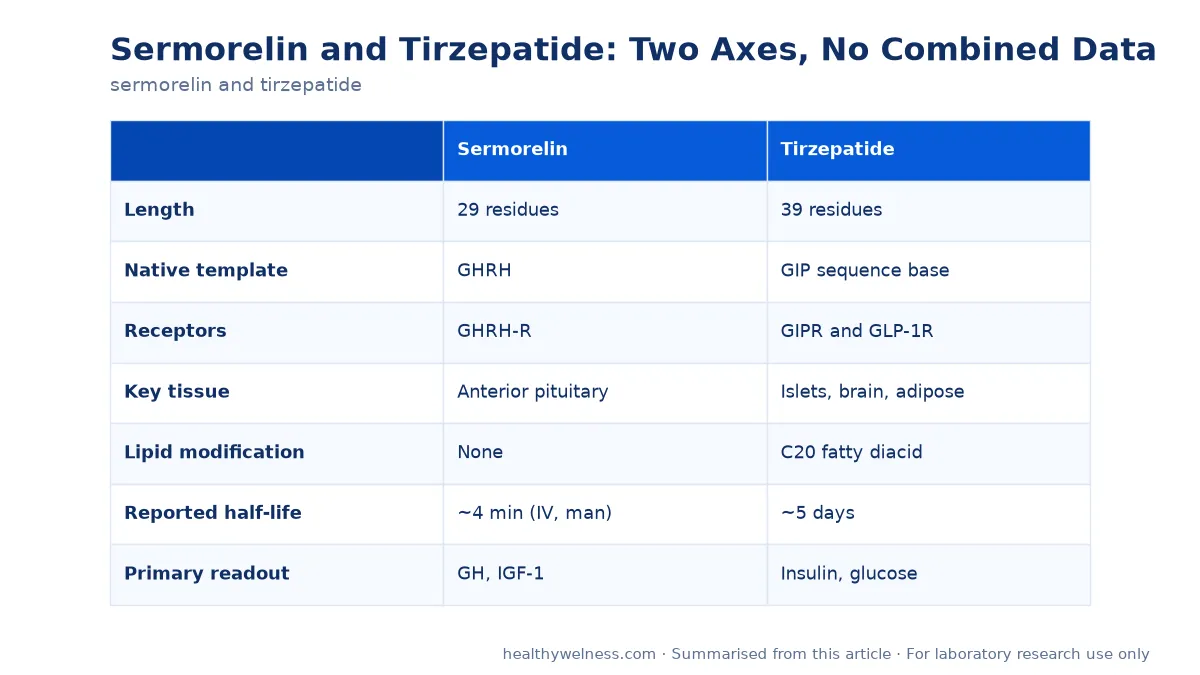
The two compounds at a glance
| Sermorelin | Tirzepatide | |
|---|---|---|
| Length | 29 residues | 39 residues |
| Native template | GHRH | GIP sequence base |
| Receptors | GHRH-R | GIPR and GLP-1R |
| Key tissue | Anterior pituitary | Islets, brain, adipose |
| Lipid modification | None | C20 fatty diacid |
| Reported half-life | ~4 min (IV, man) | ~5 days |
| Primary readout | GH, IGF-1 | Insulin, glucose |
The “Lipid modification” row explains the half-life row. Tirzepatide carries a fatty diacid that binds albumin; sermorelin has no such group and is cleared as quickly as the native fragment. Our sermorelin acetate research peptide and tirzepatide research material are listed separately for that reason, among others.
What the GHRH receptor does
The GHRH receptor sits on somatotroph cells of the anterior pituitary. Binding activates Gs, cAMP accumulates, protein kinase A phosphorylates CREB, and CREB drives the transcription factor Pit-1, which controls the growth hormone gene (Mayo et al., 1995). The output is release of stored hormone and synthesis of new hormone.
This is a narrow target. The receptor is expressed predominantly in the pituitary, and its gene promoter is selectively active there (Mayo et al., 2000). Effects of sermorelin elsewhere are expected to be downstream, carried by growth hormone and IGF-1 rather than by the peptide itself. The full pathway is set out in how sermorelin works.
What the incretin receptors do
Tirzepatide engages two receptors that are distributed far more widely. GIP and GLP-1 both stimulate insulin secretion from beta cells and act on satiety centres in the brain, but they differ in their effects on glucagon, and GIP directly promotes lipogenesis in adipocytes while GLP-1 acts indirectly on lipolysis (Liu, 2024).
Willard and colleagues established methodology for estimating occupancy of each receptor and found greater engagement of the GIP receptor than the GLP-1 receptor. At the GIP receptor tirzepatide behaved like native GIP; at the GLP-1 receptor it favoured cAMP generation over beta-arrestin recruitment and drove less receptor internalisation than GLP-1 (Willard et al., 2020). A fuller treatment is in how tirzepatide works.
One shared feature, read carefully
Both compounds raise cAMP in their target cells. That does not make them interchangeable. The second messenger is common to a large share of G protein-coupled receptors; what differs is the cell in which it is raised and the genes that respond there.
Time scale is the practical difference
| Kinetic property | Sermorelin | Tirzepatide |
|---|---|---|
| Reported half-life | 4.3 min | ~5 days |
| Model used | IV infusion, 10 men | Two-compartment, pooled |
| Half-life mechanism | Proteolysis, clearance | Albumin binding |
| Sampling needed | Minutes | Days to weeks |
Sources for the table: Soule and colleagues for sermorelin’s fragment (Soule et al., 1994); Schneck and Urva for tirzepatide, whose model described the compound with two compartments and first-order absorption and elimination (Schneck and Urva, 2024).
Any experiment that includes both compounds has to accommodate this gap. A sampling schedule designed for one will miss the other: minute-scale draws capture the sermorelin curve and see tirzepatide as flat; daily draws capture tirzepatide and never see sermorelin at all. The half-life calculator makes the mismatch visible when both values are entered.
What has and has not been studied
Searches for the pair are common, and the phrasing often implies that the two are used together. The peer-reviewed literature does not support any statement about combined use. As of 2026-11-03, a PubMed search for “sermorelin tirzepatide” returned no records. That is a statement about one search; related work might sit under other terms, such as studies of growth hormone status in incretin-agonist trials, but no combined study is cited here because none was located.
What the literature does support is a separation of questions. If a metabolic readout changes, it may come from the GH axis or from incretin receptors, and each compound is a tool for probing one of them.
Designing an attribution experiment
- Use each compound alone before considering any combined arm.
- Measure growth hormone or IGF-1 in tirzepatide arms, and insulin or glucose in sermorelin arms, so cross-effects are visible.
- Match sampling to each compound’s kinetics rather than to a single shared schedule.
- Report species, model and readout for every effect, since receptor distribution differs between rodents and other species.
Why metabolic readouts blur the line
The reason the pair is worth comparing at all is that both axes reach metabolism, from different directions. Growth hormone has well-known effects on glucose and lipid handling, and the GIP and GLP-1 receptors act on insulin secretion, glucagon and adipocyte function (Liu, 2024). A change in fasting glucose, adipose tissue mass or insulin sensitivity in an experiment could in principle arise from either.
| Readout | GH-axis route | Incretin route |
|---|---|---|
| Insulin secretion | Indirect | Direct, beta cell |
| Glucagon | Indirect | GIP raises, GLP-1 lowers |
| Adipocyte lipogenesis | Indirect | GIP promotes |
| Food intake | Not primary | Satiety centres |
The incretin column follows Liu’s review, which describes GIP as glucagonotropic during hypoglycaemia, GLP-1 as glucagonostatic during hyperglycaemia, and GIP as directly lipogenic in adipocytes (Liu, 2024). The GH column is deliberately coarse: it indicates where a GH-axis effect would be expected to enter, not a measured effect of sermorelin.
This is the practical case for keeping the two compounds in separate arms. If an outcome moves in a tirzepatide arm, growth hormone and IGF-1 should be measured before the result is attributed solely to incretin receptors, and the reverse holds for sermorelin arms.
Handling in the lab
On the bench, the two peptides share the general rules for lyophilised material: minimise moisture, avoid repeated freeze-thaw cycles, and calculate concentration from net peptide content. Tirzepatide’s lipid chain can make it more prone to surface adsorption in dilute solution. Compound-specific notes are in sermorelin reconstitution and storage and tirzepatide reconstitution.
Where each compound sits in its own family
Each compound also has closer relatives that are better comparators. Sermorelin’s are the other GHRH analogues, which differ mainly in how they extend circulating time; tirzepatide’s are the other incretin agonists, which differ in receptor coverage and bias. Comparing within a family holds the receptor constant and isolates one variable, which is why most of the useful published comparisons are made that way.
Related research
Sermorelin is compared with other GH-axis peptides in tesamorelin versus sermorelin, and tirzepatide with a single-receptor agonist in liraglutide versus tirzepatide. Those pairings share a receptor family; this one does not, which is the main thing to take from it.
Frequently asked questions
Do sermorelin and tirzepatide act on the same receptor?
No. Sermorelin, GHRH(1-29)-NH2, acts on the GHRH receptor of pituitary somatotroph cells (Mayo et al., 2000). Tirzepatide (LY3298176) acts on the GIP and GLP-1 receptors, with greater engagement of the GIP receptor at clinically studied exposures (Willard et al., 2020).
Has a study examined sermorelin and tirzepatide together?
As of 2026-11-03, a PubMed search for “sermorelin tirzepatide” returned no records. That is a statement about this search, not proof that no work exists, but no peer-reviewed combined study is available to cite.
How different are their half-lives?
By more than three orders of magnitude. GHRH(1-29)-NH2 had a disappearance half-time of 4.3 minutes during intravenous infusion in men (Soule et al., 1994). Tirzepatide’s half-life in a pooled population model was about 5 days (Schneck and Urva, 2024).
Which signalling pathway does each use?
Both receptors are G protein-coupled and both raise cAMP. Sermorelin’s GHRH receptor signals mainly through cAMP, PKA and CREB (Mayo et al., 1995). Tirzepatide favours cAMP generation over beta-arrestin recruitment at the GLP-1 receptor, which is what the term biased agonist refers to (Willard et al., 2020).
Why would a researcher compare them?
Mainly to separate effects that come from the growth hormone axis from effects that come from incretin receptors, since both can change metabolic readouts. The comparison is about attribution of a result, not about combining them.
For laboratory research use only. The research materials supplied by HealthyWelness are not approved medicines, foods or cosmetics and are not for human or veterinary use. This article summarises published research and is not medical advice.
Sources
- Mayo KE, et al. Regulation of the pituitary somatotroph cell by GHRH and its receptor. Recent Prog Horm Res. 2000. PMID: 11036940
- Mayo KE, et al. Growth hormone-releasing hormone: synthesis and signaling. Recent Prog Horm Res. 1995. PMID: 7740167
- Willard FS, et al. Tirzepatide is an imbalanced and biased dual GIP and GLP-1 receptor agonist. JCI Insight. 2020. PMID: 32730231
- Schneck K, Urva S. Population pharmacokinetics of the GIP/GLP receptor agonist tirzepatide. CPT Pharmacometrics Syst Pharmacol. 2024. PMID: 38356317
- Soule S, et al. Incorporation of D-Ala2 in growth hormone-releasing hormone-(1-29)-NH2 increases the half-life and decreases metabolic clearance in normal men. J Clin Endocrinol Metab. 1994. PMID: 7962295
- Liu QK. Mechanisms of action and therapeutic applications of GLP-1 and dual GIP/GLP-1 receptor agonists. Front Endocrinol (Lausanne). 2024. PMID: 39114288