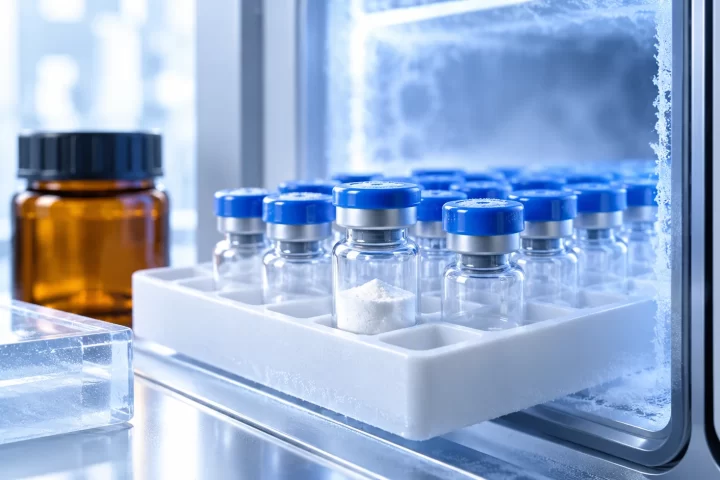
Lab Handling
Does NAD+ Need Refrigeration? Storage and Stability
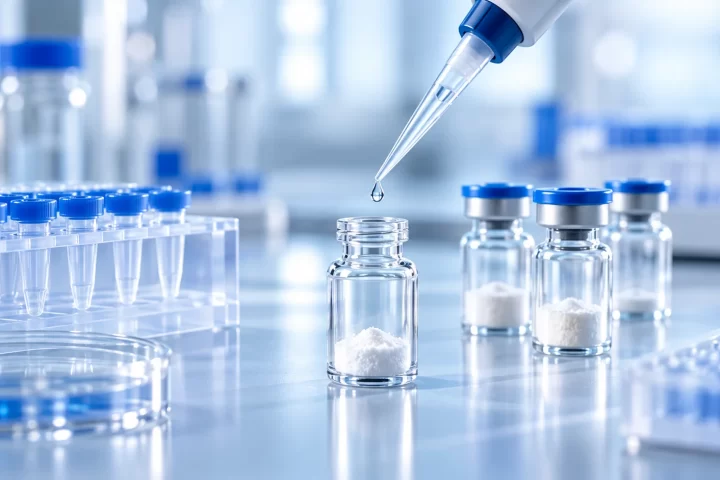
NAD+ is hygroscopic and degrades in solution. Why the solid needs dry cold storage and why solutions should be prepared close to use.
BEHIND THE ARTICLES
Areas of expertise: Peptide lead discovery & screening, structural modification & stability optimization, pharmacodynamics & mechanism of action
Lab Handling
NAD+ is hygroscopic and degrades in solution. Why the solid needs dry cold storage and why solutions should be prepared close to use.
Comparisons
Semax is a water-soluble ACTH fragment analogue; Dihexa is a lipophilic angiotensin IV derivative with a retracted key paper. A careful comparison.
Research Reviews
Dihexa is a modified angiotensin IV tripeptide carrying two hexanoyl groups. What the acetate salt means and why the mass must be checked.
Comparisons
BPC-157 is studied as a locally acting repair peptide; sermorelin acts on a defined endocrine axis. The comparison turns on that difference.
Research Reviews
A 2026 rat Achilles tendon study tested both peptides and their combination. The combination conferred no additional benefit over either alone.
Lab Handling
ARA-290 reproduces a helical face of erythropoietin in eleven residues. Why that makes handling unforgiving, and how to reconstitute it properly.
Peptide Profiles
Oxytocin is a nine-residue cyclic neuropeptide with a disulfide bridge. Its receptor, its notorious solution instability and the published chemistry.
Peptide Profiles
Orexin A is a 33-residue peptide with two disulfide bridges, acting at OX1R and OX2R. Its discovery, receptor pharmacology and analytical literature.
Peptide Profiles
Hexarelin is a hexapeptide secretagogue with a methylated tryptophan. Its structure, acetate salt, rodent kinetics and cardiovascular literature.
Peptide Profiles
Gonadorelin is synthetic GnRH, a decapeptide whose defining feature is pulsatile signalling. Its structure, receptor behaviour and research literature.
Peptide Profiles
GHRP-6 is a hexapeptide secretagogue acting at the ghrelin receptor. Its sequence, acetate salt form, receptor pharmacology and published research.
Peptide Profiles
DSIP is a nine-residue peptide isolated in the 1970s whose mechanism remains unestablished. What the literature actually says, and what it does not.