Testing & Quality
How Are Peptides Made? Solid-Phase Synthesis Explained
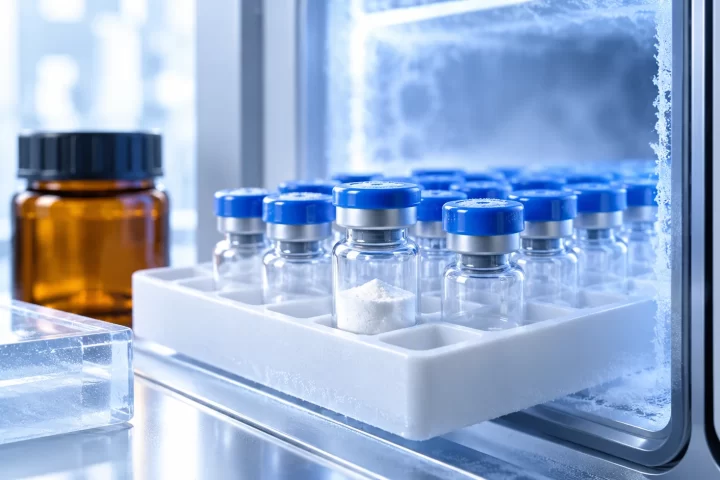
Research peptides are built one residue at a time on a solid resin, then cleaved, purified by HPLC and freeze-dried. Each step explains part of the COA.
BEHIND THE ARTICLES
Areas of expertise: Peptide lead discovery & screening, structural modification & stability optimization, pharmacodynamics & mechanism of action
Testing & Quality
Research peptides are built one residue at a time on a solid resin, then cleaved, purified by HPLC and freeze-dried. Each step explains part of the COA.
Comparisons
GLOW is GHK-Cu 50 mg plus TB-500 10 mg and BPC-157 10 mg. What the extra components contribute, how the maths differs, and when the single peptide is better.
Lab Handling
How to reconstitute 50 mg and 100 mg GHK-Cu vials, whether it needs refrigeration, what its stability study showed, and why half-life claims are unreliable.
Peptide Profiles
What sermorelin/ipamorelin and tesamorelin/CJC-1295/ipamorelin blends contain, how to calculate each component, molar ratios and how blends are tested.
Comparisons
Cagrilintide acts on amylin and calcitonin receptors, not incretin receptors. Why it is paired with GLP-1 agonists, what CagriSema showed, and blend handling.
Lab Handling
How to reconstitute BPC-157, concentration tables for 5-20 mg vials, whether it needs refrigeration, and which parts of its sequence limit solution stability.
Research Reviews
Tirzepatide's half-life is about 5 days, from a population PK model of 19 pooled studies. How albumin binding produces it and what it means for study design.
Comparisons
Thymosin alpha-1 and beta-4 are unrelated peptides that share only a historical name. How they differ, and how TB-500's 17-23 fragment relates to beta-4.
Comparisons
Tesamorelin works through the GH axis; incretin peptides through GIP, GLP-1 and glucagon receptors; MOTS-c through AMPK. Four different mechanisms compared.
Comparisons
Tesamorelin stimulates the pituitary, HGH is the hormone itself, IGF-1 LR3 acts downstream. How the three differ in feedback, size and research use.
Comparisons
Tesamorelin keeps all 44 GHRH residues with an N-terminal cap; CJC-1295 shortens to 1-29 and substitutes four residues. How the two strategies compare.
Peptide Profiles
Survodutide (BI 456906) is a dual glucagon and GLP-1 receptor agonist peptide. Its receptor design, trial literature and laboratory handling.